Malaysia's higher education institutions have demonstrated sustained momentum in international competitiveness, with latest rankings data reinforcing the nation's credentials as a knowledge hub within Asia. The Times Higher Education Asia University Rankings 2026 releases have highlighted breakthrough achievements across the country's university sector, signalling the tangible outcomes of systematic investment and research capability development over recent years. Higher Education Minister Datuk Seri Dr Zambry Abd Kadir has framed these results as validation of Malaysia's ambitions to position itself among Asia's premier education destinations, though he emphasised that numerical rankings serve as measurement tools rather than defining institutional purpose.
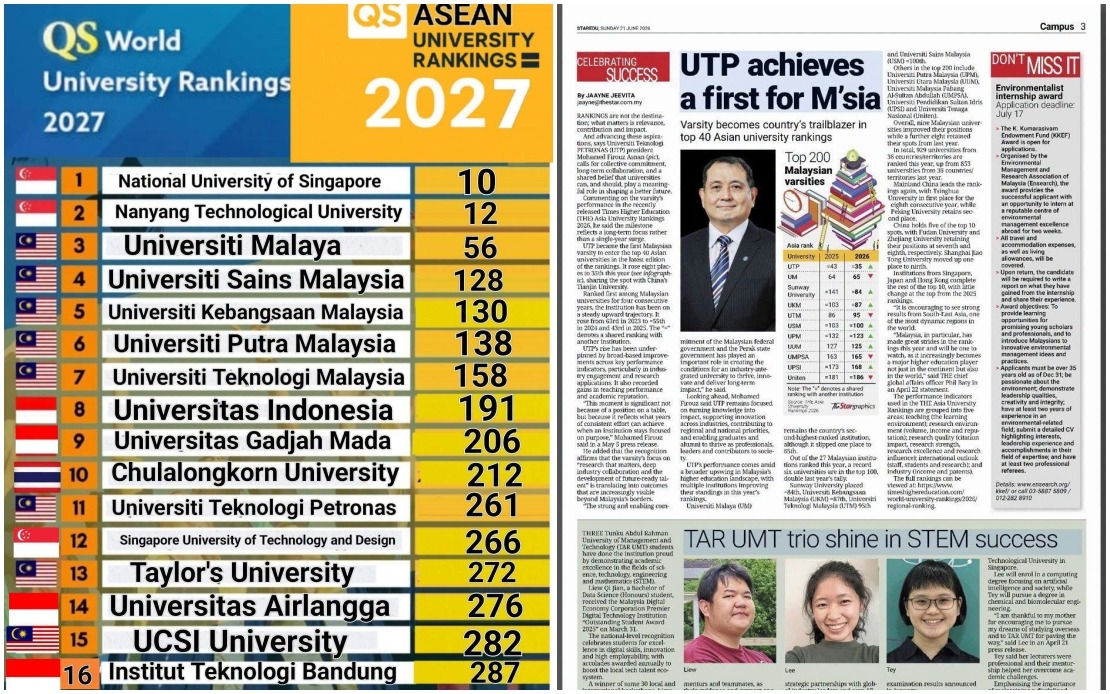
The most striking outcome involves Universiti Teknologi Petronas, which has achieved the distinction of becoming the first Malaysian university to break into Asia's top 40, securing 35th position in the 2026 rankings. This represents substantial progress from the institution's 43rd ranking in the preceding year, demonstrating the accelerated trajectory that focused research investment and international collaboration strategies can generate. UTP's advancement carries particular significance for Malaysia's technological education profile, given the university's specialisation in engineering and petroleum-related disciplines—sectors of strategic economic importance to the country.
Beyond the headline achievement, the broader Malaysian university ecosystem has shown resilience and growth across the rankings. Twenty-seven Malaysian institutions appeared on the 2026 THE Asia rankings overall, a testament to the sector-wide commitment to quality assurance and international standards. Within this cohort, six universities achieved placement in Asia's top 100, matching the strongest previous performance and indicating that Malaysia's competitive advantage has stabilised at this level rather than representing a one-off spike. Furthermore, eleven local universities secured positions within the top 200 Asian institutions, suggesting depth in excellence across both established research universities and emerging institutions.
The named institutions recognised for maintaining or improving their standings encompass the full spectrum of Malaysian higher education. Universiti Malaya continues as the nation's traditional research leader, while Universiti Kebangsaan Malaysia, Universiti Teknologi Malaysia, Universiti Sains Malaysia and Universiti Putra Malaysia represent the older generation of public research universities that have anchored Malaysia's academic ecosystem. Simultaneously, private sector representatives including Sunway University have demonstrated that the commercialised university model can compete effectively with public counterparts on international platforms. This diversity of success suggests that Malaysia's ranking improvements are not concentrated in isolated pockets but reflect systemic improvements across both funding models and institution types.
The minister's statement acknowledged the distributed nature of these achievements, crediting academics, researchers, students, alumni and industry partners as collaborators in building institutional reputation. This framing carries practical implications—international rankings depend significantly on research output measured through citation indices, industry collaboration signals, and international researcher networks. The participation of industry in the acknowledgment reflects Malaysia's trajectory toward the knowledge economy model, where university-industry linkages strengthen research applicability and graduate employment prospects simultaneously.
Malaysia's positioning within Asia's rankings hierarchy carries implications beyond institutional prestige. As the regional education market becomes increasingly competitive, with countries such as Thailand, Vietnam and Indonesia investing heavily in university excellence programmes, Malaysia's maintenance of top-tier representation protects the nation's capacity to attract international student enrolments and research talent. The ability to retain and grow regional standing directly influences the country's soft power within Southeast Asia and its capacity to position itself as the preferred destination for higher education seekers across the broader region.
The trajectory evident in the data suggests that Malaysia's strategy of supporting research intensity through government funding mechanisms and encouraging international partnerships has yielded measurable returns. However, the consolidation at the current level—rather than continuous acceleration—may indicate that further breakthroughs will require either additional resource allocation or strategic shifts toward higher-impact research domains. The regional competitive landscape continues evolving, with multiple countries targeting substantial investments in flagship universities and emerging fields such as artificial intelligence and green technology.
For Malaysian policymakers, the rankings provide both validation and warning signals. The validation confirms that decades of investment in tertiary education have generated globally competitive institutions capable of contributing to regional knowledge economies. The warning signals lie in the competitive pressure from neighbouring nations pursuing aggressive university development strategies. The government's stated intention to consolidate this momentum suggests recognition that maintaining current positions requires sustained effort and investment, not merely capitalisation on past successes.
Students and institutional leaders across Malaysia can interpret these rankings as evidence that degrees from Malaysian universities carry meaningful international currency, enhancing graduate mobility and employment prospects in global labour markets. For researchers considering academic careers, the improved institutional standings should signal that Malaysian universities increasingly provide research infrastructure and international networks comparable to alternatives in neighbouring countries, reducing the brain drain incentive that has historically drawn Malaysian talent toward Australia, the United Kingdom or the United States.
Looking forward, the sustainability of Malaysia's competitive standing will depend on universities' capacity to specialise in research domains with demonstrated regional and global demand. UTP's advancement through petroleum and engineering focus provides a template—excellence concentrated in strategically relevant fields generates both economic value and ranking traction. As Malaysia transitions toward knowledge-intensive economic activity, aligning university research strengths with national development priorities offers a pathway toward continued ranking improvements while simultaneously strengthening the nation's economic competitiveness.

