Malaysia's senior government leadership has rallied behind a call for citizens to embody the deeper principles of Hijrah, the Islamic migration narrative commemorated at Awal Muharram, framing the new year not merely as a calendar shift but as a watershed moment for individual and collective transformation. The message resonates particularly at a time when Malaysia, like much of Southeast Asia, navigates complex external pressures and internal cohesion concerns that demand both spiritual grounding and pragmatic action.
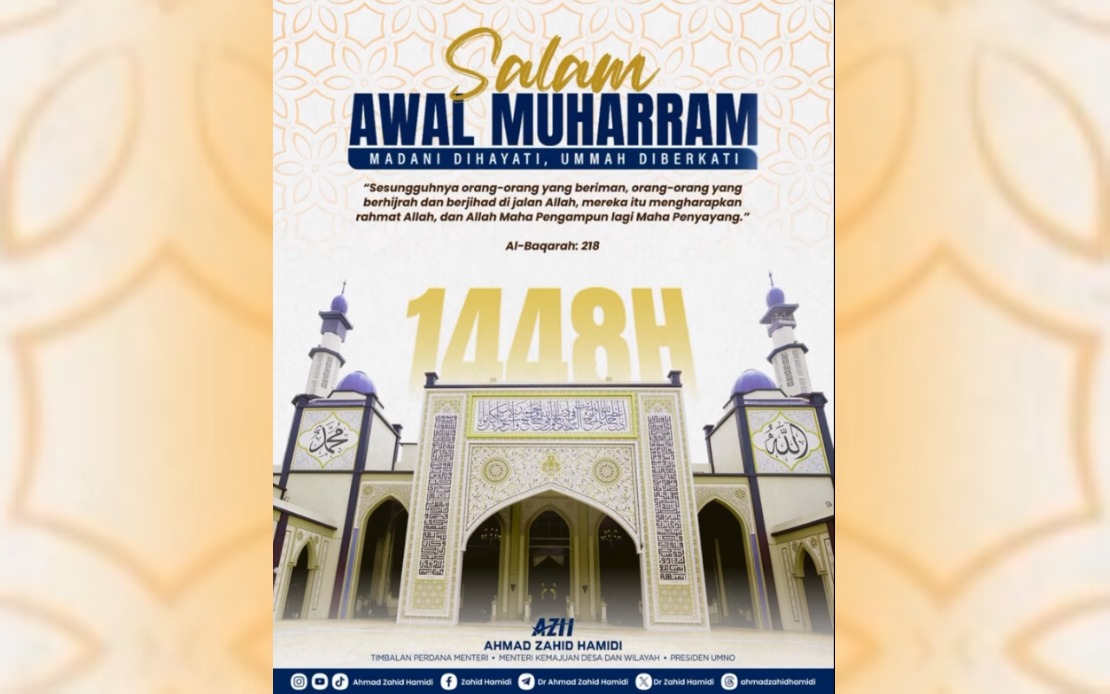
Deputy Prime Minister Datuk Seri Dr Ahmad Zahid Hamidi articulated the core principle undergirding this year's observance: that meaningful change emerges not from rhetoric but from sustained effort, discipline and an unwavering commitment to improvement. In his remarks marking the occasion, he positioned Hijrah as a pedagogical framework teaching sacrifice and perseverance—qualities he suggested must anchor how Malaysians lead their communities, execute their professional responsibilities and serve the broader national interest. His emphasis on courage in embracing reform and confronting institutional weaknesses implies an acknowledgment that the country faces structural challenges requiring more than goodwill pronouncements.
The timing of this exhortation carries strategic weight. Malaysia's economy has absorbed shocks from global supply chain fragmentation, inflationary pressures and persistent uncertainty in international markets. Deputy Prime Minister Datuk Seri Fadillah Yusof specifically invoked these turbulent conditions as a rationale for drawing on Hijrah's lessons, particularly its emphasis on prudence, adaptability and resilience. His framing transforms a religious observance into a practical governance lesson: that individual and household-level discipline in resource consumption—energy conservation, food waste reduction, spending restraint—aggregates into meaningful national economic fortitude. This localization of Hijrah's message to everyday consumer behavior and family economics makes the Islamic principle tangible for ordinary Malaysians confronting rising costs of living.
Fadillah's broader point on unity strikes at Malaysia's foundational challenge. The country's strength, he contended, historically has derived from its multiethnic and multifaith cohesion. By coupling this observation with a call to subordinate sectarian differences to shared prosperity and national stability, he echoes a consistent theme in contemporary Malaysian leadership discourse: that diversity, properly managed through mutual respect and institutional cooperation, constitutes an asset rather than a liability. For Southeast Asian observers, Malaysia's continued emphasis on inter-communal harmony despite periodic tensions offers both a model and a cautionary tale about the fragility of pluralism.
Communications Minister Datuk Fahmi Fadzil distilled Hijrah into three essential virtues: courage to improve, patience through adversity and sincerity in effort. His framing appeals to both the spiritual and the psychological—Hijrah becomes not only a religious duty but an emotional and ethical renewal, a recalibration of personal commitment to self-improvement and purposeful action. This speaks to a generation of Malaysians who may approach religious observances through multiple lenses simultaneously: cultural identity, spiritual obligation and personal development.
Minister in the Prime Minister's Department (Religious Affairs) Zulkifli Hasan directed Muslim Malaysians toward specific devotional practices—particular prayers marking the transition between Islamic years—while emphasizing that the observance's deepest purpose lies in self-examination and moral reformation. His invocation of the concept of Islah (self-improvement) suggests that Hijrah's relevance extends beyond historical commemoration into contemporary life, positioning personal spiritual accounting as inseparable from the observance itself.
The breadth of cabinet participation in these messages underscores institutional coherence around the Hijrah narrative. Ministers spanning portfolios from agriculture to technology, from education to defense-adjacent roles, collectively articulated a consistent theme: that this Islamic New Year serves as a societal reset button, an occasion for Malaysians across sectors and backgrounds to assess their contributions, recommit to excellence and renew focus on collective wellbeing. Such orchestrated messaging, while common in government communications, gains force when leaders explicitly connect religious observance to tangible policy domains and national priorities.
The emphasis on economic prudence and resource stewardship reflects broader anxieties about Malaysia's fiscal sustainability and the impact of global headwinds on ordinary households. By anchoring discussions of spending restraint, energy efficiency and waste reduction in Islamic teaching, the government positions financial discipline not as technocratic austerity imposed from above but as a moral imperative aligned with religious principle. This rhetorical strategy acknowledges that Malaysians respond to calls framed within their cultural and spiritual frameworks more readily than to abstract economic arguments.
Fadillah's specific reference to global supply crises and economic uncertainty contextualizes this year's Hijrah observance within the post-pandemic, multipolar disruption affecting Southeast Asia. Malaysia's dependence on international trade, its vulnerability to semiconductor supply constraints and its exposure to currency volatility all contribute to the urgency with which leaders emphasize adaptability and resilience. The Hijrah message, in this light, becomes a tool for preparing public consciousness for continued volatility and for marshaling social cohesion in response to external shocks beyond immediate government control.
The national 1448H/2026M celebration theme, though incompletely articulated in official statements, presumably carries symbolic weight for the year's governance priorities. Maal Hijrah observances traditionally revolve around themes of renewal, rectification and spiritual recommitment—language that Malaysian leadership has weaponized toward broader national ends. This transforms a religious calendar milestone into a governance checkpoint, a moment for ministers and ministries to reorient priorities and reaffirm commitments.
For Malaysia's diverse population, the celebration presents both opportunity and tension. While the overwhelming Muslim majority shares in Hijrah observance, the broader invocation of religious principle as a governance framework underscores how Islamic values have become increasingly woven into national-level policy discourse and civic messaging. Non-Muslim Malaysians, while largely respectful of these observances, may perceive such messaging as potentially exclusionary unless explicitly positioned within frameworks of shared national values and pluralistic cooperation—a balance the cabinet's rhetoric has attempted to strike through emphasis on unity and mutual respect.
The cumulative effect of this coordinated messaging is to position Hijrah not as a compartmentalized religious event but as a nodal point in Malaysia's national calendar with implications for governance, economic policy, social cohesion and personal conduct. By encouraging Malaysians to embrace Hijrah's spirit across multiple registers—spiritual renewal, economic prudence, inter-communal unity and institutional reform—the leadership seeks to channel religious observance toward practical national ends. Whether this rhetorical framework translates into sustained behavioral change and policy implementation remains contingent on follow-through beyond the ceremonial moment of marking the Islamic New Year.