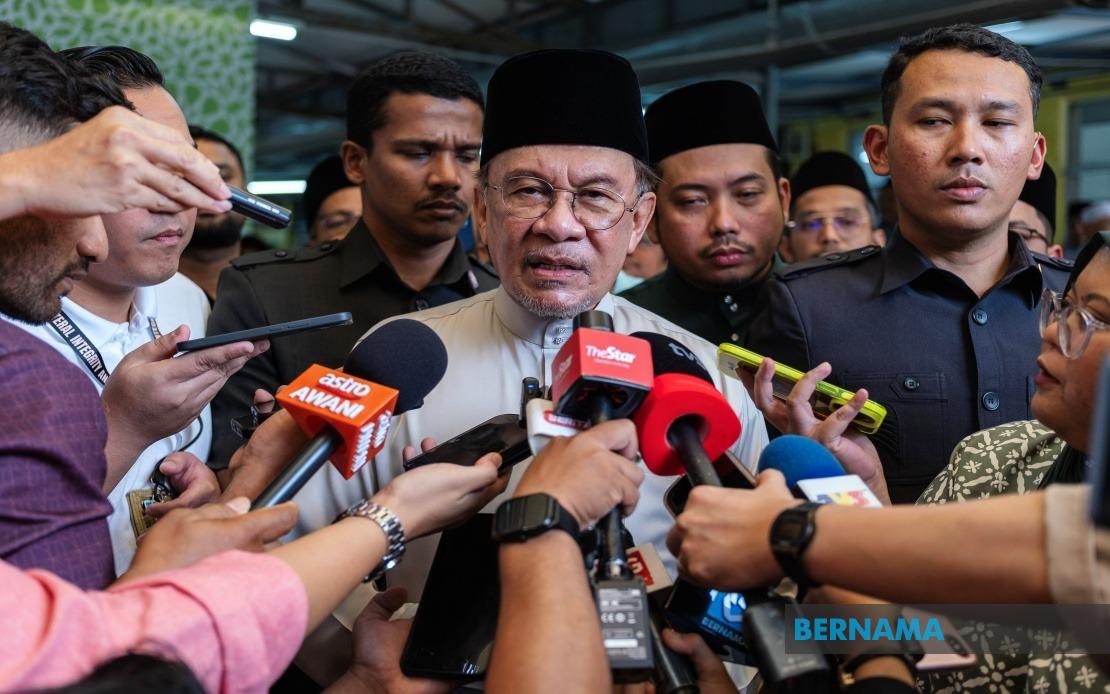
Prime Minister Datuk Seri Anwar Ibrahim has firmly restated Malaysia's unwavering commitment to pursuing justice against fugitive businessman Low Taek Jho—better known as Jho Low—irrespective of any potential pardon from United States President Donald Trump. Speaking to journalists after Friday prayers at Masjid As-Sodiqin in Taman Kobena on July 3, Anwar underscored that Malaysia's approach is grounded in adherence to legal principles and will remain unaffected by external pressures or geopolitical considerations.
The timing of Anwar's remarks is significant, coming amid international media reports that Jho Low features among approximately 250 individuals being evaluated for possible clemency by Trump ahead of the nation's 250th Independence Day. The fugitive financier, who has become synonymous with one of the world's largest financial scandals involving state investment fund 1Malaysia Development Berhad (1MDB), has long been a focal point of Malaysia's anti-corruption agenda. His evasion of Malaysian law enforcement and continued absence from the jurisdiction have made him a symbol of impunity that the government has sought to dismantle.
Anwar's declaration carries particular weight given the broader context of Malaysian-American relations and the country's judicial independence. By explicitly stating that Malaysia will not be "influenced, disturbed or affected" by Washington's decisions, the Prime Minister was signalling to both domestic audiences and international observers that Malaysia's legal system operates on principles fundamentally separate from diplomatic considerations. This distinction is crucial in a region where economic and military partnerships with major powers can sometimes influence national priorities in ways that compromise institutional autonomy.
The 1MDB scandal, which implicated figures at the highest levels of Malaysian government during the previous administration, resulted in billions of ringgit in losses and triggered investigations across multiple jurisdictions. Jho Low's central role in orchestrating the fund's misappropriation made him a key target for Malaysian authorities seeking to recover assets and demonstrate accountability. His continued freedom, despite being declared a fugitive and the subject of Interpol red notices, has been a source of public frustration and a measure of the government's commitment to the rule of law.
A pardon by Trump would not extinguish Malaysia's legal claims or its desire to bring Jho Low to justice domestically. However, it would complicate extradition efforts and remove one potential leverage point for international pressure. The scenario underscores a broader tension in transnational financial crime prosecutions: the difficulty of enforcing accountability when fugitives can exploit jurisdictional boundaries and cultivate relationships in countries with varying priorities regarding diplomatic cooperation.
Anwar's framing of the issue as an "internal matter" for the United States reflects a diplomatic courtesy while simultaneously asserting Malaysia's agency. By categorising the pardon decision as Washington's prerogative rather than something that demands Malaysian acquiescence, the Prime Minister was recalibrating the narrative away from Malaysia as a passive observer towards Malaysia as an independent actor with its own legal obligations and institutional credibility at stake. This rhetorical move is important for maintaining public confidence in the government's commitment to anti-corruption efforts, particularly given the deep public disillusionment triggered by 1MDB.
In a related development, Anwar noted Malaysia's receipt of a proposed contribution of RM1 million from the United States designated for restoration work on Tugu Negara, the National Monument, as part of preparations for next year's National Day celebrations. The gesture, while modest in monetary terms, reflects ongoing bilateral cooperation and cultural exchange between the two nations. Anwar indicated that the Cabinet would examine the proposal at its next meeting, suggesting a deliberative approach to accepting foreign assistance for national heritage projects.
The coexistence of these two issues—Malaysia's determined prosecution of Jho Low and cooperation with the US on monumental restoration—illustrates the compartmentalised nature of modern international relations. Nations can simultaneously maintain firm positions on matters of criminal justice while engaging pragmatically on other fronts. However, the juxtaposition also raises questions about leverage and reciprocity: whether Malaysia's acceptance of American assistance creates expectations regarding other matters, and how smaller nations navigate such dynamics without compromising institutional integrity.
For Malaysian observers and policymakers, Anwar's statement serves as a reaffirmation that despite geopolitical shifts and changing administrations in partner countries, the domestic imperative to pursue accountability remains paramount. The message is particularly relevant given Malaysia's efforts to rebuild institutional trust following years of governance scandals. Demonstrating that legal processes are insulated from external political pressure—whether from powerful allies or antagonists—is essential to restoring public faith in the judiciary and law enforcement apparatus.
The broader implications extend beyond Jho Low himself. How Malaysia responds to potential American clemency will signal to other fugitives, corrupt officials, and international observers whether the country's commitment to the rule of law is principled or merely tactical. This is especially important as Southeast Asia grapples with transnational corruption and money laundering that often involves actors seeking refuge in jurisdictions with weak governance. Malaysia's stance under these circumstances becomes a regional statement about the seriousness with which nations take financial crime and the independence of their legal systems.
Moving forward, the matter will test the resilience of Malaysia's anti-corruption framework against real-world complications. Should Trump grant Jho Low a pardon, Malaysia will face practical challenges in pursuing extradition but will retain the moral and legal authority to continue its prosecution. The government's public commitment, articulated clearly by Anwar, establishes a baseline expectation that this pursuit will continue undiminished, reinforcing the principle that justice operates according to law rather than diplomatic convenience.

