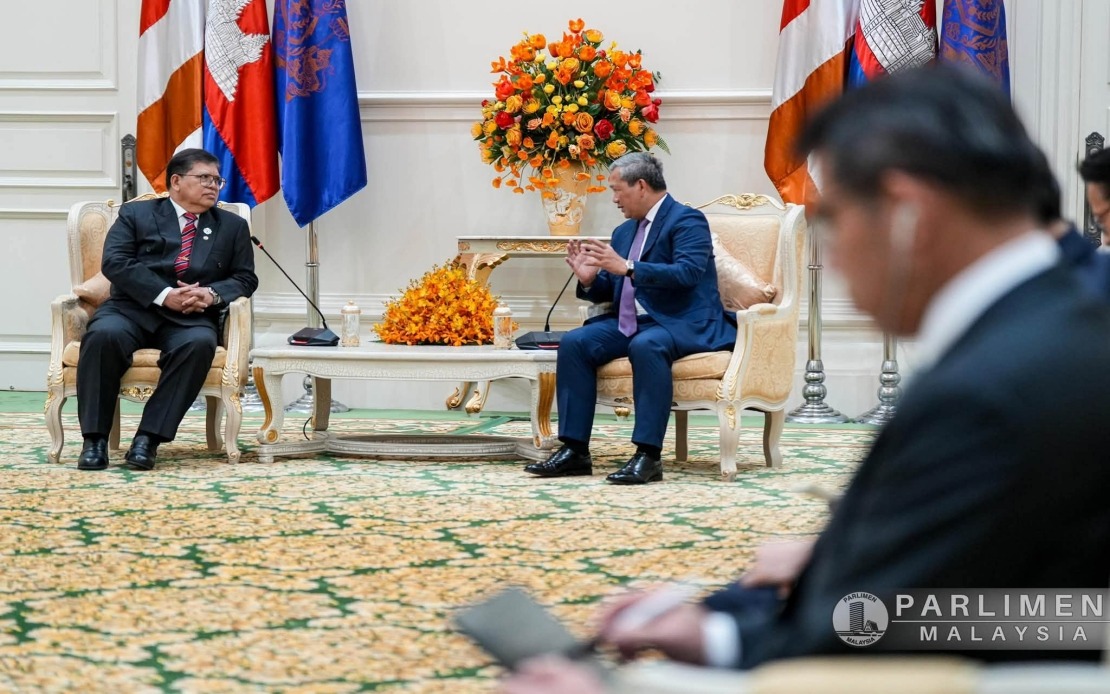
Malaysia's Dewan Rakyat Speaker Tan Sri Johari Abdul has stressed the critical importance of maintaining dialogue and diplomatic channels in resolving the longstanding Cambodia-Thailand border dispute, emphasising that such an approach is essential for preserving regional peace and stability. Speaking during a high-level meeting in Phnom Penh, Johari underscored that dialogue represents the most constructive pathway forward for managing disputes among Southeast Asian nations, particularly given the potential for border tensions to destabilise the broader region.
The border issue between Cambodia and Thailand represents one of Southeast Asia's most persistent diplomatic challenges, with periodic flare-ups over disputed territorial claims along their shared frontier. The conflict has occasionally resulted in military confrontations and civilian casualties, making it a matter of genuine concern not only for the two nations directly involved but for the entire ASEAN community. Johari's intervention signals Malaysia's commitment to playing a stabilising role within the regional bloc, leveraging its position as a respected middle power to encourage restraint and negotiation.
During his engagement with Cambodian Prime Minister Hun Manet on the margins of the Second Inter-Parliamentary Speakers' Conference in Phnom Penh from August 26 to 28, Johari highlighted Malaysia's understanding of Cambodia's legitimate concerns regarding the current situation along the border. He acknowledged the real hardship faced by residents living in affected areas, whose daily lives are disrupted by tensions and periodic incidents. This recognition of Cambodia's perspective demonstrates Malaysia's balanced approach to the issue, avoiding taking sides while supporting all efforts to de-escalate and find peaceful resolutions.
Johari framed the dispute within the broader context of ASEAN solidarity and the principles upon which the regional organisation was founded. He argued that bilateral issues, if left unresolved or if handled through confrontational means, risk undermining the spirit of togetherness and unity that defines ASEAN as a platform for building mutual trust among its ten member states. The ASEAN way, rooted in non-interference and consensus-seeking, requires member states to manage differences constructively rather than allowing disputes to metastasise into regional fault lines that could weaken the bloc's collective voice and influence on the global stage.
Malaysia has positioned itself as a supporter of efforts to bring all parties involved in the Cambodia-Thailand border issue back to the negotiating table. This commitment reflects Malaysia's broader diplomatic strategy within ASEAN, where it has consistently advocated for conflict prevention and peaceful resolution mechanisms. By offering to facilitate dialogue and providing platforms for discussion, Malaysia seeks to prevent the dispute from escalating further and to create space for pragmatic solutions that address both nations' core security and sovereignty concerns.
Beyond the immediate border dispute, Johari and Hun Manet also explored opportunities to deepen Malaysia-Cambodia bilateral cooperation across multiple dimensions. Parliamentary cooperation emerged as a key area for strengthening institutional ties, with both legislatures committed to expanding exchanges and joint initiatives. Economic integration remains a priority, with Malaysia keen to enhance commercial ties and facilitate Malaysian business investments in Cambodia, thereby creating mutual prosperity that can undergird stronger diplomatic relationships.
Human capital development and youth empowerment featured prominently in bilateral discussions, reflecting recognition that the next generation will shape regional relationships for decades to come. Johari advocated for expanded opportunities for young people from both countries to build personal and professional connections through exchange programmes and participation in economic and social spheres. Such people-to-people exchanges create networks of understanding that transcend official diplomacy and help build resilient relationships capable of weathering political tensions.
Technical and Vocational Education and Training emerged as a particularly promising area for cooperation between Malaysia and Cambodia. The expansion of TVET initiatives through skills training, institutional exchanges, and industry collaboration can address shared challenges in workforce development while creating practical benefits for both nations' economies. As Southeast Asia increasingly competes in the global knowledge economy, countries that invest in human capital development gain competitive advantages; Malaysia's willingness to share its TVET expertise with Cambodia reflects enlightened self-interest alongside genuine partnership.
Johari expressed appreciation for Cambodia's role in creating a conducive business environment for Malaysian enterprises, acknowledging the mutual benefits that flow from open investment policies and supportive regulatory frameworks. This recognition matters politically, as it demonstrates that Malaysia values Cambodia's economic governance and is committed to rewarding responsible stewardship with deeper commercial engagement. Such positive reinforcement can encourage both nations to maintain the institutional quality and policy stability necessary for sustained economic cooperation.
The broader significance of Malaysia's diplomatic intervention lies in its demonstration that ASEAN mechanisms remain relevant for addressing member states' disputes. Despite criticisms that ASEAN's consensus-based approach lacks enforcement mechanisms, the organisation continues to provide valuable forums for dialogue and trust-building. Malaysia's active engagement in these processes, through parliamentary exchanges and high-level political meetings, keeps disputes from festering in isolation and maintains communication channels that might otherwise close during periods of tension.
For Malaysia specifically, this diplomatic engagement advances the nation's interests in maintaining a stable, prosperous Southeast Asia where regional institutions function effectively and disputes are resolved peacefully. A region wracked by border conflicts would undermine Malaysia's own security and economic interests, making conflict prevention a matter of enlightened self-interest as much as regional solidarity. This alignment of principles and interests gives Malaysia's advocacy for dialogue particular credibility and staying power.
The Cambodia-Thailand border issue remains unresolved after decades of diplomatic effort, suggesting that easy solutions do not exist and that sustained, patient diplomacy will be required. Malaysia's continued emphasis on this approach, reinforced through high-level meetings and parliamentary exchanges, sends a signal that the region's more stable countries remain committed to supporting Cambodia and Thailand in finding mutually acceptable solutions. This steady diplomatic engagement, though unglamorous, forms the bedrock upon which regional stability rests.

