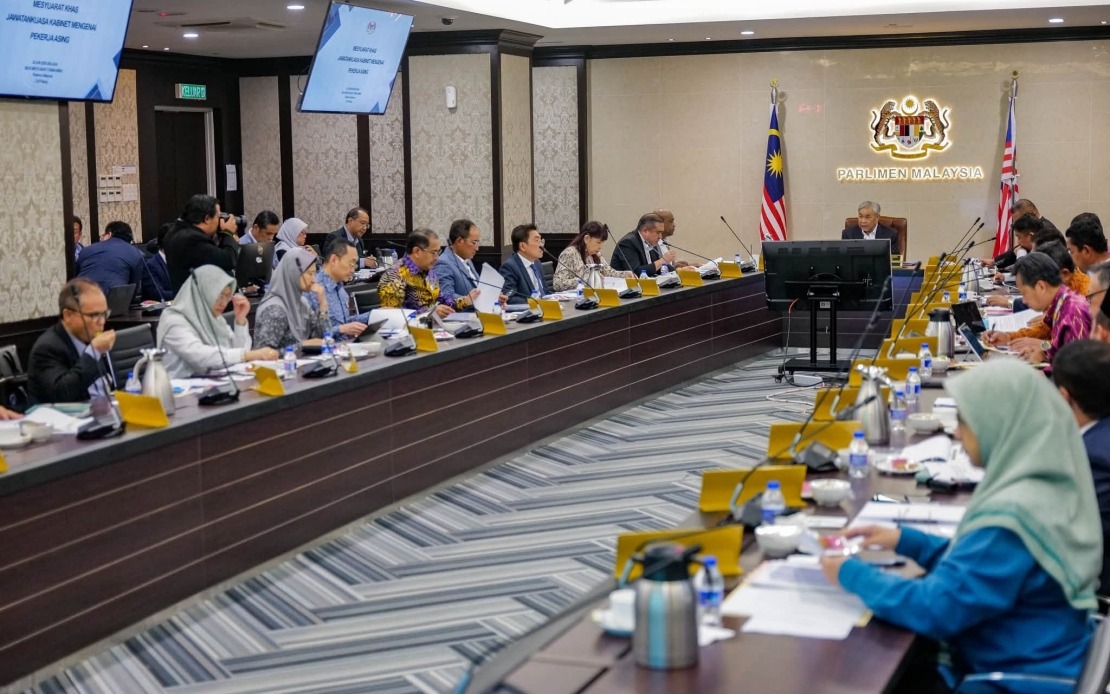
Malaysia's government has committed to a fundamental overhaul of how it manages foreign workers, Deputy Prime Minister Datuk Seri Dr Ahmad Zahid Hamidi revealed following a special Cabinet Committee meeting at Parliament. The restructuring initiative aims to create a more cohesive, responsive framework that balances competing national interests: industrial competitiveness, security concerns, and job protection for Malaysian workers. Zahid, who chaired the meeting, indicated that the reforms represent a significant policy shift designed to address longstanding inefficiencies in how labour migration is currently administered across multiple government agencies.
Central to the government's new approach is the relocation of the One Stop Centre for Foreign Worker Management under the Ministry of Human Resources. This consolidation reflects an acknowledgment that fragmented oversight had hampered coordination and responsiveness. By anchoring the centre within a single ministry, officials believe they can streamline licensing, compliance monitoring, and worker registration processes that previously involved numerous touchpoints across different departments. For employers navigating Malaysia's complex labour market, this centralisation could significantly reduce bureaucratic friction and processing times, potentially addressing long-standing complaints from the manufacturing, construction, and hospitality sectors about administrative delays.
The Deputy Prime Minister articulated a clear vision for the restructured system: maintaining operational efficiency while simultaneously raising integrity standards and ensuring national security considerations are properly embedded in all labour decisions. Zahid emphasised that the reformed framework would better serve Malaysia's strategic interests by making foreign worker allocation genuinely responsive to documented industry needs rather than following historical patterns or political pressure. This represents a departure from previous approaches where the allocation of foreign worker quotas was sometimes disconnected from actual sectoral requirements, leading to bottlenecks in industries facing genuine shortages while others held unused allocations.
Underscoring the government's broader labour strategy, Zahid confirmed that Malaysia remains committed to reducing its dependence on foreign labour through multiple complementary initiatives. Increasing participation by Malaysian workers in sectors currently dominated by migrant labour remains a stated priority, though implementing this goal has proven challenging given wage expectations, working conditions, and skills mismatches. The government plans to address these barriers through workforce development programmes that aim to equip local workers with skills demanded by evolving industries, making domestic employment more attractive across service and production sectors.
Simultaneously, the government is pursuing automation and industrial upgrading as long-term mechanisms to reduce reliance on foreign workers. This dual-track approach acknowledges that Malaysia cannot simply restrict foreign labour without addressing the competitive pressures that drive employers toward cheaper migrant workforces in the first place. By investing in technology adoption and skills enhancement, policymakers hope to create higher-value employment opportunities for Malaysians while gradually reducing the structural need for lower-skilled foreign workers. Such a transition, however, requires sustained investment and coordination between government agencies, educational institutions, and private sector employers.
The Cabinet Committee's decision to conduct a more strategic review of foreign labour requirements signals a move away from blanket approvals toward sectoral analysis. Rather than allocating foreign worker quotas based on predetermined levels, the reformed system would tie allocations to documented evidence of labour shortages, skills requirements, and employment forecasts specific to each industry. This evidence-based approach could produce more rational outcomes than existing processes, though it requires building analytical capacity within the Human Resources Ministry and establishing clear criteria for what constitutes proven labour shortage versus market tightness that should be addressed through wage adjustment or automation.
For Malaysia's manufacturing sector—particularly electronics, semiconductors, and automotive industries—these reforms carry significant implications. Many manufacturers rely on migrant workers across production and assembly roles, and restructured approval processes could either streamline operations or create new bottlenecks depending on implementation details. The semiconductor industry, which faces global talent competition and operates on tight production schedules, will likely benefit from faster approvals if the One Stop Centre delivers promised efficiency gains. However, sectors struggling to attract Malaysian workers despite competitive wages may find themselves constrained by stricter quota enforcement.
The security dimension of these reforms, though less explicitly detailed by Zahid, reflects genuine government concerns about irregular migration, human trafficking networks, and labour exploitation. A centralised management structure theoretically enables better background verification, worker tracking, and employer compliance monitoring. These safeguards protect both migrant workers from exploitation and Malaysian communities from potential security risks. The credibility of Malaysia's foreign worker programme internationally depends partly on demonstrable commitment to labour standards and orderly migration management, matters increasingly scrutinised by neighbouring countries and international labour organisations.
Regional context matters considerably here. Malaysia's neighbours, particularly Thailand and Indonesia, are simultaneously managing large migrant populations and facing similar tensions between labour market needs and political pressures to protect domestic workers. The Malaysian restructuring may signal shifting regional norms around formalising migrant worker systems rather than allowing informal, unregulated labour flows. Singapore's more tightly controlled approach to foreign workers, with clear sectoral quotas and regular reviews, has influenced thinking in Malaysian policy circles, though Malaysia's larger economy and different sectoral composition require different calibration.
Implementation will prove crucial. Restructuring an embedded bureaucratic system involves not merely administrative reorganisation but genuine cultural change within participating agencies, shift in decision-making authority, and retraining of officials accustomed to existing procedures. The success of the One Stop Centre under Human Resources Ministry oversight depends on adequate funding, clear enforcement mechanisms against non-compliant employers, and genuine inter-agency cooperation rather than turf protection. Regional labour-sending countries, particularly Bangladesh, Myanmar, and the Philippines, have expressed concerns about Malaysian labour practices, and a visibly reformed system could improve Malaysia's standing as an employer of choice.
The government's commitment to keeping all foreign worker decisions guided by national interests and public welfare reflects a calibrated political stance acknowledging legitimate domestic anxieties about wage depression and job competition, while avoiding populist restrictions that could damage economic competitiveness. This balancing act mirrors tensions visible across Southeast Asia as countries grapple with labour market transformation. The coming months will reveal whether the restructured framework delivers on promises of efficiency and integrity, or whether implementation challenges replicate past inefficiencies within a new organisational structure. Early results will likely inform broader questions about how Malaysia manages labour market adjustment amid demographic change and economic evolution.

