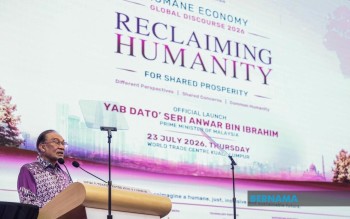
Prime Minister Datuk Seri Anwar Ibrahim has signalled that Malaysia's budgetary process will swing into high gear next month, with the government commencing work on Budget 2027 in August ahead of its presentation to Parliament in early October. Speaking in his capacity as both premier and Finance Minister, Anwar outlined a timeline that suggests the administration intends to maintain momentum on fiscal planning while the nation navigates the complexities of economic management and development strategy.
What distinguishes Anwar's approach to the upcoming budget cycle is his explicit articulation of a philosophical framework underpinning fiscal policy. Rather than allowing budget formulation to become merely a technical exercise dominated by revenue projections and expenditure schedules, the Prime Minister has positioned Budget 2027 within a broader narrative about the moral dimensions of governance. This framing reflects growing international discourse on what economists and policymakers term the "humane economy" — a conceptual shift away from treating gross domestic product growth as an end in itself and toward viewing economic activity as a vehicle for improving human welfare and dignity.
At the Humane Economy Global Discourse 2026 forum in Kuala Lumpur, Anwar articulated a vision in which Malaysia's economic machinery should function as an instrument of social betterment rather than wealth accumulation divorced from its distributional consequences. He challenged the conventional metrics by which nations measure economic success, suggesting that stronger numbers and higher consumption alone represent an incomplete and potentially misleading picture of genuine development. For Malaysian readers accustomed to decades of growth-focused rhetoric, this represents a notable recalibration of how the government frames its relationship with the economy.
The substance of Anwar's remarks indicates that Budget 2027 will be structured around several interconnected principles. First, economic expansion must demonstrably widen opportunities for citizens across income levels rather than concentrating wealth among an already-privileged minority. This directly addresses longstanding concerns about inequality in Malaysia, where despite sustained periods of growth, income disparities have persisted and in some measures widened. The budget, under this framework, would be evaluated not merely by how much it allocates to growth-enhancing investments, but whether those investments create pathways for ordinary Malaysians to advance their circumstances.
Second, prosperity generated through economic activity should crystallize into measurable improvements in living standards that affect Malaysians daily. Anwar specified that this encompasses better wage structures, jobs that provide meaningful engagement rather than mere subsistence income, housing that remains affordable for young families and middle-income earners, healthcare systems that do not impose catastrophic financial burden, educational institutions that deliver quality instruction, and communities that thrive socially rather than merely exist physically. These specifics suggest the budget may prioritize allocations to social infrastructure and human capital development alongside traditional productivity-focused spending.
The emphasis on sustainability adds another layer to the budgetary framework. Anwar's insistence that current generations should not saddle future Malaysians with environmental degradation, fiscal deficits, or social fractures reflects mounting awareness that short-term economic gains obtained through unsustainable practices represent a form of intergenerational theft. For a nation grappling with climate change impacts, budget deficits, and shifting demographics, this principle has immediate relevance. It suggests Budget 2027 may incorporate stronger commitments to environmental protection, fiscal consolidation, and social cohesion alongside growth objectives.
The Prime Minister's reference to innovation as a tool that should expand rather than restrict human capability carries particular significance for Malaysia's development trajectory. As the country seeks to climb the value chain through semiconductor manufacturing, digital economy expansion, and technological advancement, there exists a genuine risk that automation and technological displacement could create winners and losers in ways that deepen inequality. By explicitly framing innovation within a humane economy lens, Anwar signals that Budget 2027 will likely include provisions for workforce reskilling, social safety nets for workers displaced by technological change, and mechanisms to ensure technology benefits are widely distributed.
The timeline Anwar announced provides insight into the government's operational priorities. Commencing formulation in August and tabling in early October allows approximately two months for policy design, consultation with relevant ministries, and preliminary economic forecasting. This schedule differs markedly from some previous budget cycles where last-minute revisions and compressed timelines were common. The compressed but planned approach suggests the administration has already engaged in significant preliminary work and possesses clear directional thinking about budgetary priorities.
For Malaysia's business community, civil society, and development advocates, Anwar's statements provide both opportunity and challenge. The emphasis on humane economy principles invites stakeholders to engage in budget consultation processes by articulating how specific policy choices might advance or hinder the stated objectives of dignified living, expanded opportunity, and sustainable development. Simultaneously, the framework creates benchmarks against which Budget 2027 will inevitably be evaluated once tabled. If the actual budget appears misaligned with the humanistic rhetoric, the disconnect will become immediately apparent and politically consequential.
Regionally, Malaysia's adoption of humane economy language places it within a broader conversation spanning Southeast Asia about balancing growth with equity and sustainability. Neighbouring nations grappling with similar challenges of rapid development, inequality, and environmental pressure will likely monitor how Malaysia translates philosophical commitments into concrete budgetary allocations. The coming months will reveal whether Budget 2027 represents genuine reorientation of fiscal policy or articulates aspirations that budgetary reality only partially fulfils.
Anwar's dual role as Prime Minister and Finance Minister positions him centrally in determining whether humane economy principles permeate budget formulation or remain largely rhetorical. His explicit connection between semiconductor strategy, energy transition, digital transformation, and moral governance suggests an integrated approach where sectoral policies consciously incorporate social and sustainability considerations. Whether government agencies and political constituencies align with this vision during the August-October formulation period will significantly influence the budget's ultimate character and impact.

