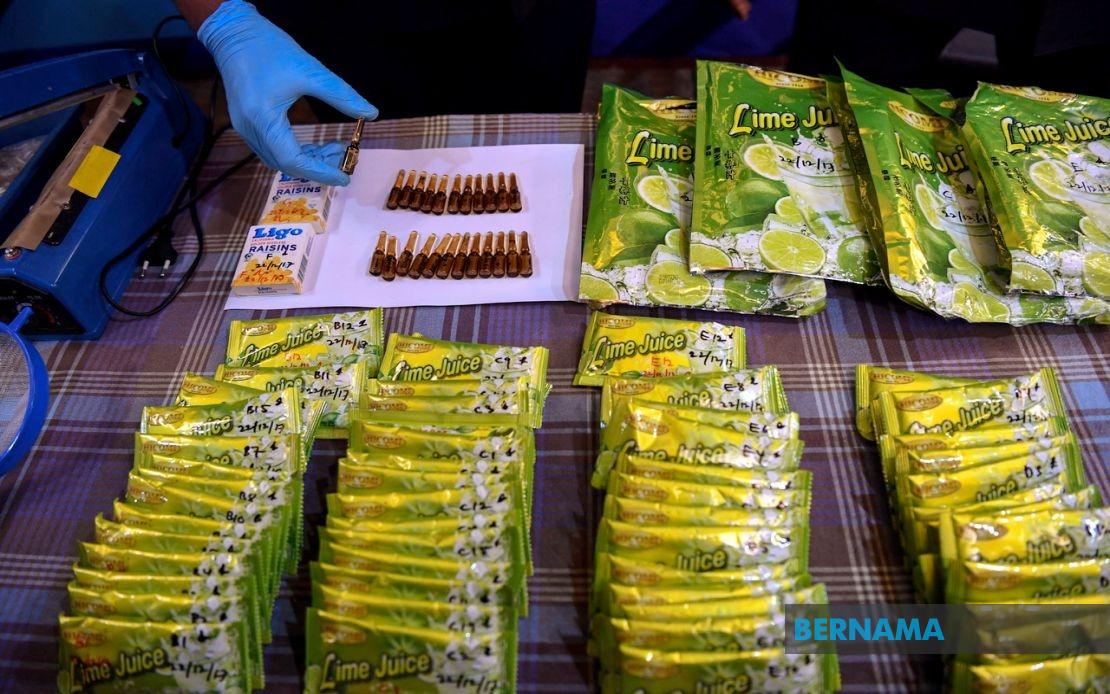
The Malaysian government is mounting an aggressive campaign against a new wave of synthetic narcotics flooding domestic markets, with Home Minister Datuk Seri Saifuddin Nasution Ismail warning that methamphetamine, fentanyl, and street pills dubbed "piu-piu" represent an intensifying public health and security challenge. The Ministry revealed in Parliament this week that the Royal Malaysia Police have arrested nearly a quarter-million individuals across the country for synthetic drug-related crimes in just over three years, underlining the scale of the problem facing law enforcement.
The emergence of these potent substances marks a significant shift in Malaysia's drug landscape. While heroin and cannabis have long dominated the local drug economy, the proliferation of synthetic alternatives presents fundamentally different enforcement and health complications. Fentanyl, a synthetic opioid up to 100 times more powerful than morphine, poses acute overdose risks even in microscopic quantities. The "piu-piu" pills—colourful psychoactive tablets of varying composition—are particularly insidious because their potency and ingredients vary unpredictably, making medical intervention and harm reduction efforts extraordinarily challenging. These substances have been linked to a documented surge in overdose deaths and emergency hospitalizations across Southeast Asia, and Malaysia is no exception to this regional trend.
Saifuddin Nasution detailed the scope of enforcement activity, noting that between 2023 and June 2026, the Royal Malaysia Police recorded 238,704 arrests for various synthetic drug offences nationwide. This figure encompasses traffickers, possessors, and users, reflecting the multi-layered approach authorities are attempting to adopt. The Home Ministry has mobilized specialized operations including Op Tapis and Op Tapis Khas, designed to target drug networks across diverse geographical zones—from urban manufacturing and distribution hubs to rural and remote communities where supply chains often terminate. Collaboration between the National Anti-Drugs Agency, Royal Malaysian Customs Department, and state-level law enforcement has been strengthened to create more coordinated interdiction efforts.
Technology has become central to this intensified campaign. Drones and surveillance camera networks are now deployed systematically to monitor trafficking corridors and identify distribution points, offering real-time intelligence that traditional patrols cannot match. This technological pivot reflects recognition that synthetic drug networks operate with greater sophistication than their predecessors, utilizing encrypted communications, decentralized supply chains, and rapid market adaptation. The investment in drone surveillance and CCTV infrastructure suggests the government views this as a long-term operational necessity rather than a temporary measure, signaling the permanence of the synthetic drug threat in Malaysia's security calculus.
Beyond enforcement, the government is pursuing legislative reform to address the structural inadequacy of existing drug laws. The Dangerous Drugs Act 1952, which remains the statutory foundation for drug policy, was drafted for an era dominated by plant-based narcotics. New Psychoactive Substances and synthetic variants emerge faster than regulatory bodies can classify them, creating legal grey zones where novel compounds remain technically unscheduled. The Home Ministry is considering amendments to expand the Act's schedules to encompass emerging synthetic drugs, a reactive but necessary evolution as chemists continue synthesizing novel compounds designed to circumvent existing legislation. This cat-and-mouse regulatory dynamic is playing out globally, and Malaysia's legislative response places it among countries attempting proactive scheduling adjustments.
Community-based prevention has been positioned as an essential counterweight to enforcement alone. Between 2023 and June 2026, authorities conducted 1,144 drug prevention programmes nationwide, targeting public awareness and community engagement. This represents a conscious shift toward recognizing that arrest statistics and seizures, while operationally important, do not address underlying demand drivers or the social vulnerabilities that make certain populations susceptible to substance abuse. In Malaysian context, where informal networks and family structures traditionally mediate social support, community policing approaches leverage existing social capital to discourage drug initiation and facilitate treatment access.
Sarawak has emerged as a particular focal point for synthetic drug activity, likely due to its geographical remoteness, porous border regions, and historical vulnerabilities in supply chain security. Between January 1 and June 7 this year, Sarawak authorities arrested 7,097 individuals on drug-related charges, comprising 342 traffickers, 1,314 possessors, and 5,441 users. During the same six-month period, law enforcement seized 418.01 kilogrammes of drugs valued at RM53.73 million, alongside confiscation of RM1.95 million in syndicate assets. These figures suggest that while Sarawak does not dominate national drug statistics by volume, the state's remoteness makes it strategically significant for trafficking networks seeking lower-profile distribution routes.
The regulatory response includes detention mechanisms targeting persistent offenders. Authorities employed the Dangerous Drugs (Special Preventive Measures) Act 1985 to detain 13 individuals in Sarawak during the first half of this year, while action was initiated against 131 hardcore addicts under Section 39C of the Dangerous Drugs Act 1952. These provisions allow prolonged administrative detention without trial for individuals deemed to pose ongoing public danger, a controversial but established feature of Malaysian drug policy. The application of these provisions reflects determination to interrupt chronic drug use cycles, though questions persist internationally regarding rehabilitation effectiveness and human rights implications of indefinite detention frameworks.
Forensic laboratory capacity has been systematically expanded to profile emerging synthetic substances and identify novel fentanyl analogues before they achieve market penetration. This scientific approach enables faster detection, more precise dosage assessment for enforcement charging purposes, and epidemiological tracking of drug composition trends. Understanding which fentanyl variants are circulating helps authorities anticipate overdose clusters and tailor public health warnings accordingly. The investment in forensic capability positions Malaysia alongside regional peers in attempting to maintain technical parity with drug manufacturers who continuously innovate formulations.
The response also reflects Malaysia's role within broader Southeast Asian drug supply dynamics. The region occupies a critical position in global drug trafficking networks, serving simultaneously as a transit corridor for substances originating in the Golden Triangle and a manufacturing hub for synthetic drugs destined for regional and international markets. Synthetic drug production requires less geographical specificity than poppy cultivation, making it compatible with urban and semi-urban locations throughout Malaysia. This accessibility has contributed to decentralized manufacturing clusters that are inherently more difficult to disrupt than traditional cultivation-dependent supply chains.
Policymakers recognize that sustained success requires balancing enforcement intensity with treatment infrastructure development. The arrest statistics, while demonstrating operational activity, may inadvertently mask treatment capacity gaps. Malaysian prisons and rehabilitation facilities were already operating near capacity before the synthetic drug surge; integration of synthetic drug offenders into existing systems creates processing challenges and potentially overwhelms counseling and medical support capacity. Effective synthetic drug policy therefore depends not merely on apprehension numbers but on parallel investment in post-arrest intervention pathways.
The government's intensified campaign, encompassing legislative reform, technological deployment, enforcement operations, and community engagement, represents a multifaceted acknowledgment that synthetic drugs constitute a qualitatively different challenge than traditional narcotics. Success will ultimately hinge on sustaining political commitment across electoral cycles, securing adequate budgetary resources for enforcement and treatment infrastructure, and maintaining interagency coordination amid bureaucratic pressures. For Malaysian citizens, the policy escalation signals determination to confront an emerging public health crisis, though the long-term effectiveness of these measures remains contingent on implementation fidelity and adaptive refinement as drug markets themselves continue evolving.

