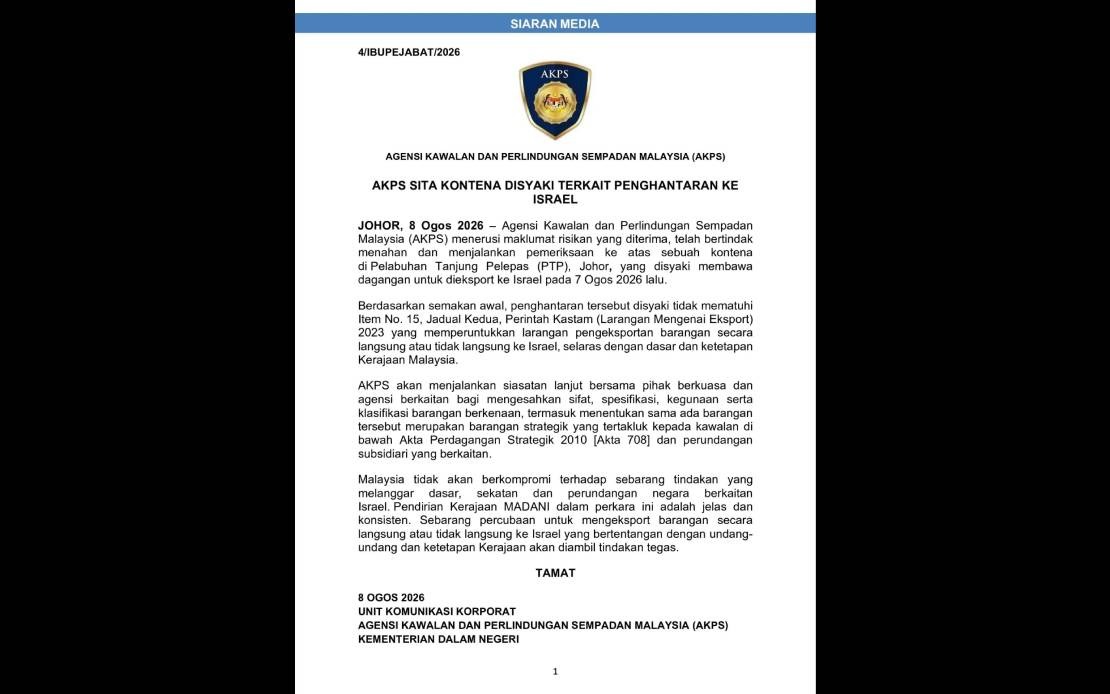
Malaysia's border control authorities have demonstrated the country's unwavering commitment to its Israel trade embargo by seizing a container at Johor's Tanjung Pelepas port suspected of carrying strategic goods destined for Israeli markets. Prime Minister Datuk Seri Anwar Ibrahim publicly acknowledged the swift intervention by the Malaysian Border Control and Protection Agency (AKPS), characterising the interception as a decisive enforcement of Malaysia's principled trade policies and its rejection of activities that could indirectly support what the government describes as Israeli military operations against Palestinians.
The detained shipment triggered an investigation under Item No. 15 of the Second Schedule of the Customs (Prohibition of Exports) Order 2023, a regulatory framework that specifically criminalises both direct and indirect commercial transactions with Israel. This legislative mechanism reflects Malaysia's institutional approach to enforcing what amounts to a comprehensive commercial boycott, distinguishing the country from many regional and global peers that have maintained diplomatic and trade relationships with Tel Aviv despite ongoing Middle Eastern tensions.
Anwar's public statement underscored that Malaysia views its port system not merely as commercial infrastructure but as a strategic extension of the nation's foreign policy doctrine. By preventing Malaysian territory from becoming a transshipment hub for Israel-bound cargo, the government aims to prevent indirect complicity in what it characterises as violations of Palestinian rights and dignity. This philosophical framing transforms port security and customs compliance into matters of national conscience rather than routine bureaucratic procedure.
The government's position aligns with Malaysia's membership in The Hague Group, an international coalition that coordinates efforts to support Palestinian causes through diplomatic and economic channels. The reference to this grouping contextualises the container seizure within a broader multilateral framework, suggesting that Malaysia's unilateral embargo is part of a coordinated, if loosely organised, international response to Middle Eastern geopolitics. However, Malaysia's stance remains significantly more stringent than many fellow ASEAN members, positioning it as a regional outlier in terms of formalised trade restrictions.
The December 2023 prohibition on Israeli ships and vessels carrying Israel-bound cargo represents a watershed moment in Malaysian trade policy, establishing unprecedented barriers to Israeli maritime commerce. This measure goes beyond typical sanctions by restricting port access itself, a particularly consequential action for a maritime trading nation that depends on regional ports for billions in annual commerce. The decision reflects domestic political consensus around Palestinian solidarity, a sentiment that commands broad support across Malaysia's diverse political spectrum.
For Malaysian exporters and logistics companies, the enforcement action carries important operational implications. Businesses must now implement robust due diligence procedures to verify end-destinations for their shipments, creating additional compliance costs and administrative burdens. Multinational corporations operating regional distribution networks from Malaysia must recalibrate supply chain strategies to ensure goods do not inadvertently transit through or originate from Israeli suppliers, potentially complicating sourcing arrangements and inventory management across Southeast Asia.
The seizure also signals intensified monitoring capacity within Malaysian customs and border agencies, suggesting that port authorities have enhanced their ability to identify suspect shipments through improved intelligence gathering or international information sharing. This capability enhancement reflects broader investments in port security infrastructure and reflects the government's determination to enforce the embargo through sustained operational vigilance rather than symbolic gestures.
From a regional trade perspective, the incident highlights divergent approaches to Israel within ASEAN. While Malaysia implements comprehensive trade restrictions, other member states maintain more conventional commercial relationships with Israeli technology, agricultural, and industrial sectors. This heterogeneity complicates intra-ASEAN trade and regional supply chain integration, as goods flowing through Malaysian ports must satisfy stricter destination requirements than those passing through Singapore, Thailand, or other regional hubs.
The enforcement action also reflects Malaysia's domestic political economy, where Palestinian solidarity constitutes a non-negotiable consensus that transcends the traditional government-opposition divide. Both ruling coalitions and previous administrations have supported the embargo, suggesting that Israel-Malaysia trade restrictions possess durable political foundations unlikely to shift regardless of electoral outcomes or leadership transitions. This stability distinguishes the embargo from temporary diplomatic gestures and suggests it represents embedded policy architecture.
International legal dimensions add another layer of complexity. While Malaysia frames its embargo as consistent with international law and humanitarian principles, such measures operate in contested legal terrain. Unilateral trade restrictions may conflict with WTO obligations or regional free trade commitments, though Malaysia appears willing to accept potential legal challenges in service of its stated foreign policy objectives. This willingness reflects the political salience of Palestinian issues within Malaysian society and the government's assessment that domestic political costs of reversing the embargo far exceed any international trade litigation risks.
Looking forward, the container seizure suggests that enforcement will remain a central feature of Malaysia's Israel policy framework. Rather than allowing the embargo to become merely nominal legislation, authorities appear committed to detecting and intercepting suspect shipments, creating real commercial friction for entities seeking to route Israel-bound goods through Malaysian territory. This sustained enforcement approach transforms formal prohibitions into operational realities that shape business decision-making across the region.

