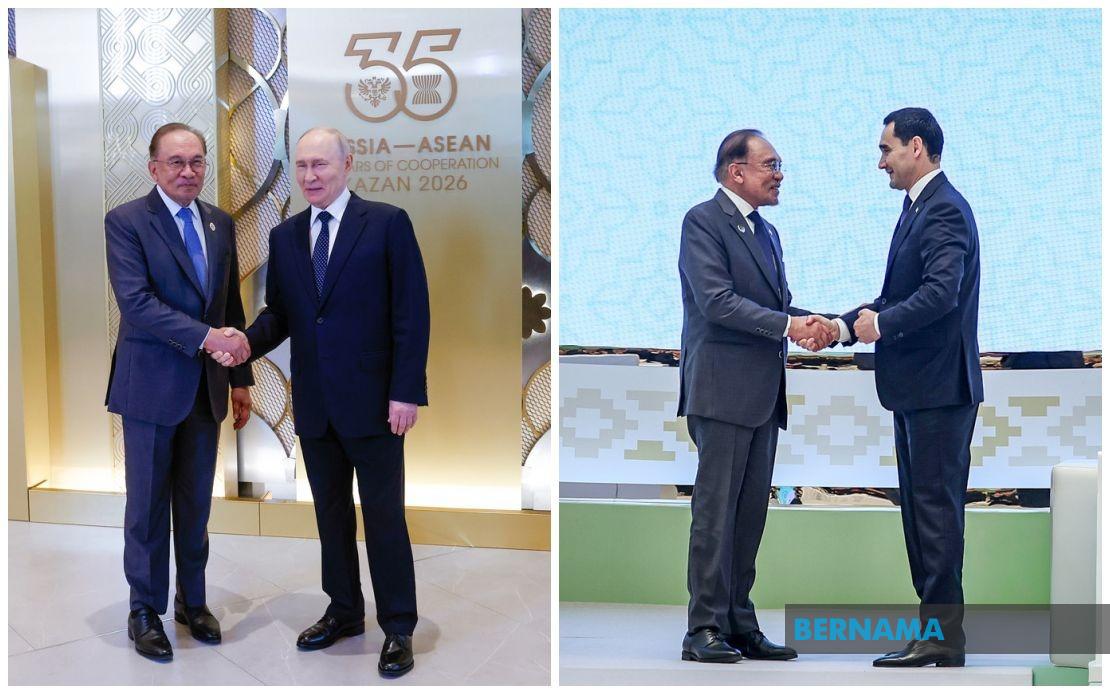
Prime Minister Datuk Seri Anwar Ibrahim's official visits to Russia and Turkmenistan represent a turning point in Malaysia's energy diplomacy, delivering concrete commitments that address the country's long-term resource needs while elevating Malaysian companies on the global stage. The two-nation mission has been widely hailed by government ministers as a watershed moment in bilateral relations, underpinned by agreements that will reshape Malaysia's energy landscape and extend its geopolitical influence in Central Asia and Eastern Europe.
At the heart of these diplomatic gains lies a landmark energy security arrangement with Russia. During his two-day working visit to Kazan, the capital of Russia's Republic of Tatarstan, Anwar secured a commitment from Moscow to provide Malaysia with long-term petroleum, oil and gas supplies extending up to two decades. This departure from conventional annual or seasonal renewal cycles reflects a strategic pivot toward predictable, multi-year supply agreements that insulate Malaysia from volatile global energy markets. Housing and Local Government Minister Nga Kor Ming underscored the domestic implications of this achievement, noting that stable Russian supplies will underpin the government's BUDI MADANI RON95 programme, enabling the continued subsidy of petrol at RM1.99 per litre—a politically sensitive price point that affects millions of commuters and small businesses across the nation.
The energy security dimension carries profound economic and social ramifications for Malaysia. As a net importer of petroleum products, the country has long grappled with exposure to price fluctuations and supply disruptions in global markets. The diversification strategy championed by the MADANI government seeks to reduce this vulnerability by cultivating relationships with multiple suppliers across different regions. Russia's commitment, supplemented by existing partnerships and arrangements, strengthens Malaysia's negotiating position and provides a cushion against geopolitical tensions or market shocks that might otherwise destabilize domestic fuel prices and inflation rates.
Equally transformative is Petronas' newly secured role in developing one of Turkmenistan's major gas fields, a breakthrough that Minister for Human Resources Datuk Seri R. Ramanan characterised as validation of Malaysian corporate competence on the world stage. Turkmenistan ranks among the globe's top holders of natural gas reserves, yet the sector has historically been dominated by Russian, Chinese and Western operators. Petronas' appointment as operator represents a significant vote of confidence in the national oil and gas company's technical expertise, project management capabilities and political neutrality—a distinction that reflects both Malaysia's stable democratic institutions and the professionalism of its state-owned enterprises.
The gas field development carries strategic implications that ripple far beyond shareholder returns. For Petronas, currently ranked 139th on the Fortune Global 500 list, the project offers a pathway toward the top 100—an ascent that would consolidate Malaysia's standing as a consequential player in global energy markets. Such advancement enhances the company's access to capital, attracts top international talent and strengthens its capacity to bid competitively for future projects in Africa, the Middle East and Southeast Asia. The demonstration effect is particularly valuable in an era when Malaysia competes with regional peers for finite resource extraction opportunities and energy partnerships.
From a broader economic standpoint, Petronas' expansion into Turkmenistan opens avenues for technology transfer, skills development and workforce training that will benefit Malaysian professionals and technicians. The energy sector remains one of Malaysia's most sophisticated industrial complexes, and exposure to Central Asian hydrocarbon projects exposes local engineers and managers to diverse geological, regulatory and operational environments. This human capital dimension often receives less attention than the headline figures but proves crucial to building a self-reliant, high-value economy capable of competing in industries beyond commodity extraction.
The Russia and Turkmenistan visits also illuminate Malaysia's broader geopolitical positioning during a period of great power competition. By simultaneously cultivating partnerships with Moscow and establishing footholds in Central Asia through Turkmenistan, Anwar has demonstrated a non-aligned approach that prioritizes Malaysian national interests over ideological alignment. This flexibility—unusual among Southeast Asian peers—reflects Malaysia's historical role as a bridge between East and West, a positioning that yields tangible dividends when executed with diplomatic skill. Neither Russia nor Western powers seeking to contain Moscow have grounds to view these agreements as threatening; instead, they represent pragmatic energy commerce conducted between sovereign nations.
The agreements also underscore Malaysia's capacity to punch above its weight diplomatically. While the country lacks the military might or continental scale of larger regional players, its demonstrated expertise in managing complex energy projects, its stable macroeconomic environment and its track record of honouring international commitments make it an attractive partner for resource-rich nations seeking competent operators and fair-dealing collaborators. These attributes become increasingly valuable as energy transition accelerates and traditional petro-states seek to diversify their operator base and geopolitical partnerships.
Minister Nga's emphasis on the connection between energy security and the BUDI MADANI programme highlights how international resource diplomacy translates into domestic social policy. Maintaining the RON95 price at RM1.99 per litre requires a delicate balance between subsidy costs, fiscal capacity and global energy prices. Securing reliable Russian supplies over two decades removes a significant source of uncertainty from government budgeting and provides policymakers with predictability when forecasting expenditure on fuel subsidies—a critical input for lower-income households and commercial transport operators whose livelihoods depend on affordable fuel.
The ministerial statements also reveal careful messaging around Petronas' global competitiveness. By framing the Turkmenistan appointment as recognition of Malaysian corporate excellence, government officials reinforce narratives of national capability and institutional effectiveness that bolster investor confidence and morale domestically. In a competitive regional landscape where Singapore, Thailand and Indonesia all maintain substantial state-owned energy companies, such affirmation of Malaysian prowess serves strategic communications purposes alongside the tangible commercial benefits.
Looking forward, these agreements establish frameworks for expanded cooperation across energy, trade, investment and technology sectors. The Russia visit produced bilateral commitments spanning tourism, skills exchange and broader economic integration—domains where Malaysia's geographic position as a Southeast Asian gateway and its relative development levels create natural complementarities with Eurasian partners. The Turkmenistan arrangement, meanwhile, opens pathways for Malaysia to deepen ties throughout Central Asia, a region historically oriented toward Russia and China but increasingly receptive to diversified partnerships.
The timing of these missions coincides with Malaysia's broader strategy of repositioning itself as a neutral, capable actor in global energy markets during a period of geopolitical fragmentation. As traditional energy alliances fracture and sanctions regimes reshape trade patterns, nations like Malaysia that maintain productive relationships across ideological divides gain leverage and flexibility. The Anwar government's diplomatic approach—earnest engagement without ideological posturing—appears calibrated to maximize these advantages while maintaining the international standing and institutional credibility upon which Malaysia's long-term prosperity depends.

