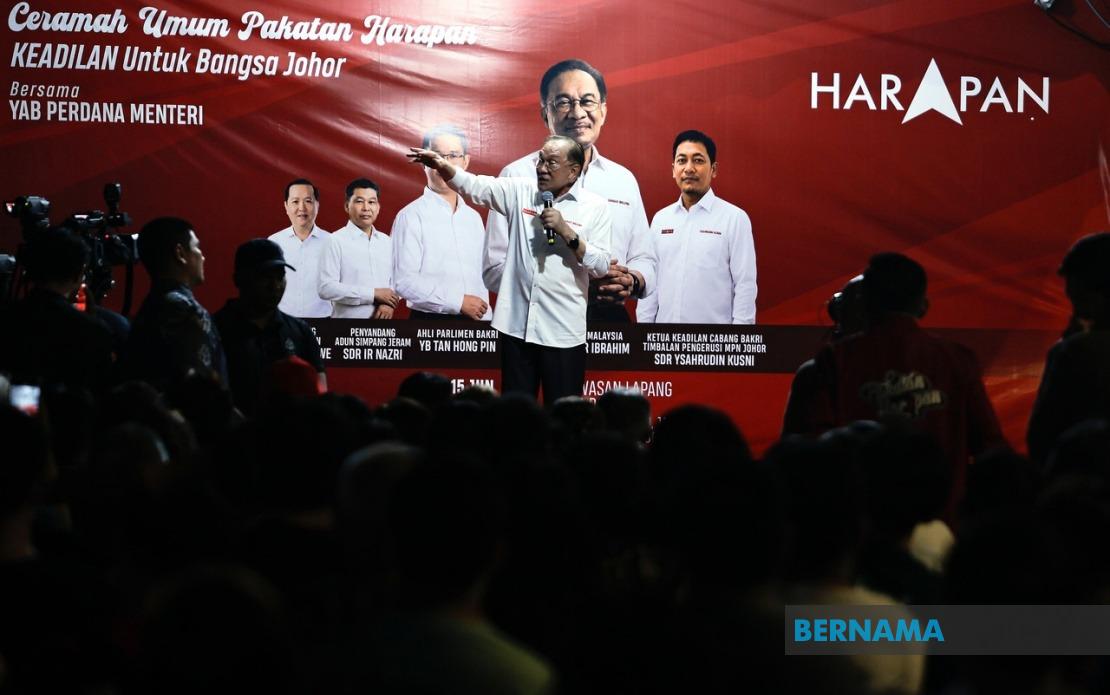
Prime Minister Datuk Seri Anwar Ibrahim has drawn a stark contrast between Malaysia's potential as a technology-driven nation and the risks of remaining mired in divisive politics, urging the country to harness artificial intelligence and quantum computing as engines of national progress. Speaking at a People's Justice Party gathering in Muar on June 15, Anwar framed technological advancement not as a optional policy preference but as an existential imperative for ensuring prosperity for future generations of Malaysians.
The Prime Minister's comments reflect a deliberate pivot in government messaging away from the communal tensions that have periodically dominated Malaysian politics. By emphasizing shared technological ambitions, Anwar positioned himself as offering a unifying vision that transcends the ethnic and religious fault lines that periodically paralyze national discourse. His remarks underscore growing recognition among policymakers that Malaysia risks being left behind in the global digital economy if political energy continues to be consumed by disputes over cultural and religious issues rather than directed toward economic transformation.
Anwar outlined concrete steps his government has already undertaken to establish Malaysia as a regional hub for artificial intelligence and data centre operations. These investments represent a strategic bet that attracting multinational technology companies and developing indigenous AI capabilities will create high-value employment and position the country favourably within the emerging quantum computing sector. During recent visits to Japan, the Prime Minister has explored partnership opportunities in quantum technology, signalling Malaysia's intention to participate in cutting-edge scientific advancement rather than remaining a peripheral player in Asia's technology revolution.
The practical implications of this technological shift extend far beyond boardrooms and research laboratories. Deployment of AI systems across government services, healthcare, education, and infrastructure could dramatically improve efficiency and service delivery to ordinary Malaysians. Quantum computing, still largely in development stages globally, promises breakthroughs in drug discovery, materials science, and cryptography that could generate entirely new industries and employment categories. For Southeast Asia's largest economy, the stakes of embracing or avoiding this transition are substantial.
Yet Anwar's implicit critique of political leaders who exploit communal grievances suggests genuine frustration with the opportunity cost of constant ethnic and religious messaging. He challenged politicians to ask themselves whether endless disputes over temples, mosques, and communal representation serve Malaysian citizens' actual interests or merely distract from fundamental challenges in education quality, healthcare access, and economic competitiveness. This argument resonates particularly with urban, younger voters who increasingly view identity politics as disconnected from the practical concerns shaping their lives.
The Prime Minister's appeal for national unity carries particular weight given Malaysia's history of communal tensions. By framing technological progress as a collective endeavour requiring Malay, Chinese, and Indian Malaysians working in harmony, Anwar offered an aspirational counternarrative to zero-sum communal competition. This approach acknowledges ethnic diversity without allowing it to become an obstacle to shared national purpose, a delicate balance that has eluded many Malaysian politicians.
International investor sentiment toward Malaysia appears to vindicate Anwar's optimism. The observation that foreign companies are approaching Malaysia unprompted, without government marketing campaigns, suggests genuine confidence in the country's potential as a technology destination. This confidence could evaporate quickly if Malaysia becomes perceived as politically unstable or consumed by internal divisions rather than focused on delivering a predictable, competitive business environment. The government's technological ambitions thus depend fundamentally on political stability and the capacity to govern above sectional interests.
Anwar's emphasis on developing future capabilities also reflects demographic awareness. Malaysia's working-age population will begin contracting within the next decade as birth rates decline and ageing accelerates. Without substantial productivity improvements driven by technological adoption and innovation, per capita income growth will stall. AI and quantum computing represent potential solutions to this demographic challenge, enabling smaller workforces to generate greater economic output. This long-term perspective explains why Anwar frames these investments as essential to children's futures rather than merely contemporary policy preferences.
The challenge ahead involves translating rhetorical emphasis into institutional reality. Developing AI and quantum computing ecosystems requires sustained investment in higher education, particularly in science, technology, engineering, and mathematics disciplines. It demands regulatory frameworks that encourage innovation while managing risks. It necessitates attracting and retaining skilled workers in a competitive global labour market. Most critically, it requires political consensus that transcends electoral cycles and coalition dynamics, allowing for consistent policy implementation across administrations.
Anwar's framing also implicitly acknowledges that Malaysia cannot compete with wealthier developed nations through traditional manufacturing or resource extraction. Technological innovation and intellectual capital represent the country's most viable path toward sustaining middle-income status and progressing toward high-income achievement. This reality constrains Malaysia's strategic options and makes political divisiveness not merely undesirable but economically ruinous, as it deters the investment and talent migration essential for technological transformation.
The political dimension of Anwar's message carries significance for coalition dynamics within Malaysia's governing structure. By publicly advocating for transcendence of ethnic politics, he signals to coalition partners that the government's legitimacy rests on delivery of tangible improvements in citizens' lives rather than on ethnic patronage or communal mobilisation. This positioning could gradually reshape expectations about what Malaysian politics should deliver, though entrenched interests benefiting from the current system will resist such transformation persistently.
As Malaysia navigates an increasingly competitive regional environment where Vietnam, Thailand, and Indonesia are also pursuing technology-driven development strategies, Anwar's call for focus and unity speaks to genuine urgency. The window for establishing regional leadership in emerging technologies may be constrained, requiring rapid decision-making and implementation. Political disputes that consume time and political capital ultimately represent luxury Malaysia may no longer be able to afford if it wishes to secure prosperity for coming generations.