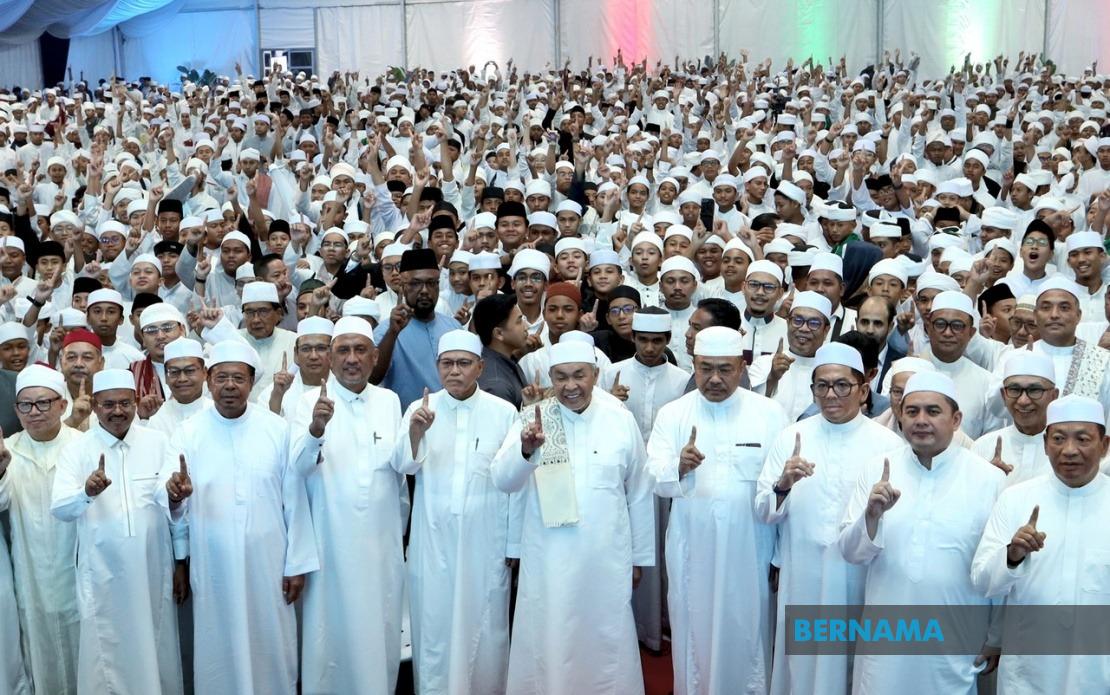
Malaysia's federal government has taken a significant step toward formalising Islamic education by approving the establishment of a National Tahfiz Council, an institutional framework designed to coordinate the direction, educational models, and academic standards for tahfiz programmes across the nation. The initiative was confirmed by Deputy Prime Minister Datuk Seri Dr Ahmad Zahid Hamidi during his address at the Pahang State Huffaz Gathering 2026 in Kuantan, an event that drew over 5,000 huffaz participants from throughout the state. This move represents recognition by the government that tahfiz education—the practice of memorising the Quran—requires systematic oversight and integration within Malaysia's broader educational ecosystem.
Datak Seri Anwar Ibrahim, the Prime Minister, has appointed Ahmad Zahid Hamidi as chairman of the newly formed council. This appointment signals high-level political commitment to the initiative and suggests that tahfiz education will receive sustained attention at the Cabinet level. Ahmad Zahid's dual role as Deputy Prime Minister and Rural and Regional Development Minister positions the council within a broader governmental agenda to develop education and skills across Malaysia's diverse communities. The timing of the announcement at a state-level gathering in Pahang also reflects the government's strategy to build consensus and engagement among practitioners and students before rolling out national policies.
The core objective of the National Tahfiz Council is to position tahfiz education as a recognised and viable pathway within Malaysia's formal education system, rather than as a parallel or supplementary track. Currently, many tahfiz students face institutional barriers when attempting to transition from religious schools to secular universities or the professional job market. Ahmad Zahid articulated an ambitious vision in which tahfiz graduates would progress seamlessly from madrasah institutions into tertiary education, acquire marketable skills beyond memorisation, and enter professional careers with credentials recognised by employers. This reframing challenges the traditional separation between religious and secular education in Malaysia and aims to create multiple educational trajectories that value Quranic scholarship alongside practical competencies.
Pahang state has emerged as a model for comprehensive tahfiz education development, demonstrating how Islamic learning can be embedded throughout a student's educational journey beginning in early childhood. The state has implemented Tadika Tahfiz Negeri Pahang, a kindergarten programme designed to instil appreciation for the Quran from a young age. This foundational approach, which the Deputy Prime Minister noted was inspired by Sultan Al-Sultan Abdullah Ri'ayatuddin Al-Mustafa Billah Shah, allows students to build strong religious grounding before progressing through structured schooling and eventually reaching international standards of Quranic scholarship. The success of Pahang's integrated model provides evidence that tahfiz education can function as a comprehensive knowledge system rather than a narrow specialisation, offering a blueprint for other states to consider.
The government is currently implementing revisions to the National Tahfiz Policy 2.0, which introduces several structural innovations aimed at enhancing the sector's credibility and accessibility. Among these initiatives is the introduction of TVET Tahfiz, which combines Quranic memorisation with technical and vocational training, addressing the practical skills gap that has historically limited tahfiz graduates' employment prospects. The Malaysian Tahfiz Certificate 2.0 provides standardised credentials recognising different levels of Quranic mastery, while the Graded Hafazan Certification offers granular assessment of students' progress. These formal certification systems represent a departure from traditional, informal recognition structures and align tahfiz education with international quality assurance frameworks.
Financial barriers have long deterred talented students from pursuing tahfiz education, particularly those from modest economic backgrounds. The introduction of the Huffaz Financing Scheme addresses this obstacle by making tahfiz study more accessible to lower-income families. Combined with the Graded Hafazan Certification and Malaysian Tahfiz Recognition Standard, these mechanisms create a more transparent and equitable system in which advancement depends on demonstrated competence rather than family resources or social connections. Such reforms are essential for expanding the talent pool within tahfiz education and ensuring that the sector benefits from Malaysia's full demographic diversity.
Strategic partnerships between tahfiz institutions and higher learning establishments represent another dimension of the council's work. By formalising collaborations between traditional madrasahs, TVET providers, universities, and skills institutes, the government seeks to create integrated educational ecosystems where students can move fluidly between different learning environments. These partnerships reduce institutional silos and enable tahfiz students to combine religious scholarship with science, technology, business, or practical trades. For Malaysian universities, such arrangements could enrich their student bodies and research communities by incorporating perspectives rooted in Islamic scholarship, while tahfiz institutions gain access to advanced facilities and expertise.
During the Kuantan gathering, Ahmad Zahid witnessed the signing of a memorandum of understanding among Yayasan Pahang, the Community Development Department (KEMAS), and Majlis Amanah Rakyat (MARA). This agreement formalises cooperation to strengthen tahfiz education and expand skills development opportunities for huffaz graduates. MARA's involvement is particularly significant, as the agency has long been mandated to develop bumiputera communities economically and educationally. By partnering with MARA, tahfiz students gain access to the organisation's extensive microfinance, vocational training, and entrepreneurship programmes, creating pathways for graduates to launch businesses or enter professional employment. KEMAS's community development expertise complements these economic initiatives by addressing the social and organisational dimensions of tahfiz sector growth.
For Southeast Asian observers, Malaysia's formalisation of tahfiz education offers insights into how Islamic-majority nations can integrate religious education with modern skills development and professional advancement. The region includes several countries with substantial Muslim populations and long traditions of Quranic scholarship, yet these educational systems often remain disconnected from mainstream economic and social institutions. Malaysia's approach—standardising curricula, certifying competencies, forging partnerships with vocational and tertiary sectors, and providing financial support—demonstrates a model that other regional governments might adapt to their own contexts. Success would require similar political will, institutional coordination, and investment, but the potential benefits include stronger social cohesion, broader access to education, and more inclusive economic participation.
The establishment of the National Tahfiz Council also reflects broader demographic and economic trends affecting Malaysia. As the nation pursues higher-value manufacturing, digital services, and knowledge-intensive industries, the traditional binary choice between religious and secular education has become increasingly untenable. Many Malaysian families wish their children to maintain strong Islamic identity while acquiring globally competitive skills. The council's framework addresses this aspiration by creating educational pathways that treat Quranic scholarship and professional competence as complementary rather than conflicting. This integration aligns with Malaysia's official vision of inclusive development and its positioning as a leading Muslim-majority economy.
Looking forward, the success of the National Tahfiz Council will depend on sustained funding, effective coordination among federal and state governments, quality assurance in programmes bearing its recognition, and genuine employment opportunities for graduates. The ambitious vision articulated by Ahmad Zahid—of tahfiz students progressing confidently into universities and professional careers—requires not only institutional reform but also cultural shifts among employers, educators, and families regarding the value and relevance of Islamic scholarship in a modern economy. If the council can deliver on these expectations, it may serve as a model for educational integration in Malaysia and inspire similar initiatives across the Muslim world.

