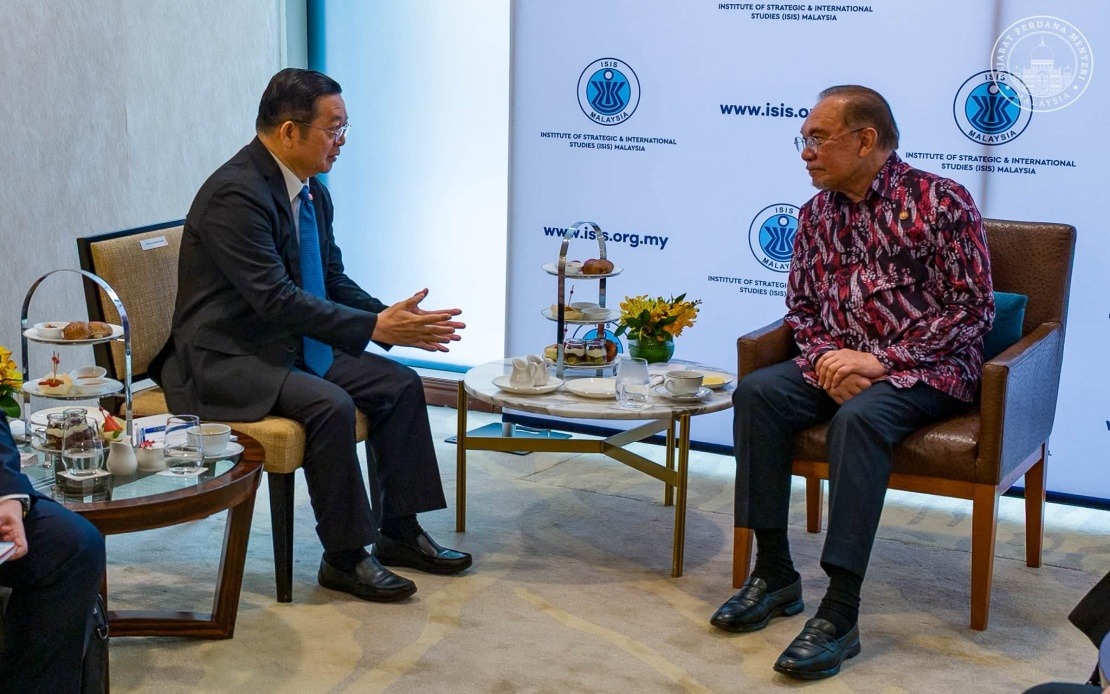
Malaysia remains committed to playing a constructive and meaningful role in strengthening ASEAN as a resilient and inclusive community that can fulfil the expectations of its citizens, Prime Minister Datuk Seri Anwar Ibrahim declared this week during a significant engagement with regional leadership. Speaking following his keynote presentation and participation in discussions at the 39th Asia-Pacific Roundtable in Kuala Lumpur, Anwar reaffirmed his government's dedication to advancing ASEAN's collective interests at a particularly delicate moment for the region's stability.
The Prime Minister's statement came during a courtesy meeting with ASEAN Secretary-General Dr Kao Kim Hourn, a session that underscored Malaysia's active involvement in shaping the regional bloc's strategic direction. As the Minister of Finance in addition to his role as Prime Minister, Anwar brought a comprehensive perspective to discussions spanning economic considerations and geopolitical developments that extend beyond traditional trade and investment frameworks.
The exchange between Anwar and the ASEAN Secretary-General proved sufficiently substantive to address multiple pressing concerns confronting the association. Myanmar's ongoing political crisis continues to present challenges to ASEAN's unity and its principle of non-interference, a tension that remains unresolved despite repeated diplomatic initiatives. The situation demonstrates the limits of consensus-based decision-making when one member state faces internal upheaval that threatens both its stability and its obligations to the broader organisation.
Tensions in the South China Sea represent another critical item on the regional agenda. Malaysia, with its own maritime interests and territorial claims in the waterway, recognises the importance of maintaining dialogue channels while protecting its economic and security concerns. The South China Sea remains one of the world's most economically vital shipping routes whilst simultaneously being one of its most contested zones, making regional consensus on peaceful resolution mechanisms essential for all member states.
Anwar highlighted discussions concerning the rapid advancement of artificial intelligence and its implications for the region's economies and societies. Southeast Asian nations face the dual challenge of harnessing AI's transformative potential whilst managing its disruptive effects on employment, skills requirements, and social structures. This positions ASEAN member states in a race to develop coherent governance frameworks that neither stifle innovation nor leave populations vulnerable to technological displacement.
The integration of Timor-Leste as ASEAN's newest member following its full accession represents a defining moment for the organisation's expansion strategy and institutional capacity. The post-accession phase requires careful attention to ensuring the youngest member state can effectively contribute to and benefit from association membership whilst the bloc adapts its mechanisms to accommodate its expanded membership. Malaysia's engagement in this transition reflects the broader commitment to inclusive growth within ASEAN structures.
The implementation of the ASEAN Community Vision 2045 remains central to the bloc's long-term strategic planning. This comprehensive roadmap, which envisions deeper political, economic, and socio-cultural integration, requires sustained commitment from all member states to realise its ambitious objectives. Malaysia's continued support for this vision signals its willingness to invest political capital in regional integration even as individual national interests occasionally diverge.
Anwar particularly emphasised that ASEAN must continue championing the principles of unity, centrality, and intensive cooperation to guarantee that Southeast Asia remains peaceful, stable, and prosperous. These foundational principles—developed over decades of association history—have proven critical for managing disputes and maintaining a regional framework capable of accommodating diverse political systems, developmental levels, and foreign policy orientations. Without strong adherence to these principles, the organisation risks fragmentation when confronted with pressures from external powers seeking to establish competing spheres of influence.
The conflict in West Asia and its potential ramifications for Southeast Asia emerged as an important agenda item during the discussions. Regional leaders recognise that instability thousands of kilometres away can affect shipping routes, energy prices, investment flows, and security calculations within their own maritime neighbourhood. Malaysia, as a major trading nation heavily dependent on open sea lanes, has particular interest in ensuring that Middle Eastern conflicts remain contained and do not spill over into creating disruptions affecting Southeast Asian commerce and security.
Anwar's reaffirmation of Malaysia's constructive role reflects the nation's self-perception as a stabilising force within ASEAN capable of bridging divides and advancing consensus. This positioning requires Malaysia to balance relationships with various great powers whilst maintaining solidarity with fellow member states on matters affecting collective interests. The Prime Minister's comments suggest that Malaysia intends to remain engaged at the highest levels of ASEAN decision-making and policy formulation as the region navigates an increasingly multipolar and strategically contested environment.
The broader context for these discussions involves growing pressures on ASEAN's centrality in Southeast Asian affairs. As major powers intensify their engagement with individual member states through bilateral arrangements and competing regional initiatives, ASEAN's ability to function as a unified voice that advances collective interests grows more challenging. Malaysia's continued advocacy for constructive engagement within ASEAN frameworks signals a preference for maintaining the organisation's relevance despite these centrifugal pressures.
The timing of these exchanges also matters significantly. Regional geopolitical tensions, including maritime disputes, great power competition, and questions about the regional order's future shape, create opportunities for ASEAN to either strengthen cohesion or fragment along competing lines of allegiance. Malaysian leadership engagement at this juncture represents an attempt to reinforce the institutional mechanisms and shared commitments that have sustained ASEAN through previous crises and challenges.

