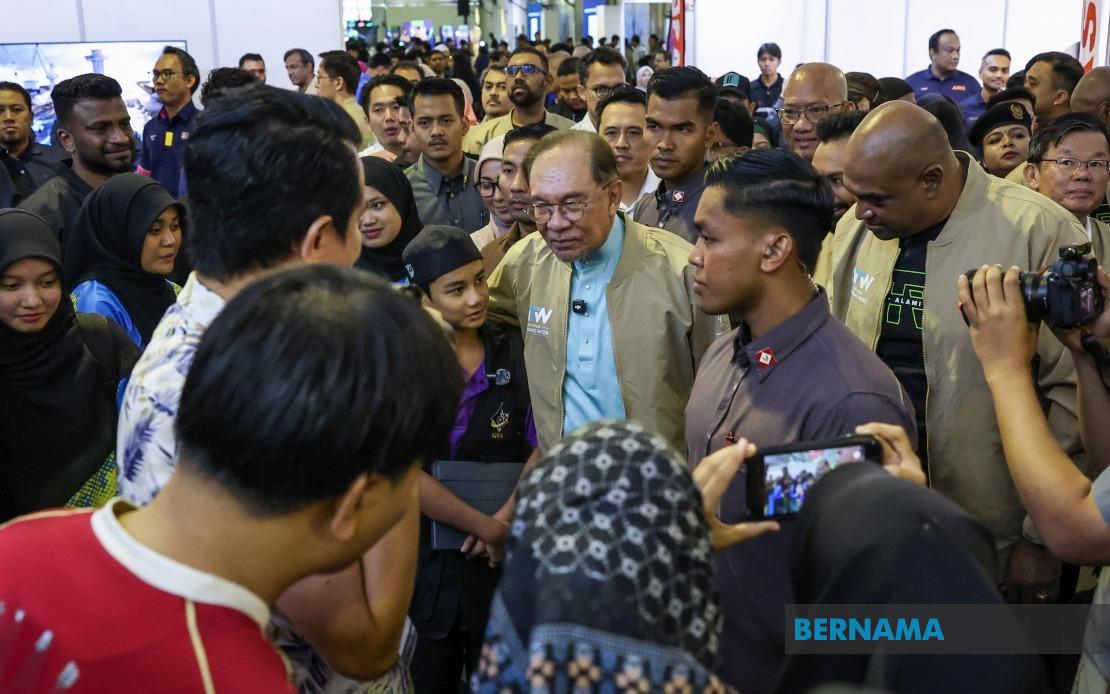
Prime Minister Datuk Seri Anwar Ibrahim has issued a stark warning that Malaysia's aspirations for greatness and development will remain unfulfilled so long as its population clings to outdated ideologies and divisive thinking patterns that foster animosity across communities. Speaking at the closing ceremony of National Training Week 2026 at Universiti Teknologi MARA's Permatang Pauh campus in Bukit Mertajam, Anwar stressed that the nation's trajectory depends fundamentally on moving beyond entrenched political divisions that pit citizens against one another rather than working toward common prosperity.
The remarks underscore a central pillar of the MADANI Government's approach to governance, which prioritises dialogue and inclusive policymaking over confrontational rhetoric. Anwar's emphasis on transcending divisive and racial politics reflects broader concerns within Malaysia's leadership about the persistence of identity-based fault lines that have historically complicated efforts to build consensus on national priorities. By positioning such divisions as inherently incompatible with development, the Prime Minister is signalling that economic progress and social cohesion are inextricably linked in the government's strategic vision.
Anwar directed particular attention toward Malaysia's younger generation, positioning youth as agents of transformative change capable of breaking cycles of antagonism. He called on young Malaysians to organise themselves as a unified force dedicated to elevating the dignity and circumstances of all citizens, irrespective of background. This framing of youth engagement moves beyond conventional calls for civic participation, instead casting generational renewal as a prerequisite for national advancement. The emphasis on younger citizens reflects demographic realities and the government's strategic calculation that shifting attitudes among those still forming their political consciousness represents the most promising avenue for cultural change.
The MADANI Government's commitment to tackling societal challenges through inclusive dialogue rather than divisive campaigns represents a deliberate policy divergence from past approaches. Anwar highlighted how this methodology seeks to address the varied concerns and interests of different population segments through collaborative problem-solving rather than zero-sum political competition. Such an approach requires building institutional and social frameworks that facilitate genuine exchange across traditional dividing lines, a complex undertaking in a country with Malaysia's particular history of community relations.
Economic resilience and skills development featured prominently in Anwar's address, reflecting the government's conviction that prosperity serves as both a practical benefit and a psychological foundation for social unity. The Prime Minister noted that Malaysia's economy has demonstrated durability despite global uncertainties, bolstered by systematic economic reforms and government interventions designed to insulate ordinary citizens from cost-of-living pressures. He cited concrete achievements including the ringgit's emergence as Asia's strongest-performing currency, record-breaking foreign investment inflows, and sustained economic expansion as evidence that reform efforts are yielding measurable results.
Anwar emphasised that the government intends to substantially expand training and skills enhancement opportunities through established institutions including the Ministry of Human Resources and the Human Resource Development Corporation. This expanded commitment encompasses reskilling and upskilling initiatives designed to improve employability and earning potential across demographic groups. The underlying theory posits that access to better jobs and higher incomes creates material conditions conducive to social stability and reduced resentment, thereby diminishing the appeal of divisive politics rooted in perceived scarcity or unfair distribution of opportunities.
The National Training Week initiative itself serves as a practical manifestation of this philosophy, offering diverse learning and development pathways while simultaneously creating spaces where young Malaysians from varied backgrounds interact around shared professional objectives. Anwar urged participants to exploit these opportunities fully and provide feedback that could strengthen future programming. This emphasis on both individual agency in skill acquisition and collective responsibility for programme improvement reflects the government's broader emphasis on partnership between state institutions and citizens in solving shared challenges.
Penang Chief Minister Chow Kon Yeow and Human Resources Minister Datuk Seri R. Ramanan's presence at the ceremony underscored cross-level governmental coordination on skills development and youth engagement. Such collaborative arrangements between federal and state authorities suggest recognition that addressing divisive politics and building inclusive economic opportunity requires coordinated action across administrative levels. The involvement of both political leadership and technical ministry expertise signals that the government is deploying multiple mechanisms—from rhetorical emphasis to institutional programming—to advance its agenda.
For Malaysia's business community and foreign investors, Anwar's emphasis on political stability and social cohesion carries significant implications. Sustained economic progress depends partly on investor confidence in Malaysia's political environment and social durability. By positioning the reduction of divisive politics as essential to development, the Prime Minister is essentially arguing that political and social reform serve economic interests, potentially aligning business interests with government efforts to shift political culture. The reference to record-high investments suggests such messaging may already be influencing investor sentiment positively.
The challenge ahead lies in translating rhetorical commitment into sustained behavioural change across society. While government institutions can expand skills training and promote dialogue, the deeply rooted nature of identity-based political divisions means that cultural shift requires time, consistency, and engagement at multiple social levels simultaneously. Whether Malaysia's younger generation proves responsive to appeals for unity, and whether material improvements in opportunity genuinely reduce political resentment, will substantially determine whether the MADANI Government's approach yields meaningful transformation or remains primarily aspirational.
Regionally, Malaysia's experience with navigating plural societies and attempting to forge political consensus across diverse communities carries relevance for other Southeast Asian nations grappling with similar tensions. The government's explicit framing of divisive politics as incompatible with development provides a distinctive articulation of why inclusive governance matters, one grounded in concrete economic and social outcomes rather than abstract principles. Whether this framing proves persuasive enough to shift behaviour among those invested in existing political arrangements remains an open question that will substantially shape Malaysia's trajectory over coming years.

