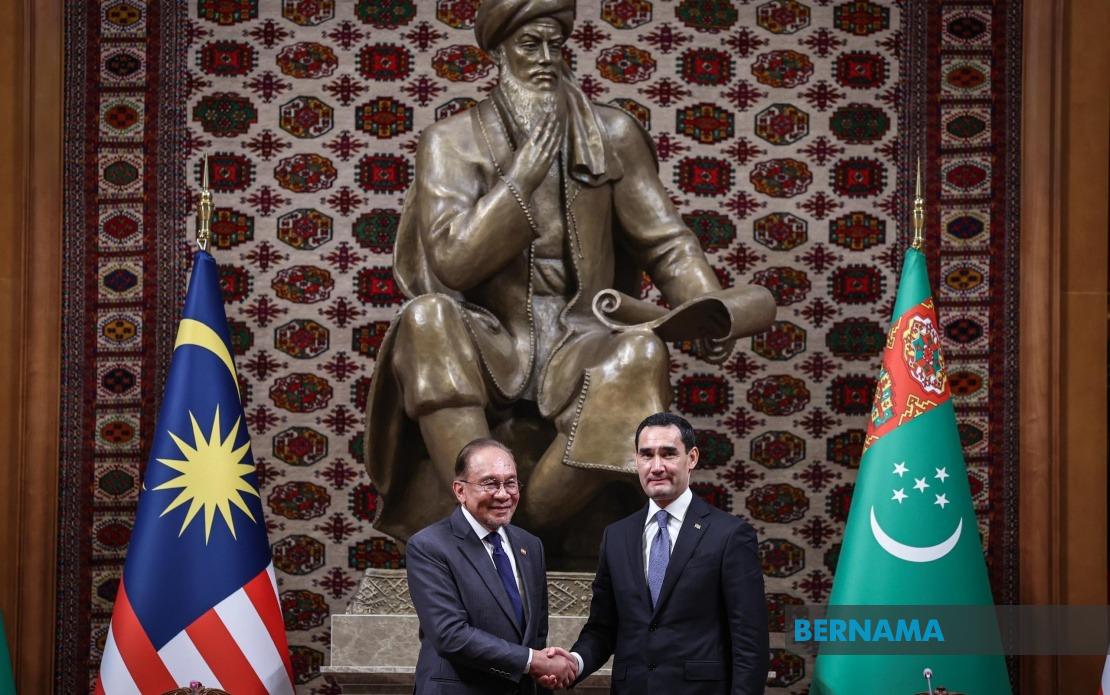
Prime Minister Datuk Seri Anwar Ibrahim has outlined an ambitious framework for Malaysia-Turkmenistan relations, establishing what both governments characterise as a structured and progressive partnership designed to yield sustained benefits for their citizens. The commitments emerged from high-level discussions in Ashgabat on Friday, where Anwar met with Turkmenistan President Serdar Berdimuhamedov at the Presidential Palace, resulting in the formal exchange of binding agreements and memoranda of understanding that will guide cooperation across multiple economic and strategic sectors.
The bilateral engagement represents a deliberate pivot toward institutionalising ties between the two nations through transparent frameworks and disciplined implementation mechanisms. Both leaders underscored their resolve to ensure that cooperation initiatives proceed methodically, with clear accountability structures and measurable outcomes. This emphasis on structured engagement reflects a broader diplomatic approach where aspirational partnership statements are buttressed by concrete institutional arrangements and accountability measures designed to prevent agreements from languishing as mere symbolic gestures.
The cooperation agenda encompasses an unusually diverse portfolio of sectors, signalling that Malaysia views Turkmenistan through multiple economic and strategic lenses simultaneously. Energy collaboration stands prominently, reflecting Malaysia's sustained need to diversify energy sources and Turkmenistan's position as a significant energy producer. Beyond hydrocarbon sectors, the partnership extends into trade and investment frameworks, positioning both economies to explore complementary commercial opportunities. The inclusion of the halal industry in bilateral discussions carries particular significance for Malaysia, whose halal certification standards and expertise have become valuable commodities in global markets, while Turkmenistan's Muslim-majority population and growing halal-conscious consumer base present expansion opportunities.
Financial services cooperation through Islamic banking initiatives acknowledges the denominational alignment between the two nations and recognises the growing sophistication of Malaysia's Islamic finance sector, which has become a regional and global reference point. Educational and scientific collaboration, encompassing research and technological development, suggests both governments recognise mutual value in knowledge-sharing and capacity-building endeavours. The inclusion of tourism demonstrates efforts to enhance people-to-people connections beyond governmental channels, potentially unlocking travel and hospitality opportunities for private sector actors in both countries.
Central to the partnership architecture is an Air Services Agreement, whose prominence underscores recognition that aviation connectivity serves as foundational infrastructure for deepening economic and cultural ties. Enhanced flight connectivity between Malaysian and Turkmen cities would facilitate business travel, tourism flows, and investment missions, effectively reducing friction costs for bilateral interaction. This agreement carries particular relevance for Malaysia's regional aviation strategy, as expanded links to Central Asian markets complement existing Southeast Asian connections and reflect Kuala Lumpur's positioning as a regional and international aviation hub.
The formal documents exchanged include three memoranda of understanding alongside the Air Services Agreement, creating a layered institutional framework. An MoU between Malaysia's Institute of Diplomacy and Foreign Relations and Turkmenistan's Institute of International Relations institutionalises diplomatic dialogue and people-to-people exchange at the intellectual level. The agreement between Malaysia's Ministry of Transport and Turkmenistan's State Service establishes transportation sector coordination beyond aviation, potentially encompassing maritime, rail, and road linkages. Critically, the Academy of Sciences Malaysia signed an MoU with Turkmenistan's Academy of Sciences, establishing direct scientific and research collaboration that transcends governmental diplomatic channels and engages national scientific communities in sustained engagement.
Anwar's visit marks his inaugural official trip to Turkmenistan since assuming office as Malaysia's 10th Prime Minister in November 2022, indicating that Central Asian engagement has risen on his administration's diplomatic agenda. The timing and emphasis suggest Malaysia is consciously cultivating deeper relationships beyond its traditional Southeast Asian focus, recognising that diverse partnerships enhance economic resilience and geopolitical influence. The delegation accompanying Anwar—including the Minister of Investment, Trade and Industry Datuk Seri Johari Abdul Ghani and Minister of Economy Akmal Nasrullah Mohd Nasir—reflects the government's integrated approach, bringing ministerial expertise across commerce, finance, and economic development to the bilateral discussions.
For Malaysia, engagement with Turkmenistan carries strategic implications extending beyond bilateral commerce. Central Asia represents an emerging market with significant growth potential, yet one that has historically received limited attention from Southeast Asian governments. By establishing robust partnerships now, Malaysia positions itself advantageously as regional economies increasingly seek South-South cooperation and alternative trading arrangements beyond traditional Western-centric frameworks. Turkmenistan's geographic position along historic Silk Road corridors also positions it as a potential transit node for Malaysian products reaching European and Russian markets, while Malaysian expertise in sectors ranging from Islamic finance to petrochemical refining offers transferable value.
The joint statement signed by both leaders following the bilateral talks provides the overarching political framework within which the technical agreements operate. This layering of instruments—from high-level political declarations to sector-specific technical MoUs—reflects contemporary diplomatic practice wherein symbolic commitment is formalised through actionable institutional arrangements. Both governments have explicitly committed to implementing these cooperation areas in disciplined and transparent fashion, suggesting previous experiences where partnership declarations failed to generate substantive outcomes have informed their current approach.
For Malaysian stakeholders across the private and public sectors, these agreements open pathways for engagement with a relatively untapped market. The halal industry component offers particular promise, as Malaysian enterprises have developed globally competitive expertise in halal certification, halal tourism, and halal financial products. Energy sector cooperation could provide Malaysian companies opportunities to leverage technological expertise in petrochemical processing and downstream industries. Educational institutions benefit from the scientific cooperation framework, enabling faculty exchange, joint research initiatives, and student mobility programmes that enrich academic experiences while building lasting personal networks.
The emphasis on mutual respect, trust, and long-term benefit framing suggests both governments are calibrating their engagement as a sustained commitment rather than transactional arrangement. This orientation distinguishes serious partnership development from the ceremonial diplomatic exchanges that characterise many international meetings. The explicit commitment to transparent and effective implementation mechanisms indicates both sides recognise that partnership credibility depends on demonstrable results rather than aspirational rhetoric alone.
Looking forward, the success of this partnership framework will be measured by the extent to which the signed agreements generate tangible outcomes in trade volumes, investment flows, tourism arrivals, and scientific publications emanating from collaborative research. The various institutional mechanisms established through the MoUs will require sustained staffing, resourcing, and political will to function effectively. Malaysian businesses and institutions should proactively engage with their Turkmen counterparts to actualise the opportunities these agreements create, transforming diplomatic commitments into commercial and intellectual reality.

