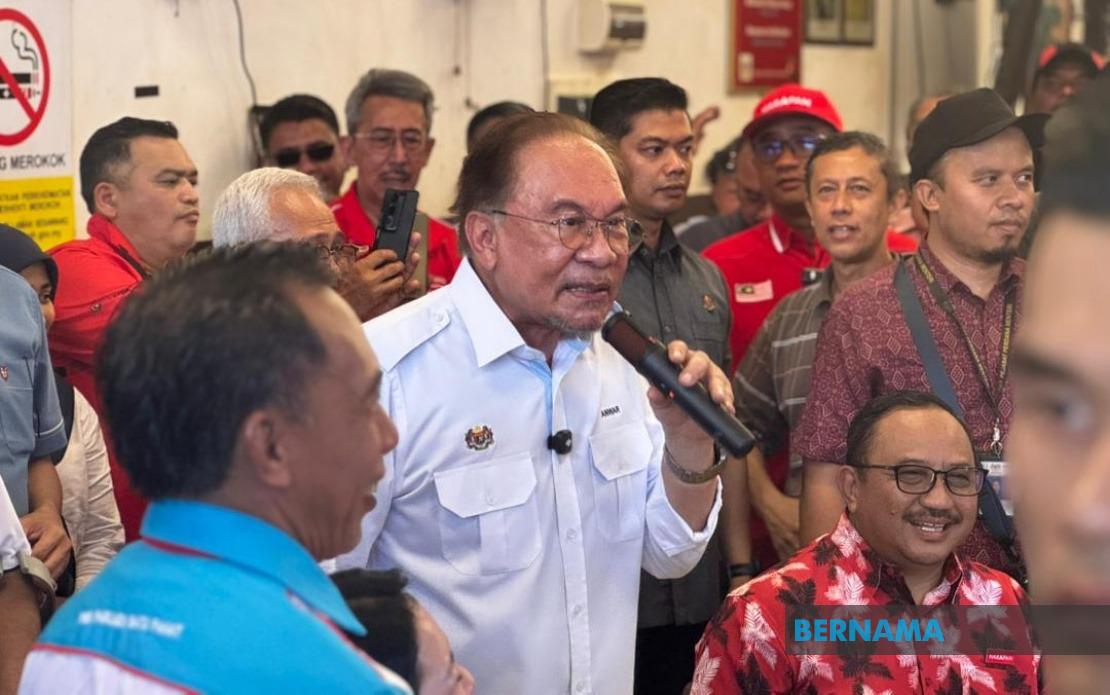
Prime Minister Datuk Seri Anwar Ibrahim has unveiled plans for a comprehensive overhaul of border crossing procedures between Malaysia and Singapore, with a new digital immigration system and expanded lane infrastructure targeted for launch in January 2025. Speaking at the Temu Anwar Johor Ke Depan programme in Muar, Anwar outlined the bilateral initiative that aims to tackle the chronic congestion plaguing one of Southeast Asia's busiest international checkpoints. The project represents a significant step forward in addressing mobility challenges that have long frustrated the hundreds of thousands of commuters and travellers who cross the Causeway daily.
The planned digital immigration system will constitute a major technological upgrade designed to expedite movement across the border. Anwar indicated that the Home Ministry's Immigration Department has been coordinating closely with counterparts in Singapore to ensure the seamless deployment of this modernised framework. The system's development has required extensive technical preparation and infrastructure investment on both sides of the causeway, reflecting the complexity of harmonising immigration procedures between two sovereign nations with distinct administrative systems. Once operational, the technology is expected to enable faster processing of travellers while maintaining robust security and immigration compliance standards that both nations consider essential.
Anwar emphasised that the initiative would be formally inaugurated jointly with Singapore Prime Minister Lawrence Wong, underscoring the collaborative nature of the endeavour. The target timeline of January represents an ambitious yet realistic goal, contingent on completion of final technical specifications and physical infrastructure enhancements. The dual-nation launch ceremony would symbolise the commitment both governments have made to facilitating cross-border movement, a critical aspect of regional economic integration in the Malaysia-Singapore relationship.
Notably, Anwar stressed that this project should not be characterised as a new political manifesto or election-period pledge. His clarification reflects the government's awareness of electoral regulations that restrict announcements of new commitments during campaign periods. By framing this as a continuation of existing government initiatives rather than a novel policy proposal, Anwar sought to position the border improvements as an extension of ongoing administrative efforts rather than a campaign promise.
Beyond the digital system itself, the expansion of physical crossing infrastructure is equally significant. The planned additional lanes represent a tangible increase in border crossing capacity, addressing one of the most visible manifestations of congestion problems. During peak hours, particularly during weekday rush periods when Malaysian workers commute to Singapore, both vehicle and pedestrian crossings experience substantial delays. The extra lanes should help absorb demand surges and improve overall throughput at the checkpoints, providing immediate relief to frustrated travellers even before the digital system delivers its efficiency gains.
The Prime Minister highlighted that the Immigration Department is simultaneously pursuing faster clearance mechanisms through enhanced operational efficiency. These intermediate improvements do not depend on the new digital infrastructure and can be implemented immediately through optimised staffing, revised processing protocols, and better resource allocation. Anwar noted that border efficiency has demonstrably improved compared to conditions three years prior, suggesting that incremental enhancements have already yielded measurable benefits. However, the government recognises that further substantial improvements require the comprehensive digital overhaul now being prepared.
An important component of the new travel arrangements will specifically accommodate the Johor Bahru to Singapore corridor, acknowledging the particular importance of this primary crossing route. The digital system will be tailored to the specific needs and volumes of travellers utilising this route, which bears the heaviest traffic burden. By customising the system to this high-volume crossing, planners can optimise functionality for real-world conditions rather than applying generic solutions unsuitable for the scale of movement between these two states.
Beyond border infrastructure, Anwar articulated a broader strategic vision addressing the structural factors driving cross-border commuting. He acknowledged that Malaysian workers travelling to Singapore often endure multiple-hour queues, an arrangement he characterised as unsustainable and demeaning. To reduce this reliance on Singaporean employment, the government intends to strengthen Malaysia's high-technology sector, creating quality employment opportunities domestically. This approach reflects understanding that border efficiency improvements alone cannot address the underlying economic imbalances driving cross-border commuting.
Anwar highlighted artificial intelligence, data centre development, and emerging technologies as focal areas for creating high-income employment within Malaysia. By fostering these sectors, the government hopes to offer Malaysians—particularly those currently commuting to Singapore—the prospect of comparable wages without the costs and inconvenience of daily cross-border travel. This strategy recognises that technological development and labour market transformation must accompany infrastructure improvements if the region is to achieve sustainable mobility patterns. The vision extends beyond mere convenience to address fundamental economic disparities between Malaysia and Singapore that motivate commuting patterns.
Complementing workforce development initiatives, Anwar identified affordable housing as essential infrastructure for retaining talent and enabling homeownership among Johor Bahru's younger residents. The Rumah MADANI programme represents the government's commitment to controlling property costs amid rapid development pressures. As Johor Bahru experiences accelerated growth and urbanisation, housing affordability becomes increasingly critical to ensuring that local workers can establish roots and build permanent lives in their home state, rather than being drawn toward Singapore's higher wages. This integrated approach—combining border efficiency, technological employment creation, and affordable housing—reflects comprehensively addressing the multiple dimensions of cross-border mobility challenges.
The January 2025 timeline positions these improvements as near-term deliverables, likely influencing public perception of government competence and responsiveness to transportation frustrations. However, successful execution requires sustained coordination between Malaysian and Singaporean authorities, with both nations demonstrating genuine commitment to overcoming technical, procedural, and bureaucratic obstacles. The joint launch ceremony symbolises this commitment, though the real test will be whether the implemented system delivers the promised efficiency improvements once operational under real-world conditions with genuine traveller volumes. For Malaysian commuters, construction workers, and business travellers, these announcements offer prospect of reduced border crossing times, though delivering on these expectations remains contingent on flawless implementation.

