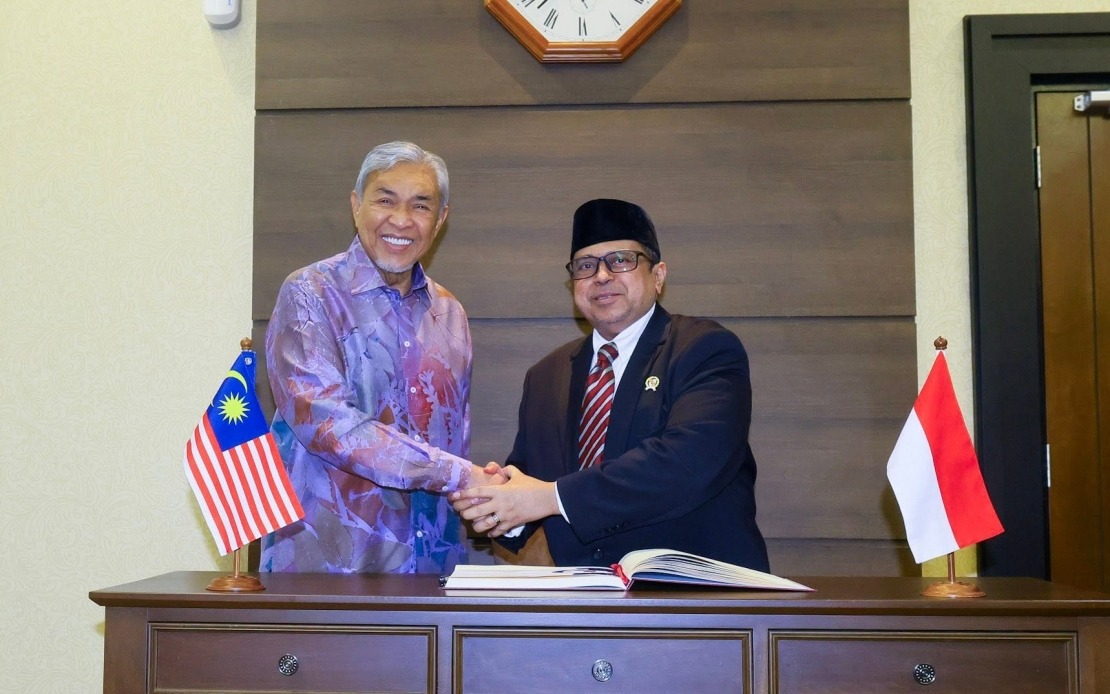
Malaysia and Indonesia are preparing to significantly expand their collaborative efforts across the halal sector, marking a strategic pivot toward deeper integration in one of the region's most dynamic industries. The commitment emerged during discussions between Deputy Prime Minister Datuk Seri Dr Ahmad Zahid Hamidi and Indonesian officials at Parliament in Kuala Lumpur, signalling renewed momentum in bilateral ties that extend far beyond trade mechanics into the creation of sophisticated institutional frameworks.
The meeting brought together Indonesia's Ambassador to Malaysia, Raden Datuk Mohammad Iman Hascarya Kusumo, and Dr Ahmad Haikal Hassan, who heads Indonesia's Halal Product Assurance Organising Body (BPJPH). Their visit to Malaysia reflected Jakarta's recognition that cooperative halal standards development requires sustained engagement with Kuala Lumpur, which has positioned itself as a global hub for halal certification and industry leadership. Ahmad Zahid, operating in his dual capacity as Deputy Prime Minister and chairman of the Malaysia Halal Industry Development Council, emphasised that the discussions encompassed not merely trade flows but the architecture needed to support a thriving halal ecosystem.
Central to the bilateral agenda is the proposed establishment of the Malaysia-Indonesia Halal Council (MIHC), a specialised body designed to serve as a conduit for policy harmonisation and joint standard-setting between the region's two largest Muslim-majority economies. This council would function as both a diplomatic instrument and a technical forum, enabling officials and industry practitioners from both nations to align regulatory approaches and eliminate unnecessary friction in cross-border halal product movements. For Malaysian businesses, this represents an opportunity to access Indonesia's vast consumer market of over 270 million people under streamlined certification frameworks, potentially unlocking billions in additional export revenue.
Beyond the bilateral dimension, Malaysian and Indonesian officials are contemplating participation in broader regional architecture through the proposed ASEAN Halal Council. Such a body would extend cooperative frameworks across Southeast Asia, creating unified pathways for halal product certification and trade that could position the entire region as a credible alternative to existing global halal standards bodies. This move acknowledges a reality that has become increasingly apparent: as global halal markets expand, driven by rising Muslim populations in non-Muslim-majority countries and increasing consumer demand for ethically sourced and religiously compliant products, the fragmentation of standards across different nations and certifying bodies becomes a competitive disadvantage.
The third institutional initiative under discussion—the World Halal Development Council—signals ambitions that extend beyond regional boundaries into the global arena. By establishing such a body with Indonesian partnership, Malaysia seeks to influence and potentially reshape international conversations about halal standards, positioning Southeast Asia as a thought leader rather than a market follower. This has particular resonance given that global halal markets are estimated to exceed $2 trillion annually, with the projection that this figure will continue expanding as Muslim purchasing power increases worldwide.
The practical implications of these cooperative initiatives are substantial for Malaysian enterprises operating in food manufacturing, pharmaceuticals, cosmetics, and logistics. Currently, companies seeking to export halal products to Indonesia often navigate separate certification requirements, documentation processes, and compliance verification systems. Harmonisation through the proposed councils would reduce transaction costs, accelerate time-to-market, and create clarity around regulatory expectations. For small and medium-sized Malaysian halal producers, these efficiency gains could prove transformative, potentially lowering barriers to Indonesian market entry that currently privilege larger corporations with dedicated compliance teams.
Indonesia's participation reflects Jakarta's own strategic interests in halal industry development. The establishment of the BPJPH demonstrates Indonesia's commitment to professionalising halal assurance, moving beyond informal or ad-hoc certification toward systematic, internationally credible frameworks. Through closer Malaysia cooperation, Indonesia gains access to Malaysia's established halal ecosystem, technical expertise, and international recognition in this space. Conversely, Malaysia benefits from Indonesia's market access and demographic heft, creating a mutually reinforcing partnership where both nations strengthen their respective halal industries while simultaneously enhancing their global standing.
The broader context for these discussions involves the increasing sophistication of global halal markets and rising consumer expectations around transparency and traceability. Major multinational corporations and consumer goods manufacturers now recognise halal compliance as a commercial imperative rather than a niche consideration. This shift has elevated halal standards from religious observance markers into matters of genuine competitive differentiation. Malaysian and Indonesian cooperation on unified standards could create compelling advantages, as harmonised frameworks would allow regional manufacturers to achieve scalable compliance across multiple markets simultaneously.
Ahmad Zahid's emphasis on the role of Malaysia-Indonesia ties as a catalyst for broader development underscores the diplomatic calculus underlying these initiatives. The two nations share historical ties, geographic proximity, and overlapping commercial interests that create natural synergies for cooperation. Yet translating such potential into concrete institutional arrangements requires sustained political commitment and technical coordination. The willingness of both governments to discuss formal council structures suggests this commitment exists at high levels, though implementation will require patient negotiation of specific governance arrangements, funding mechanisms, and decision-making protocols.
For Malaysian policymakers, the halal sector represents a unique opportunity to leverage the country's religious authority and technical capacity into sustained economic advantage. Malaysia's strong brand recognition in global halal markets, reflected in the international prestige of the Malaysian Halal Assurance System (SHAS), provides a foundation upon which deeper Southeast Asian cooperation can build. By working closely with Indonesia—the world's largest Muslim-majority nation—Malaysia can amplify its influence while creating market opportunities for its own producers and service providers.
The implications extend into agricultural policy and rural development as well, dimensions that Ahmad Zahid specifically highlighted during the discussions. Halal supply chains depend fundamentally on agricultural practices, animal husbandry, and primary commodity sourcing that meet exacting standards. Malaysia and Indonesia both possess significant agricultural sectors, and cooperation in harmonising production standards could unlock efficiencies across the entire value chain. Rural communities in both nations stand to benefit if coordinated development initiatives create new market opportunities and higher-value economic activities around halal-certified production.
Moving forward, the success of these cooperative frameworks will depend on translating high-level political commitments into operational reality. Establishing the MIHC, ASEAN Halal Council, and World Halal Development Council requires detailed technical work around governance structures, funding arrangements, dispute resolution mechanisms, and enforcement protocols. Malaysian and Indonesian officials will need to navigate potential jurisdictional overlaps and ensure these bodies complement rather than duplicate existing regional structures and international standards organisations. The timeline for implementing these institutions remains unspecified, but the evident enthusiasm from both governments suggests that concrete progress could materialise within the next 12 to 18 months, particularly if preliminary working groups commence technical discussions soon after formal announcements.

