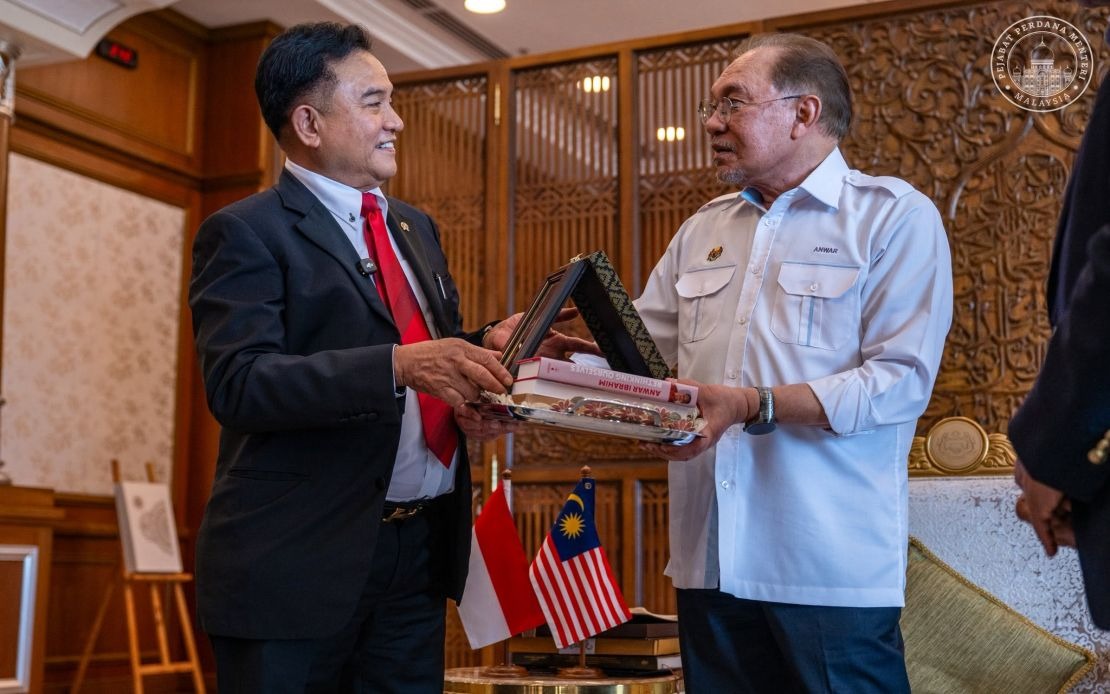
Prime Minister Datuk Seri Anwar Ibrahim has underscored Malaysia and Indonesia's shared determination to deepen cooperation across legislative frameworks, administrative systems, and key areas of mutual strategic concern. The commitment emerged from a meeting at the Prime Minister's Office in Putrajaya between Anwar and Indonesia's Coordinating Minister for Legal, Human Rights, Immigration and Correction, Prof Dr Yusril Ihza Mahendra, who visited as a courtesy call on June 29.
The bilateral engagement reflects the ongoing significance of institutional linkages between Southeast Asia's two largest Muslim-majority economies. Both nations have long recognised that strengthened governance frameworks and aligned legislative approaches can facilitate smoother cross-border cooperation, from trade facilitation to regulatory harmonisation. The discussion centred on practical mechanisms through which Malaysia and Indonesia might align their institutional development trajectories, ensuring that policy initiatives in one country complement rather than complicate business and official interactions in the other.
Anwar, who concurrently holds the Finance Minister portfolio, noted that the two leaders exchanged substantive views on advancing bilateral cooperation in the identified areas. Such ministerial-level exchanges are standard practice within ASEAN, yet they carry particular weight when they involve foundational governance matters. Indonesia's coordinating minister role places Mahendra at the intersection of legal affairs, human rights implementation, immigration policy, and correctional services—domains where bilateral coordination can yield tangible benefits for citizens and institutions alike.
The framing of these discussions as matters of mutual interest underscores a pragmatic approach to regional partnership. Rather than viewing governance cooperation as zero-sum competition, both governments appear focused on identifying complementarities that strengthen institutional capacity across both nations. This is especially relevant in areas such as cross-border law enforcement coordination, harmonisation of immigration procedures for nationals of both countries, and exchange of best practices in judicial administration.
For Malaysia, deepening ties with Indonesia on legislative and governance matters carries significant implications. Indonesia's larger population, more complex administrative structure, and regional influence mean that aligned approaches to emerging challenges—whether related to digital governance, financial crime prevention, or human rights frameworks—can amplify the effectiveness of interventions in both nations. Conversely, Indonesia benefits from Malaysia's more developed institutional infrastructure in certain regulatory domains and from alignment with a trading partner of considerable importance.
The emphasis on strategic areas of mutual interest suggests that the two governments are not limiting their engagement to formal legislative harmonisation but are also exploring coordination on broader policy questions. This could encompass responses to transnational challenges such as people trafficking, money laundering, and cybercrime—issues where legislative coordination and institutional cooperation become prerequisites for effective enforcement.
Within the ASEAN context, Malaysia-Indonesia bilateral strengthening on governance matters carries ripple effects. As two major regional economies, their institutional practices often serve as models or cautionary examples for smaller member states. When Malaysia and Indonesia synchronise their approaches to legislative matters or governance standards, they effectively set reference points for the broader regional bloc. This is particularly salient as ASEAN navigates questions around digital governance, data protection, and cross-border regulatory frameworks.
The courtesy call format, while seemingly ceremonial, serves an important function in Southeast Asian diplomacy. It provides space for frank discussion of sensitive matters and allows senior officials to establish personal rapport that facilitates subsequent institutional engagement. Mahendra's visit to Putrajaya signals Indonesia's continued investment in bilateral relationships with key ASEAN neighbours, particularly Malaysia, despite the two nations occasionally experiencing tensions over maritime boundaries and resource management.
Anwar's public affirmation of the "close fraternal relations" between the two countries carries meaning beyond diplomatic courtesy. Malaysia-Indonesia relations operate within a unique framework shaped by linguistic, religious, and cultural commonalities that distinguish the bilateral dynamic from Malaysia's ties with other ASEAN members. Simultaneously, both nations maintain distinct political systems, institutional histories, and policy priorities. The articulation of fraternal bonds alongside commitment to cooperation acknowledges these shared foundations while committing to pragmatic institutional engagement.
Moving forward, the substance of this cooperation will depend on follow-up mechanisms and institutional handoffs to lower-level working groups and technical committees. Statements of intent from senior leaders are necessary but insufficient without dedicated bureaucratic attention to implementation. Whether Malaysia and Indonesia establish joint task forces, memoranda of understanding on specific legislative initiatives, or formal exchanges of officials will determine whether this commitment translates into tangible outcomes for citizens and institutions.
The timing of this engagement, mid-2024, occurs within a broader regional context of institutional renewal and strategic repositioning. Both Malaysia and Indonesia are simultaneously managing complex internal governance agendas while positioning themselves within shifting regional and global power dynamics. Bilateral cooperation on governance and legislation can serve as a stabilising force, grounding the relationship in institutional cooperation even as political winds shift elsewhere.

