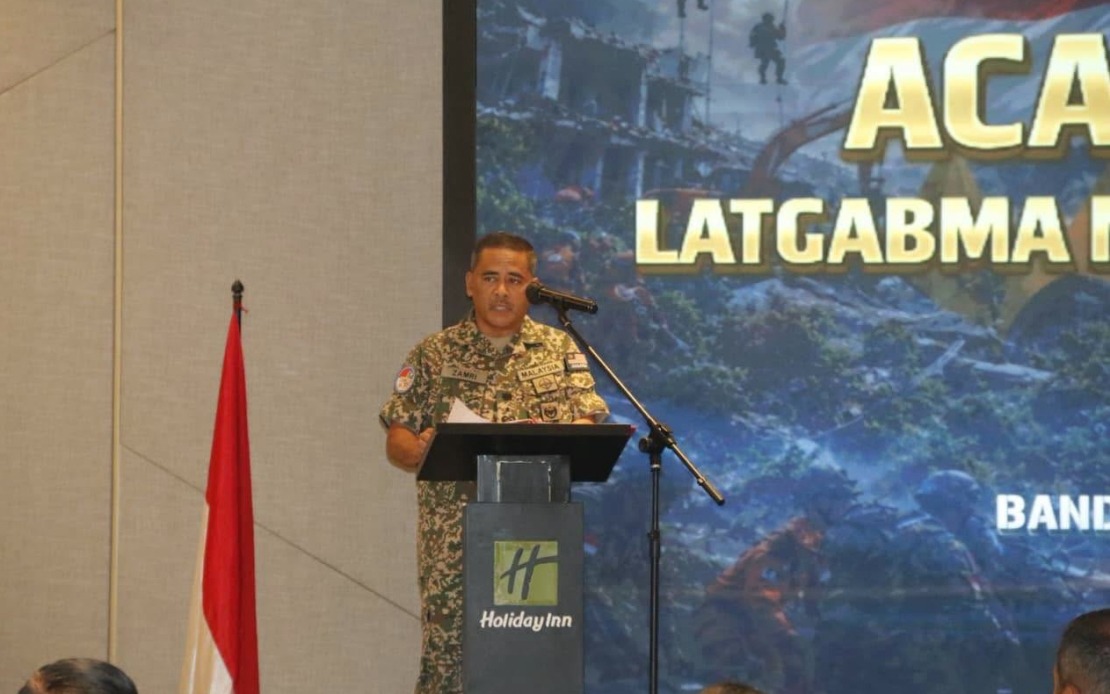
Malaysia and Indonesia have embarked on a significant show of military solidarity through a major joint exercise taking place in Lampung, Sumatra. The 13-day LATGABMA MALINDO DARSASA 12AB/2026 operation brings together 719 defence personnel from both nations, marking a deliberate effort to strengthen bilateral defence relationships at a time when security pressures across Southeast Asia are mounting. The exercise, being conducted at Al-Sultan Abdullah Camp's Joint Forces Headquarters direction, represents more than routine training; it signals deepening strategic trust between two of the region's largest military powers.
The decision to conduct this exercise in Lampung is particularly strategic given the province's geographic vulnerability. Positioned at the junction of three active tectonic plate zones, the region sits at the epicentre of Indonesia's natural disaster risk landscape. This vulnerability, while presenting genuine humanitarian challenges to Indonesian citizens, provides an exceptionally relevant training ground for the combined forces. By selecting a location facing realistic threats rather than abstract scenarios, both nations demonstrate commitment to preparing for emergencies that could actually occur within their territories.
Brig Gen Datuk Zamri Othman, commanding the 1st Infantry Brigade and leading MAF's exercise planning efforts, characterised the operation as far more than a routine activity. He emphasised that the exercise provides participating personnel an opportunity to test coordinated operational concepts spanning land, maritime and air domains simultaneously. Beyond technical proficiency, the gathering allows Malaysian and Indonesian military personnel to develop mutual understanding of how each nation's forces operate, establishing personal relationships and institutional familiarity that prove invaluable during genuine emergencies.
The contemporary security environment facing both nations has become substantially more intricate in recent years. Traditional interstate military concerns have been overshadowed by non-traditional threats including organised maritime crime, cross-border smuggling networks, terrorism financing and operations, increasingly sophisticated cyber attacks targeting government infrastructure, and the ever-present danger of natural disasters. These challenges typically transcend national borders and demand coordinated multilateral responses. Neither Malaysia nor Indonesia can effectively address maritime piracy, terrorist financing, or cyber threats operating independently; joint planning and integrated response mechanisms are essential.
This particular exercise carries special significance as it emphasises humanitarian assistance and disaster relief alongside military training. The HADR component reflects recognition that armed forces serve critical civilian protection roles, particularly in archipelagic nations where geographical dispersion complicates emergency response. The exercise also incorporates Search and Rescue operations and dedicated cyber security training, acknowledging that contemporary threats span physical and digital domains.
The triennial LATGABMA MALINDO DARSASA tradition stretches back four decades to 1984, operating under the Malaysia-Indonesia General Border Committee and their Joint Training Committee framework. This institutional continuity provides valuable structure; both nations have developed established protocols for such cooperation, reducing friction and enabling focus on genuine training objectives. The previous edition in 2023, held in Pekan, Pahah, concentrated on counterterrorism scenarios, demonstrating how exercise themes rotate to address evolving security priorities.
The academic component, organised as a Staff Exercise, walks officers through ten distinct operational scenarios reflecting plausible disaster situations. These range from Initial Disaster Response through various phases including Mass Casualty Incident management, Infrastructure Collapse recovery, Medical Emergency protocols, International Assistance coordination, Cyber Attack response, Information Warfare counteraction, Mass Evacuation procedures, Stabilisation operations and final Transition phases. This comprehensive scenario architecture ensures participants develop holistic understanding of how humanitarian disasters unfold across time, rather than viewing crisis management as isolated moments.
The Field Training Exercise phase integrates Malaysian military personnel with TNI counterparts and Indonesian civilian agencies including the National Search and Rescue Agency (BASARNAS), Disaster Preparedness Cadets (TAGANA), Indonesian Red Cross (PMI) and Regional Disaster Management Agency (BPBD). This interagency participation reflects modern disaster response reality; successful humanitarian operations require seamless coordination between military and civilian actors. Joint training during peacetime establishes relationships and shared procedures that facilitate actual cooperation when disasters strike.
Practical skills training encompasses rope techniques, rappelling operations, emergency response protocols and field hospital establishment within designated HADR and SAR segments. Simultaneously, the Exercise Civil Action Programme involves concrete repairs to two uninhabitable houses in Kampung Sukamaju and construction of a concrete road in Kampung Keteguhan. This community engagement dimension demonstrates how military training can simultaneously deliver tangible civilian benefits, strengthening local support for defence cooperation while providing realistic construction and repair skill development for participating personnel.
The Medical Civic Action Programme component, operating through Community Health Centre facilities, offers general health screenings, eyeglass provision and blood donation services to local populations. These activities transcend typical military training by addressing genuine healthcare needs in rural Indonesian communities, generating goodwill that extends beyond government-to-government relations into community awareness of defence cooperation benefits.
Cyber security training occupies an increasingly prominent role in this exercise, reflecting how modern threats have migrated into digital domains. The Cyber Exercise segment covers technical reconnaissance, systems enumeration, credential compromise techniques, man-in-the-middle attacks, spoofing methodologies and feed manipulation tactics. This training equips both militaries' cyber personnel with hands-on experience defending critical infrastructure against contemporary attack patterns.
The force composition reflects balanced participation. The 463 TNI personnel substantially outnumber the 150 Malaysian Armed Forces participants, reflecting that the exercise occurs on Indonesian territory and addresses Indonesia's specific geographic vulnerabilities. Additionally participating are representatives from Malaysia's National Disaster Management Agency, 25 Indonesian National Police personnel, and 79 participants from various Indonesian agencies. This diverse composition underscores that contemporary security challenges demand whole-of-society responses transcending traditional military boundaries.
For Malaysian observers and policymakers, this exercise demonstrates concrete manifestation of strategic partnership with Southeast Asia's largest nation. Regular defence cooperation with Indonesia addresses shared maritime security concerns, counterterrorism capabilities and humanitarian response readiness. As regional tensions fluctuate and non-traditional security threats proliferate, institutionalised cooperation frameworks like LATGABMA MALINDO DARSASA provide essential mechanisms for building mutual capability and understanding. The exercise's success will inevitably influence bilateral defence planning and potentially inspire similar cooperative initiatives throughout the region.