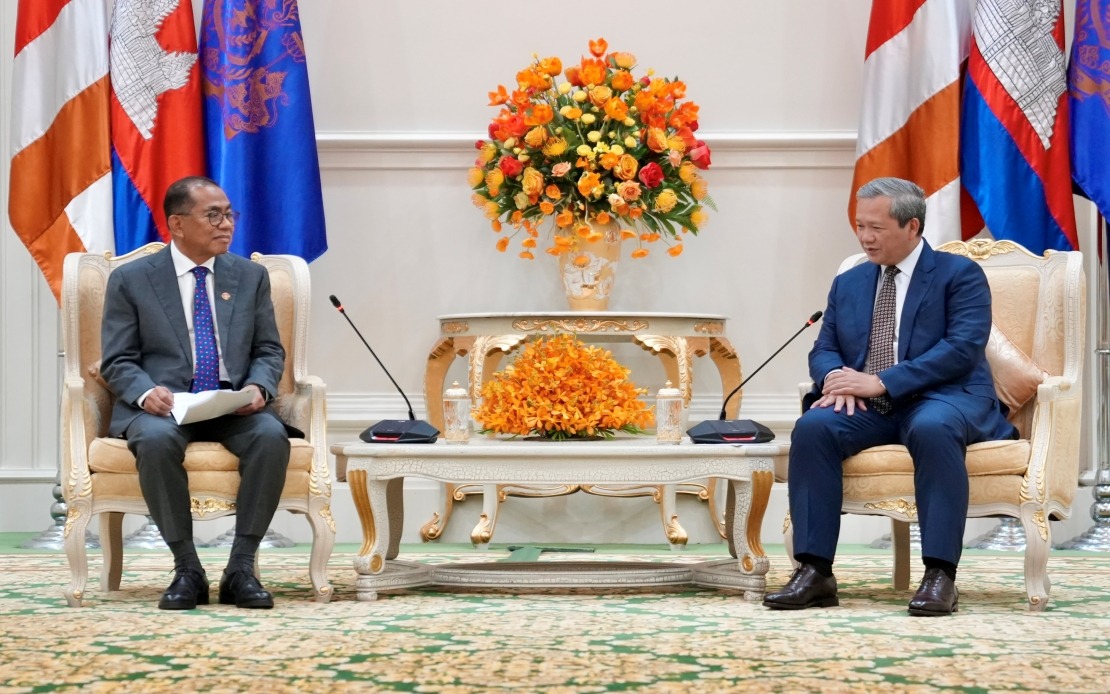
Malaysia and Cambodia are deepening their strategic defence relationship through a comprehensive framework designed to address evolving regional security challenges. During his recent visit to Phnom Penh, Defence Minister Datuk Seri Mohamed Khaled Nordin held substantive discussions with Cambodian Prime Minister Samdech Thipadei Hun Manet and Defence Deputy Prime Minister General Tea Seiha, signalling both nations' commitment to expanding their military cooperation beyond traditional bilateral channels.
The centrepiece of these discussions centres on finalising the Malaysia-Cambodia Defence Cooperation Memorandum of Understanding, which officials have positioned as instrumental in providing a lasting institutional framework for defence engagement. This MoU represents more than symbolic cooperation—it will establish formal mechanisms for sustained military-to-military relations and provide clarity on how both nations coordinate on shared security interests. The agreement's completion reflects a strategic priority for both governments, with Mohamed Khaled expressing confidence that the document could be signed during the upcoming ASEAN Defence Ministers' Meeting in the Philippines.
Beyond traditional defence matters, the two countries have identified emerging technological domains as crucial areas for collaboration. Malaysia and Cambodia have committed to developing joint capacity in jungle warfare training, defence industry partnerships, artificial intelligence applications, and drone technology development. This pivot towards modernised defence cooperation acknowledges that regional security threats now extend beyond conventional military concerns to encompass cyber capabilities, autonomous systems, and intelligence applications. For Malaysia, such initiatives represent an opportunity to develop indigenous defence technology capabilities while strengthening ties with regional partners.
The discussions also underscored both nations' emphasis on ASEAN centrality in addressing regional disputes and security challenges. Mohamed Khaled highlighted the importance of dialogue, negotiation, and regional mechanisms in tackling security issues, specifically referencing ongoing efforts to stabilise the Cambodia-Thailand border region. Malaysia's continued support for the ASEAN Observer Team mechanism demonstrates how the country positions itself as a stabilising force even as its formal chairmanship of the association concludes. This measured diplomatic approach contrasts with more assertive postures some regional actors might adopt when pursuing strategic interests.
The South China Sea's Code of Conduct emerged as another priority area during the bilateral talks. Both Malaysia and Cambodia emphasised the necessity of finalising the COC as essential to preserving peace, stability, and adherence to rules-based maritime order in the region. Given competing claims and increasing military activities in the disputed waters, progress on this agreement carries implications extending far beyond these two nations. For Malaysia, which maintains its own claims while seeking to manage tensions, Cambodia's alignment on prioritising COC completion strengthens collective ASEAN negotiating positions with Beijing.
Mohamed Khaled's visits to both Vietnam and Cambodia represent a deliberate diplomatic strategy aligned with Malaysia's Third Pillar of the National Defence Strategy, centred on establishing credible partnerships across Southeast Asia. These sequential engagements—beginning with Vietnam on August 5 and 6, followed by Cambodia—demonstrate how Malaysia is systematically cultivating defence relationships with key ASEAN partners. The participation of Chief of the Royal Malaysian Navy Admiral Tan Sri Zulhelmy Ithnain and Defence Ministry officials underscores the high-level commitment these visits carry, signalling that defence cooperation extends across multiple service branches and institutional levels.
The timing of these diplomatic initiatives proves significant given the broader regional security context. With great power competition intensifying across Asia, ASEAN nations increasingly rely on deepening intra-regional cooperation to maintain autonomy and influence. Malaysia's Defence White Paper framework explicitly addresses how the country will navigate these strategic complexities through partnerships that reinforce ASEAN cohesion while maintaining flexibility in bilateral relations. By strengthening defence ties with Cambodia, Malaysia contributes to a network of relationships that collectively enhance regional resilience against external pressures.
Cambodia's reciprocal enthusiasm for these initiatives reflects its own strategic calculations. The kingdom faces particular vulnerabilities given its geographic position, border complexities, and reliance on multilateral frameworks for security assurances. By formalising defence cooperation with Malaysia, Cambodia gains access to Malaysian defence expertise, technology partnerships, and diplomatic support within ASEAN forums. The relationship also offers Cambodia a counterbalance in regional power dynamics, particularly given historical great power interests in Southeast Asia.
Looking ahead, Mohamed Khaled expressed optimism that strengthened Malaysia-Cambodia cooperation will yield concrete benefits before the two nations commemorate 70 years of diplomatic relations in 2027. This forward-looking perspective suggests that current initiatives represent not isolated gestures but foundational steps in longer-term strategic partnerships. The Defence Cooperation MoU, once formalised, will likely serve as a template for expanded engagement across defence industry, training exchanges, and operational coordination.
For Malaysian policymakers, these defence diplomacy efforts demonstrate how the country maintains regional influence and strategic relevance despite yielding its ASEAN chairmanship. Defence Minister Mohamed Khaled's assertion that Malaysia's commitment to regional peace and stability remains unchanged regardless of formal leadership positions reflects an understanding that strategic relationships transcend rotating institutional roles. Through sustained engagement with ASEAN partners on security matters, Malaysia continues shaping the regional security architecture according to preferences that prioritise dialogue, multilateralism, and rules-based order.
The broader implications of Malaysia-Cambodia defence cooperation extend to how ASEAN collectively addresses transnational security challenges. From maritime security and counterterrorism to emerging technological threats, regional cooperation built on bilateral foundations creates interconnected security networks. When Malaysia and Cambodia advance jungle warfare training partnerships or collaborate on defence industry initiatives, they contribute to a pattern of deepening institutional cooperation that characterises modern ASEAN security architecture.

