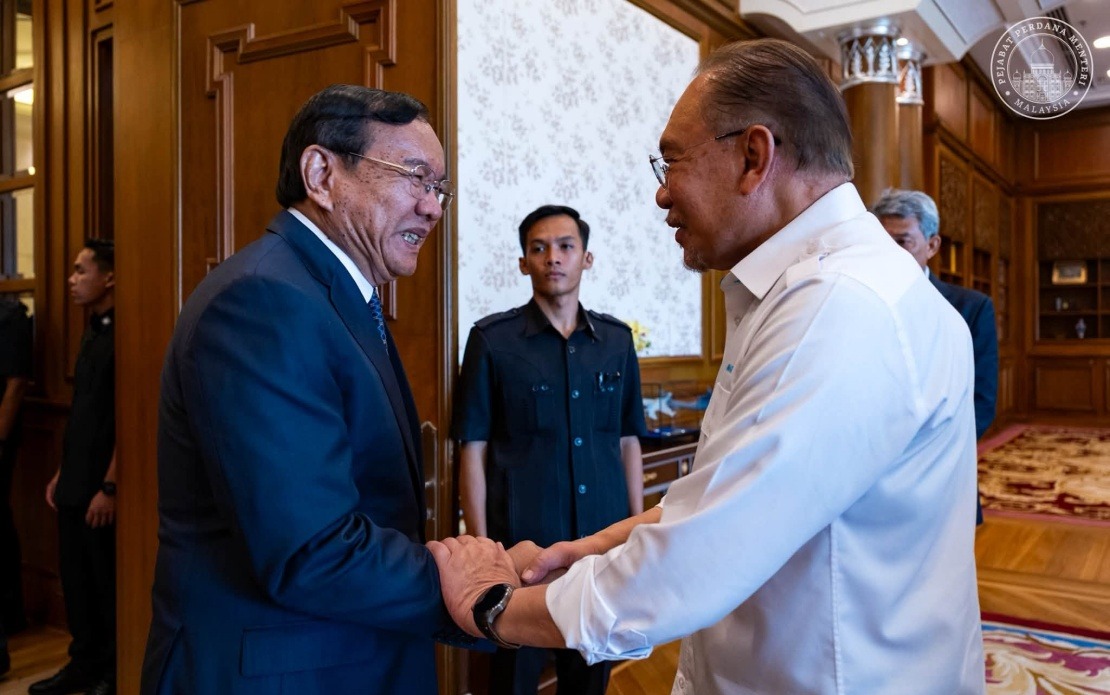
Prime Minister Datuk Seri Anwar Ibrahim has underscored the expanding scope of Malaysia-Cambodia relations, revealing that both nations are pursuing comprehensive collaboration spanning emerging technologies, traditional industries and shared security challenges. The commitment was reaffirmed during an official courtesy call by Cambodian Deputy Prime Minister and Minister of Foreign Affairs and International Cooperation Prak Sokhonn, who arrived in Malaysia to kick off a two-day engagement that signals the deepening bilateral ties between the two Southeast Asian neighbours.
The announcement comes at a particularly strategic moment, as it precedes the Third Malaysia-Cambodia Joint Commission for Bilateral Cooperation (JCBC) meeting scheduled for August 4. This institutional framework has historically served as the primary mechanism through which both governments coordinate policy, resolve bilateral matters and identify fresh avenues for mutual advancement. The timing of Prak Sokhonn's visit demonstrates both countries' intent to approach these discussions with substantive momentum and high-level political commitment.
Digital transformation and artificial intelligence feature prominently in the expanded cooperation agenda, reflecting regional priorities that extend well beyond Malaysia and Cambodia. The focus on these technology sectors aligns with broader Southeast Asian efforts to harness digital innovation for economic competitiveness and to position the region as more than a consumer of advanced technologies. For Malaysia, which has positioned itself as a regional technology hub and digital economy leader, collaboration with Cambodia offers opportunities to share expertise and build interconnected digital infrastructure across the Mekong and Malay Peninsula regions.
The halal industry component of the partnership deserves particular attention given Malaysia's established position as a global halal authority and certification hub. Cambodia, with its Muslim minority population and growing commercial interests, stands to benefit from Malaysian expertise in halal standards, supply chain management and market access to the Organisation of Islamic Cooperation (OIC) bloc. This cooperation could create tangible economic benefits for both nations while reinforcing Malaysia's role as a trusted standard-setter in the Islamic economy.
Food security emerged as a shared priority in the bilateral discussions, a concern that has gained urgency across Southeast Asia following global supply chain disruptions and climate-related agricultural challenges. By coordinating food production, storage and distribution strategies, Malaysia and Cambodia can build more resilient food systems that benefit their respective populations and contribute to regional stability. Cambodia's agricultural potential, combined with Malaysia's advanced agricultural technology and processing capabilities, creates opportunities for deepened trade and technical cooperation.
Human capital development constitutes another significant pillar of the partnership framework. Educational exchanges, vocational training programmes and skills development initiatives can enhance the capacity of both nations' workforces and promote people-to-people connections that strengthen broader diplomatic ties. Malaysia's developed higher education sector and technical training infrastructure position it well to collaborate with Cambodia on capacity building that produces tangible development outcomes.
Cross-border crime prevention represents a critical security dimension that often receives less public attention than economic cooperation but proves equally vital for regional stability. Both nations share land and maritime borders where trafficking of drugs, weapons and persons remains an ongoing challenge. Strengthened law enforcement cooperation, intelligence sharing and coordinated border management can yield significant security dividends that protect citizens on both sides of the frontier.
The reference to the approaching 70th anniversary of diplomatic relations in 2027 places current cooperation efforts within a longer historical narrative. Malaysia and Cambodia's diplomatic journey has encompassed periods of significant challenges and considerable opportunities, with the current trajectory representing a mature relationship built on shared regional interests and mutual respect. Using this milestone anniversary as a focal point allows both governments to consolidate gains and establish ambitious targets for the next phase of their partnership.
As fellow ASEAN member states, Malaysia and Cambodia shoulder collective responsibility for advancing regional cohesion and realising the ASEAN Community Vision 2045 agenda. This framework envisions a rules-based community characterised by economic integration, political-security cooperation and socio-cultural exchange. Bilateral initiatives between Malaysia and Cambodia gain additional significance when understood as building blocks for broader ASEAN objectives, with successful partnerships serving as models that other member states can reference and emulate.
The comprehensive nature of the announced cooperation agenda reflects evolving bilateral ties that move beyond traditional diplomatic courtesy into substantive engagement across multiple domains. Rather than focusing narrowly on singular sectors, the two governments are recognising that modern strategic partnerships require integrated approaches that address economic opportunity, technological advancement, security challenges and human development simultaneously. This multi-track approach increases the resilience of the relationship by creating multiple channels through which governments, businesses and citizens can interact and benefit from deeper integration.

