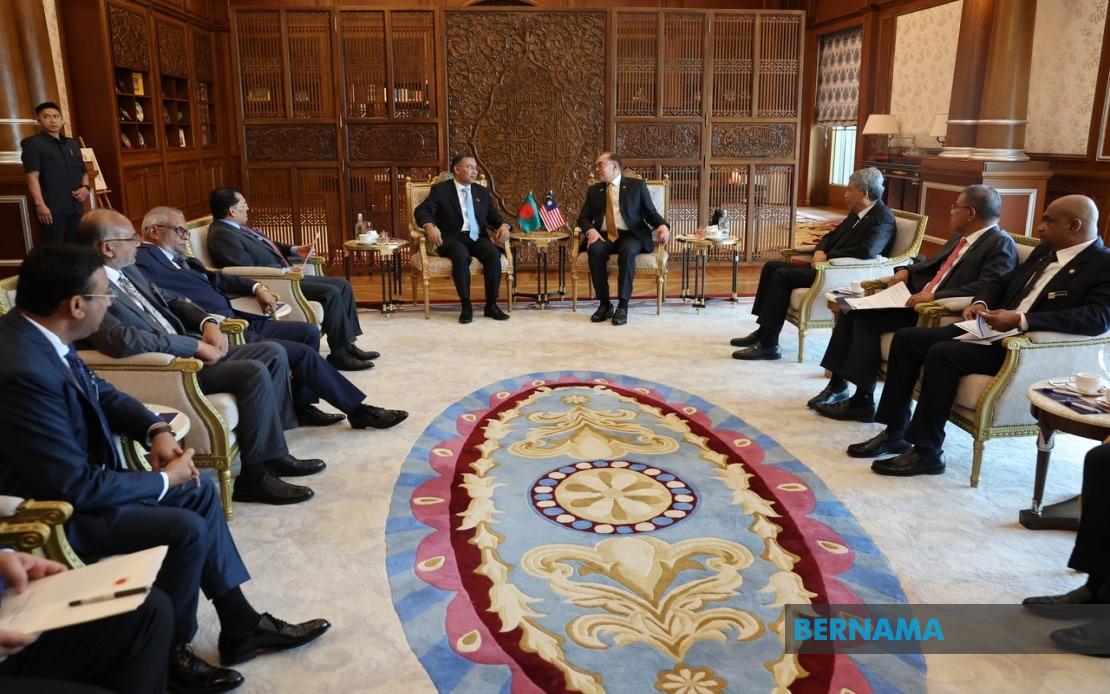
Prime Minister Datuk Seri Anwar Ibrahim has pledged that Malaysia and Bangladesh will intensify their collaborative efforts to find a durable resolution to the Rohingya crisis, utilising ASEAN's institutional capacity and diplomatic channels. During a joint press conference in Putrajaya on June 22, Anwar underscored that both nations remain resolute in their commitment to ameliorating the circumstances of Rohingya populations dispersed across Bangladesh and Malaysia, signalling a unified front on one of Southeast Asia's most intractable humanitarian challenges.
The bilateral commitment reflects deepening recognition that the refugee impasse cannot be addressed through unilateral action alone. Anwar elaborated that Malaysia and Bangladesh would operationalise this partnership by channelling engagement through their respective foreign ministers and leveraging ASEAN's diplomatic mechanisms to communicate with Myanmar's authorities. This approach acknowledges that Myanmar, as the country of origin and a fellow ASEAN member, holds critical levers for any meaningful repatriation framework. By working within regional architecture rather than circumventing it, both nations aim to maintain pressure on Myanmar while preserving the possibility of productive dialogue.
Bangladesh Prime Minister Tarique Rahman, who arrived in Putrajaya for a two-day official visit—his inaugural bilateral mission since assuming office in February 2026—articulated the acute humanitarian dimensions animating Dhaka's position. Rahman expressed profound concern regarding the predicament of Rohingya populations sheltered within Bangladesh, simultaneously acknowledging Malaysia's sustained support in facilitating their eventual, safe and dignified repatriation. His remarks highlight Bangladesh's dual burden as host to one of the world's largest refugee concentrations while simultaneously seeking international assistance to engineer solutions that ensure returnees can rebuild lives in Myanmar with genuine security and dignity intact.
The Rohingya crisis has complicated Malaysia-Bangladesh relations for years, with both nations bearing significant humanitarian and economic costs. Bangladesh hosts approximately 900,000 Rohingya in sprawling camps in Cox's Bazar, while Malaysia shelters roughly 180,000 registered refugees. The camps have become flashpoints for disease, trafficking, and instability, straining Bangladesh's resources even as Malaysian authorities grapple with integration challenges and societal pressures. By formalising commitment through ASEAN mechanisms, the two nations signal willingness to transcend bilateral frustrations and pool diplomatic capital toward regional solutions.
Beyond the Rohingya issue, Anwar and Tarique utilised their meeting to substantiate the broader Malaysia-Bangladesh relationship across multiple sectors. The leaders conducted comprehensive bilateral discussions examining progress in existing cooperation frameworks whilst identifying fresh opportunities for expansion. Trade and investment emerged as priority domains, reflecting Bangladesh's rapid industrialisation and Malaysia's capital and technological capabilities. Both nations also identified human resource management as an avenue for collaboration, suggesting potential labour mobility arrangements and skills-sharing initiatives.
Semiconductor manufacturing and energy cooperation featured prominently in sectoral discussions, underscoring both nations' aspirations within high-technology sectors and their mutual interest in diversifying energy portfolios. Agriculture and education rounded out the formal agenda, suggesting a holistic vision for bilateral partnership spanning traditional and emerging economic frontiers. This comprehensive approach reflects recognition that durable political relationships rest upon multifaceted economic interdependencies and people-to-people exchanges rather than diplomatic gestures alone.
Trade figures demonstrate the relationship's maturing economic dimensions, though significant untapped potential remains evident. During 2025, bilateral commerce reached RM12.18 billion (USD2.84 billion), with Malaysia's exports commanding RM10.08 billion (USD2.35 billion)—predominantly petroleum and refined products reflecting Malaysia's energy sector dominance. Bangladesh contributed RM2.10 billion (USD0.50 billion) in imports, centred on textiles, apparel and footwear sectors where Bangladeshi manufacturers maintain competitive advantages. This composition reveals complementary economic structures rather than redundant competition, creating natural incentives for deepened integration.
Bangladesh's position within Malaysia's trading hierarchy has strengthened considerably. The nation ranked as Malaysia's 28th largest trading partner globally and second largest within South Asia after India, encompassing exports, imports and investment destinations. This ranking underscores Bangladesh's economic significance for Malaysian businesses and its emergence as a viable manufacturing hub amid regional supply chain recalibration following geopolitical tensions. Malaysian investment in Bangladeshi manufacturing, particularly textiles and light engineering, could expand substantially with targeted cooperation frameworks.
The leaders formalised their collaboration intentions through multiple instruments executed during the visit. A Memorandum of Understanding addressing cultural cooperation signals commitment to expanding people-to-people linkages beyond commercial transactions, fostering mutual understanding and soft power dimensions of bilateral relations. Two Exchanges of Notes covering counter-terrorism research and investment promotion and facilitation address security cooperation and economic facilitation respectively—practical commitments demonstrating substance behind diplomatic rhetoric.
Tarique's inaugural bilateral overseas mission prioritising Malaysia carries symbolic weight within Bangladesh's foreign policy architecture. His selection of Malaysia as a first destination underscores Dhaka's valuation of the relationship and implicit recognition that Southeast Asian partnerships remain foundational to Bangladesh's regional integration strategy. For Malaysia, hosting the Bangladesh PM provides opportunity to solidify positioning as a bridge nation within South and Southeast Asia, capitalising upon geographic, cultural and economic connections spanning both regions.
The ASEAN mechanism referenced by Anwar represents the most promising institutional avenue for Rohingya progress, notwithstanding the bloc's historical reticence on Myanmar. ASEAN's consensus-based decision-making and non-interference principles have constrained forceful intervention, yet member states increasingly recognise that continued instability and refugee movements constitute collective concerns transcending strict non-interference norms. Malaysia and Bangladesh might catalyse substantive ASEAN engagement by presenting Rohingya resolution as a regional stability imperative rather than an internal Myanmar affair.
Successful progress will depend upon Myanmar's receptiveness to repatriation frameworks and international monitors ensuring returnee safety. Current political dynamics within Myanmar, characterised by military consolidation following the 2021 coup, complicate negotiations significantly. Nevertheless, sustained diplomatic engagement through ASEAN channels maintains pressure on the junta whilst offering face-saving pathways toward eventual accommodation. Bangladesh and Malaysia, as directly affected states with credible regional standing, possess comparative advantages in catalysing such engagement.
The bilateral visit and commitments announced represent incremental but meaningful progress on a crisis that has resisted resolution for nearly a decade. By subordinating bilateral concerns to regional frameworks and broadening cooperation beyond humanitarian issues into substantive economic partnership, Anwar and Tarique have modelled an approach that might gradually shift ASEAN's posture toward more active problem-solving. Whether such diplomatic patience ultimately yields tangible repatriation outcomes remains uncertain, yet the renewed commitment signals that neither Malaysia nor Bangladesh will permit the Rohingya crisis to fade from regional agendas.

