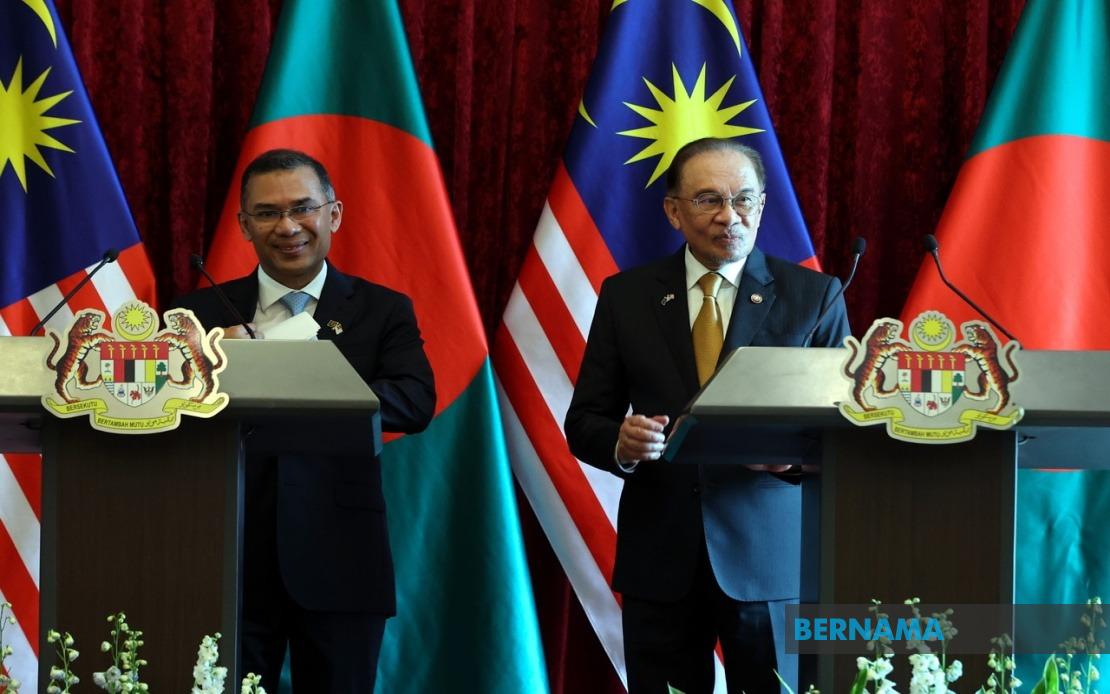
Prime Minister Datuk Seri Anwar Ibrahim has underscored the deep convergence between Malaysia and Bangladesh on a range of critical international matters, emphasising that both nations remain steadfast in their commitment to peace-building efforts across multiple regions. Speaking at a joint press conference in Putrajaya on Monday, Anwar highlighted the bilateral alignment on Palestine, Gaza, developments in the Gulf region, and Iran—issues that carry considerable weight in the foreign policy agendas of both South and Southeast Asian nations.
The Malaysian Prime Minister articulated that Malaysia and Bangladesh share a unified perspective on the Palestinian cause and the humanitarian crisis unfolding in Gaza, which has become a focal point for many Muslim-majority nations seeking accountability and resolution. By characterising Israeli actions as those of the Zionist Israeli regime and acknowledging the atrocities inflicted on Gaza's population, Anwar positioned Malaysia's stance firmly within the broader Arab and Islamic world's advocacy framework. This rhetorical alignment reflects not merely diplomatic courtesy but a substantive commitment to parallel foreign policy positions that resonate with domestic constituencies in both countries.
The emphasis on joint engagement with international partners to foster peace signals an intention by Malaysia and Bangladesh to operate as collective voices within multilateral forums. Rather than pursuing isolated diplomatic channels, both nations appear committed to leveraging their combined influence to shape discussions on contentious regional matters. For Malaysia, this partnership is particularly significant given its historical role as a convener of Muslim-majority nations and its active participation in organisations such as the Organisation of Islamic Cooperation. Bangladesh, as South Asia's predominant Muslim-majority democracy, brings its own weight to such collaborative efforts, particularly in advocating for principles of justice and international law.
Tarique Rahman's visit to Malaysia marks a notable moment in both bilateral relations and the trajectory of his premiership. Arriving in Malaysia on Sunday, the Bangladesh Prime Minister's presence represents his first official international engagement since assuming office in February this year—a choice that underscores the importance Bangladesh places on its relationship with Malaysia. The selection of Malaysia as the destination for an inaugural state visit carries diplomatic significance, suggesting that Dhaka views Kuala Lumpur as a priority partner within its wider regional and international engagement strategy.
The timing of this visit coincides with broader regional dynamics in Southeast Asia and South Asia, where middle-power nations increasingly seek to coordinate positions on global issues. Malaysia's location as a bridge between the Middle East, South Asia, and Southeast Asia positions it as a natural venue for discussions on matters affecting the Islamic world and the Indo-Pacific region. Bangladesh's participation in such dialogues reflects its growing diplomatic assertiveness and desire to be recognised as more than a regional player confined to South Asian affairs.
Anwar's characterisation of the Bangladesh Prime Minister as part of an enlarged family and his references to strengthening family bonds and brotherly relations employ language that reaches beyond conventional diplomatic discourse. Such terminology suggests a depth of cultural and religious affinity that transcends standard bilateral relations, invoking a sense of Muslim solidarity and shared civilisational values. This rhetorical approach is deliberate and meaningful in the context of both nations' domestic politics, where foreign policy decisions are often interpreted through the lens of cultural and religious identity.
The reaffirmation of support for Palestinian and Gazan causes during this diplomatic engagement reflects enduring commitments that both Malaysia and Bangladesh have maintained despite evolving geopolitical circumstances. For Malaysia, this position is consistent with its historical role as an advocate for the Palestinian cause and its active participation in international forums addressing Middle Eastern conflicts. Bangladesh similarly maintains longstanding solidarity with Palestine, though its diplomatic activism on this issue is often overshadowed by its focus on South Asian regional matters and development challenges.
The reference to ensuring lasting peace in the Gulf region and Iran deserves particular attention, as it speaks to broader concerns about regional stability that extend beyond immediate Israeli-Palestinian dynamics. The Gulf region remains a critical area of strategic competition, with implications for energy security, maritime trade, and sectarian tensions. Malaysia, as a major trading nation dependent on stable maritime corridors through the Strait of Malacca and Persian Gulf, has a direct interest in regional stability. Bangladesh's concerns are similarly rooted in practical considerations regarding shipping routes and economic interdependencies with Gulf states.
The joint commitment to continuous engagement with international partners reflects a recognition that neither Malaysia nor Bangladesh can single-handedly influence outcomes on these contentious issues. By working collectively and engaging with other nations, both countries seek to amplify their voices within global deliberations. This approach is particularly relevant for middle-power nations that lack the unilateral influence wielded by permanent Security Council members but possess sufficient diplomatic capacity and moral authority to shape discussions on issues affecting their constituencies.
Looking forward, the consolidation of Malaysia-Bangladesh relations on foreign policy matters could have implications for regional multilateral initiatives. Both nations are members of various regional organisations, and their alignment on key issues could influence decision-making within bodies such as ASEAN, the Organisation of Islamic Cooperation, and various development-focused consortiums. The visit thus represents not merely a bilateral engagement but a potential catalyst for broader coalition-building on international issues of mutual concern.

