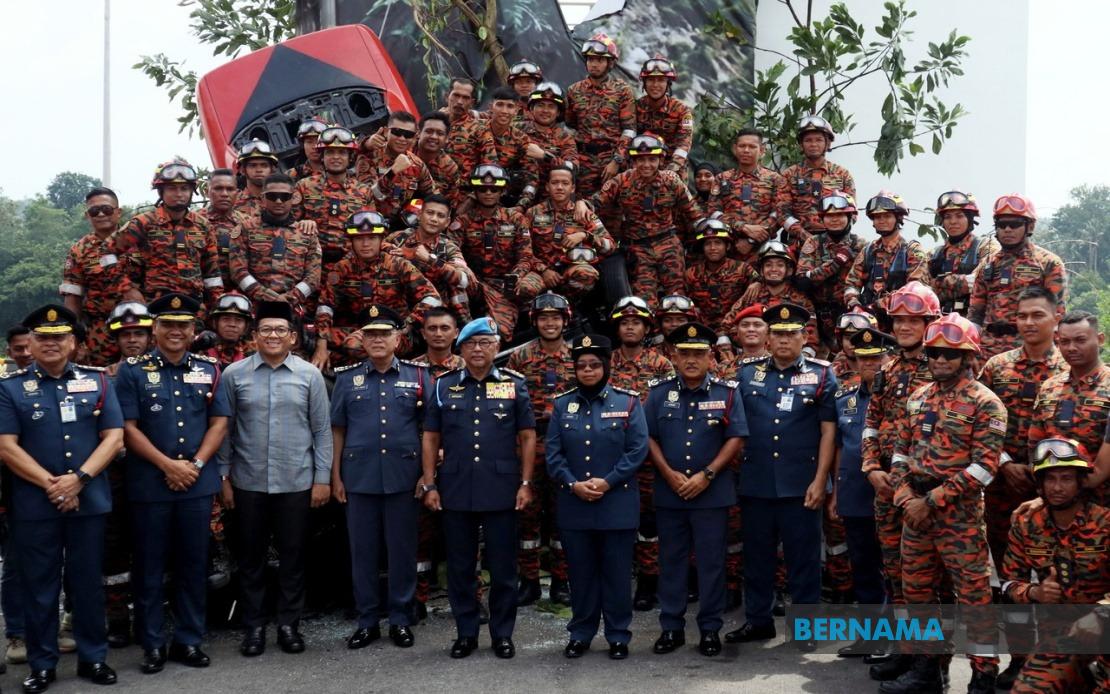
The Federal Government has committed RM278.9 million annually to advance the Malaysian Fire and Rescue Department's (JBPM) infrastructure ambitions, with 86 projects now underway as part of the First Rolling Plan of the 13th Malaysia Plan. This substantial investment demonstrates Putrajaya's determination to strengthen emergency response capabilities across the nation, addressing a critical gap in public safety infrastructure that has become increasingly important as Malaysia's urban and rural populations expand.
Deputy Minister for Housing and Local Government Datuk Aiman Athirah Sabu outlined the scope of this development push, revealing that the expenditure encompasses 27 newly launched projects alongside 59 existing initiatives that continue to progress nationwide. The portfolio reflects a deliberate strategy to balance geographic coverage, ensuring that both developed urban centres and more remote areas receive enhanced fire and rescue infrastructure. This two-pronged approach—simultaneously initiating fresh schemes while completing inherited projects—signals the government's commitment to systematic, measurable progress in emergency service delivery.
Pahang emerges as a particular beneficiary of this initiative, currently hosting seven facility development projects that span both the 12th Malaysia Plan period and the ongoing 13th iteration. The state's roster of developments reveals considerable ambition: the acquisition and refurbishment of the Gohtong Jaya Fire and Rescue Station including residential quarters, construction of entirely new stations in Benta and Tioman with accompanying accommodation, plus substantial upgrading work at existing Bentong and Kuantan facilities. Beyond these major undertakings, the government is simultaneously reconstructing Triang station and preparing preliminary works for a facility at Tanjung Lumpur, demonstrating a sustained regional investment that extends far beyond tokenistic spending.
The newly inaugurated Sungai Lembing Fire and Rescue Station exemplifies the calibre of infrastructure this funding enables. Built on a seven-acre parcel at a cost of RM6 million, the facility represents the 29th such station in Pahang and commenced operational duties on February 15 to serve approximately 15,000 residents in Sungai Lembing and adjoining communities. For a town historically dependent on tin mining, the establishment of modern emergency response infrastructure carries symbolic weight, signalling that Sungai Lembing's transformation into a heritage and tourism destination includes foundational investment in citizen safety and wellbeing.
Deputy Minister Aiman Athirah articulated an expansive vision for these fire and rescue stations that transcends their primary function. Rather than conceiving them narrowly as emergency response facilities, she characterised them as potential one-stop community centres capable of delivering fire safety knowledge, rescue training, and public awareness programming. This conceptual broadening reflects evolving international best practice in emergency management, whereby modern stations function as community hubs that proactively reduce disaster risk through education and preparedness initiatives. Such multifaceted facilities can generate measurable improvements in public safety outcomes by building a culture of prevention and resilience at grassroots level.
Deputy Economy Minister Datuk Mohd Shahar Abdullah, representing the Paya Besar constituency, positioned the Sungai Lembing station within Pahang's broader developmental narrative. He underscored that the fire station complements concurrent heritage preservation and tourism initiatives aimed at restoring Sungai Lembing's historical prominence. These parallel investments—encompassing PCCL Cinema restoration, ecotourism development, digital museum construction, Sungai Lembing Tunnel upgrades, and aspirations toward UNESCO World Heritage Site designation—collectively constitute a comprehensive revitalisation strategy. However, Shahar Abdullah emphasised that these aesthetic and economic development projects require corresponding investment in fundamental services such as emergency response to achieve their full potential.
The connection Shahar Abdullah articulated between emergency preparedness and sustainable development deserves closer examination for Malaysian and Southeast Asian policymakers. Heritage towns and emerging tourism destinations face distinctive safety challenges: increased visitor numbers, unfamiliar layouts that confuse emergency responders, and infrastructure sometimes dating from decades past that may not meet contemporary safety standards. By deploying modern fire and rescue stations in tandem with heritage tourism initiatives, the government acknowledges that successful destination development demands equal attention to visitor safety and experience quality. This integrated approach potentially positions Malaysian heritage destinations as exemplary models combining cultural preservation with responsible tourism management.
The Sultan of Pahang Al-Sultan Abdullah Ri'ayatuddin Al-Mustafa Billah Shah's ceremonial involvement in the Sungai Lembing station opening underscores the political priority attached to this development trajectory. Royal patronage of infrastructure projects carries substantial symbolic weight in Malaysian governance culture, signifying that the initiative enjoys elite institutional support and will likely receive sustained resourcing over subsequent budget cycles. This high-level engagement suggests that the RM278.9 million allocation, while substantial, represents a floor rather than ceiling for future fire and rescue investments, particularly in strategically significant regions like Pahang.
The inclusion of Pahang Menteri Besar Datuk Seri Wan Rosdy Wan Ismail and State Legislative Assembly Speaker Datuk Seri Mohd Sharkar Shamsuddin in the opening ceremony reflects a collaborative governance model wherein federal resources and state-level oversight combine to translate national policy into operational infrastructure. This institutional arrangement enables states to identify local fire and rescue needs while the federal government provides fiscal resources and technical standards, theoretically creating conditions for responsive, well-coordinated emergency service delivery. However, the effectiveness of this model depends entirely on sustained political commitment and adequate recurrent funding to maintain and staff these facilities once completed.
For Malaysian residents, particularly those in secondary towns and rural areas that have historically experienced service gaps, the RM278.9 million investment carries tangible implications. Shorter emergency response times, enhanced rescue capabilities, and locally available fire safety education can measurably reduce property loss and loss of life from fire incidents and other emergencies. For business communities in towns like Sungai Lembing, improved emergency infrastructure reduces operational risks and potentially lowers insurance premiums, thereby enhancing the destination's attractiveness to investors. The multiplier effects of such foundational investments often extend well beyond their immediate financial outlay.
Looking forward, the success of this 13th Malaysia Plan fire and rescue expansion will substantially depend on mechanisms for monitoring project completion, quality assurance, and long-term operational viability. Construction timelines frequently slip and costs escalate; ensuring that all 86 projects meet completion targets and performance standards will require robust oversight mechanisms and political will to enforce accountability. Equally critical is securing adequate annual operating budgets to staff these facilities, maintain equipment, and deliver the community-level programming that transforms physical infrastructure into genuine safety improvements. The initial capital investment, while substantial, represents only one component of the enduring commitment required to sustain enhanced emergency response capabilities.

