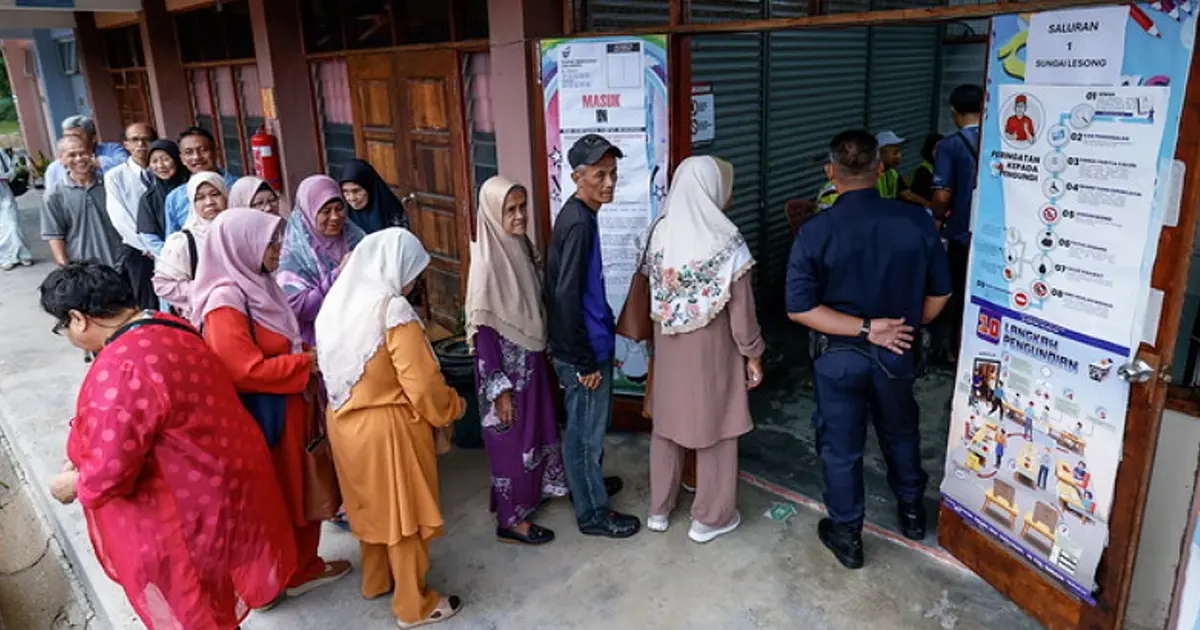
Repeated policy failures and unresolved socioeconomic challenges facing Malaysia's Malay electorate risk inducing what analysts describe as emotional fatigue—a condition where voters gradually disengage from political participation due to sustained disappointment and frustration. Awang Azman Pawi of Universiti Malaya has highlighted this emerging concern, suggesting that the cycling of similar problems without meaningful resolution could fundamentally reshape how Malaysia's largest voting bloc evaluates political parties at the ballot box.
The concept of emotional fatigue in voter behaviour reflects a psychological phenomenon where repeated exposure to unfulfilled promises and stagnant conditions erodes public trust and motivation to engage with the political process. Rather than sparking renewed activism or demand for change, this fatigue often manifests as apathy, reduced electoral participation, or a shift towards protest voting that prioritises short-term punishment of incumbents over coherent policy preference. For Malaysia's political establishment, this represents a subtle but potentially destabilising shift in the social contract that has traditionally anchored electoral outcomes.
According to Awang Azman Pawi, political parties will increasingly be evaluated not on rhetoric or ideological positioning but on their demonstrable ability to deliver tangible improvements in citizens' material circumstances. This represents a fundamental reorientation of voter expectations, moving away from identity-based or communal allegiances toward performance-based metrics. The analyst's assessment suggests that parties operating in Malaysia's competitive political environment cannot rely on inherited voter loyalty or symbolic gestures; instead, they must produce measurable results in areas that directly affect household budgets and economic security.
The cost of living crisis exemplifies the type of persistent challenge that can precipitate voter fatigue. Malaysians across all communities have witnessed sustained increases in prices for essential goods, transportation, housing, and utilities without corresponding salary adjustments or credible government interventions. When multiple election cycles pass without substantial relief, voters begin to question whether any political party genuinely possesses either the competence or the will to address their concerns. This disillusionment accelerates particularly rapidly among younger voters who have never experienced periods of economic ease and therefore lack the historical patience that sometimes characterises older demographics.
The implications for Malaysia's political parties are profound and multifaceted. Those currently in power face the challenge of demonstrating rapid, visible progress on cost-of-living mitigation—a task complicated by global inflationary pressures beyond domestic control. Opposition parties, meanwhile, must articulate credible alternative approaches while avoiding the appearance of making empty promises that merely amplify voter cynicism. The traditional approach of competing on narrative and identity may prove increasingly ineffective in an environment where voters demand documentation of policy success.
For Malay voters specifically, emotional fatigue carries particular significance given their substantial electoral weight and their historical importance to Malaysia's political stability. Any significant shift in their voting behaviour or engagement levels can dramatically alter parliamentary mathematics and government formation. If a critical mass of Malay voters disengages due to accumulated frustration with unresolved issues, neither the ruling coalition nor opposition alliances can guarantee the supermajorities historically required for stable governance or constitutional amendments.
The analyst's warning also speaks to broader governance challenges within Malaysia's federal system. Multiple layers of government—federal, state, and municipal—share responsibility for addressing inflation and cost-of-living pressures, yet these structures often fail to coordinate effectively or present unified responses. Voters observing this fragmentation understandably conclude that systemic dysfunction rather than lack of resources explains persistent failures. Building voter confidence therefore requires not just individual policy successes but demonstrable improvement in institutional coordination and transparent accountability.
Regional context further complicates the situation. Neighbouring Southeast Asian economies grapple with similar inflationary pressures, yet Malaysia's higher cost of living in absolute terms and relative to regional wages makes the situation particularly acute. Vietnamese and Indonesian voters face comparable challenges, suggesting that emotional fatigue over unresolved economic issues may become a regionalwide phenomenon reshaping electoral behaviour across Southeast Asia. Malaysian policymakers cannot assume that the electorate will remain patient while comparable neighbouring nations attempt different approaches.
The emergence of voter fatigue as a political concern also reflects structural changes in Malaysian society. Greater access to information, social media connectivity, and educational advancement mean that voters increasingly demand transparency and accountability. The traditional mechanisms through which parties maintained voter loyalty—patronage networks, communal organisation, and controlled information flows—function less effectively when voters possess direct access to comparative data about government performance and alternative policy options.
Moving forward, Awang Azman Pawi's analysis suggests that Malaysian political parties must fundamentally recalibrate their electoral strategies. Winning and maintaining power increasingly depends on establishing genuine competence in delivering measurable improvements in citizens' daily economic lives. Parties that fail to demonstrate such competence across multiple electoral cycles risk losing not just votes but the active participation of their core constituencies. Emotional fatigue, once established, proves difficult to reverse, requiring extended periods of sustained policy success to rebuild voter confidence and engagement.
The stakes for Malaysia's political system are therefore considerable. An electorate increasingly characterised by fatigue and disengagement may prove less responsive to democratic appeals and more vulnerable to populist promises or alternative mobilisation strategies. Addressing the analyst's warning requires not symbolic measures but concrete, coordinated, and sustained policy action demonstrating that Malaysia's political leadership can effectively govern in the interests of ordinary voters.

