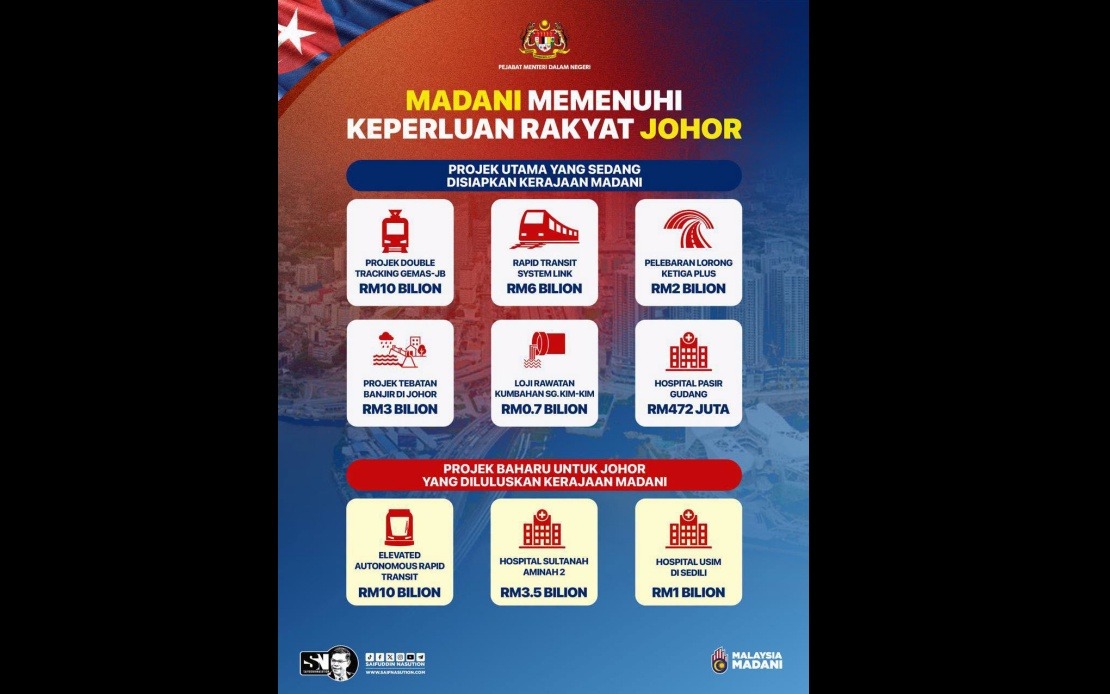
The MADANI Government has reaffirmed its dedication to fostering sustainable and inclusive development across every state in Malaysia, with Johor emerging as a key focus of this developmental agenda. Pakatan Harapan secretary-general Datuk Seri Saifuddin Nasution Ismail articulated this commitment during a recent statement, emphasising that the government under Prime Minister Datuk Seri Anwar Ibrahim remains steadfast in ensuring that citizens nationwide experience tangible improvements in their living standards through targeted investment and strategic planning.
The government's developmental framework rests on four fundamental pillars that reflect broader Southeast Asian economic priorities. Infrastructure modernisation remains at the forefront, as does the expansion and enhancement of public transportation networks that connect communities and facilitate commerce. Healthcare accessibility has become increasingly central to the administration's agenda, recognising that quality medical services are essential infrastructure. Equally crucial is flood mitigation, a concern that resonates deeply across Malaysia and the broader region, particularly as climate change intensifies weather volatility and seasonal flooding patterns become more unpredictable.
Johor's strategic position as Malaysia's second-largest state by economic output makes its development trajectory significant for the broader national economy. The state currently benefits from multiple high-impact projects at various stages of implementation, each designed to address specific developmental deficits. The Gemas-Johor Bahru Electrified Double Tracking Project represents a substantial investment in rail infrastructure, modernising transportation corridors that have supported commerce for decades. This initiative extends beyond mere passenger convenience; it fundamentally restructures logistics networks that serve Malaysia's southern industrial heartland.
The Rapid Transit System Link, meanwhile, addresses urban mobility challenges in densely populated areas, providing alternative transport solutions that reduce road congestion and carbon emissions. This project reflects regional trends toward sustainable urban development that countries across Southeast Asia are pursuing. Simultaneously, the widening of the PLUS Highway's third lane tackles a pressing bottleneck in Malaysia's North-South corridor, a critical artery for both domestic commerce and cross-border trade with Singapore.
Flood mitigation stands as another pivotal component of Johor's development portfolio. The dedicated Johor flood mitigation project, coupled with the Sungai Kim Kim Sewage Treatment Plant initiative, addresses environmental challenges that have periodically disrupted economic activity and displaced residents. These investments acknowledge that sustainable development must encompass environmental stewardship and disaster resilience, concerns that carry particular weight in Malaysia's tropical climate context where monsoons and extreme rainfall events pose recurring threats.
Healthcare expansion forms the third major plank of the government's Johor strategy. The Pasir Gudang Hospital addresses immediate healthcare gaps in one of Johor's major industrial zones, while the recently approved Sultanah Aminah Hospital 2 and USIM Hospital in Sedili represent longer-term commitments to healthcare accessibility. These facilities are not merely symbolic; they represent thousands of jobs and billions in economic activity, while simultaneously improving health outcomes across socioeconomic strata.
Notably, the government's development philosophy extends beyond quantifiable metrics like project investment value or completion rates. Saifuddin Nasution's articulation emphasises that meaningful development ultimately translates into tangible benefits experienced by ordinary citizens. This framing reflects growing recognition across the region that infrastructure without corresponding employment opportunities, or hospitals without adequate staffing, constitute incomplete development. The government measures success through job creation generated by these projects, through commute times reduced by improved transportation, through disease burdens lightened by expanded healthcare capacity, and through quality-of-life improvements that extend across multiple dimensions of daily existence.
The approval of the Elevated Autonomous Rapid Transit system signals the government's willingness to embrace emerging technologies and innovative solutions to urban challenges. This forward-looking approach positions Malaysia alongside regional peers pursuing smart city initiatives and advanced transit solutions. USIM Hospital's location in Sedili reflects strategic thinking about equitable healthcare distribution, extending quality medical facilities beyond established urban centres.
For Malaysian readers and businesses, this sustained commitment to Johor's development carries significant implications. The state's role as a manufacturing and logistics hub means that improved infrastructure directly impacts national competitiveness. Enhanced transportation networks reduce supply chain costs, while better healthcare and amenities attract skilled workers and facilitate business expansion. From a regional perspective, these investments strengthen Malaysia's position within ASEAN's supply chain networks and reinforce the country's attractiveness to foreign direct investment.
The scale and scope of these initiatives demonstrate that the government's development ambitions extend beyond rhetorical commitment. Each project requires coordination across multiple agencies, stakeholder engagement, and sustained budgetary allocation over extended periods. The concentration of projects in Johor reflects the state's economic importance, though the government's broader messaging suggests similar commitments across other states, albeit tailored to regional circumstances and priorities.
As these projects progress from approval through implementation, their success will substantially influence the government's development credentials heading toward subsequent electoral cycles. For Johor residents and businesses, these initiatives represent concrete attempts to address long-standing infrastructure deficits and service gaps. Whether implementation matches these ambitious projections will determine whether the MADANI Government's commitment translates from policy documents into the improved living standards and economic opportunities that citizens ultimately seek and deserve.

