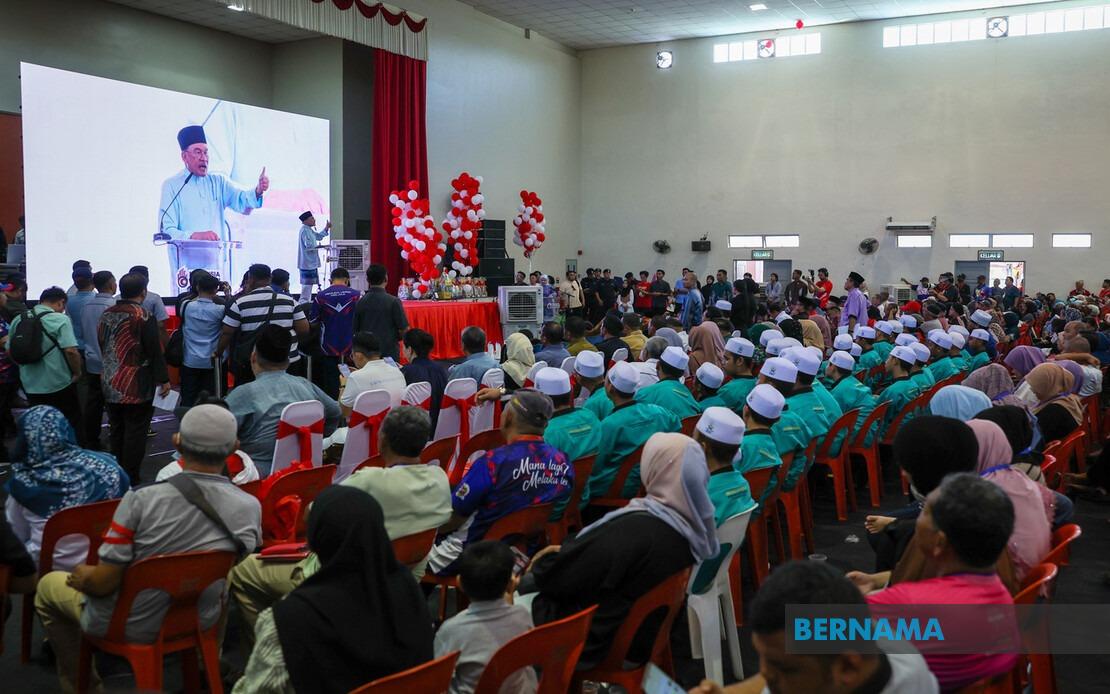
Prime Minister Datuk Seri Anwar Ibrahim has reiterated the MADANI Government's commitment to providing equitable support across Malaysia's diverse education ecosystem, clarifying that increased funding for Islamic schools does not signal reduced backing for vernacular institutions. Speaking at the Gelombang MADANI Carnival in Alor Gajah, Melaka, Anwar emphasised that maintaining national harmony requires the government to address the legitimate needs of all communities without marginalising any particular group or education system.
The Prime Minister's remarks come at a time when conversations around educational funding allocations have generated considerable public discourse. Anwar specifically addressed concerns that enhanced assistance for pondok schools and tahfiz institutions might come at the expense of Chinese and Tamil schools, institutions that have historically served hundreds of thousands of students across the country. He provided concrete reassurance that funding schedules for these vernacular schools have already been finalised, with public announcements scheduled for Kuala Lumpur within approximately two weeks.
Anwar contextualised the recent increases in Islamic education support within a broader narrative of redressing historical imbalances. He noted that many pondok schools and tahfiz institutions had suffered from prolonged neglect and minimal government assistance prior to the formation of the Unity Government in 2022. The shift towards restoration began in 2023 and has accelerated through 2024, reflecting what the administration frames as a recalibration rather than a redistribution of educational resources. This framing is significant for Malaysian stakeholders seeking to understand the government's education philosophy and budgetary priorities.
The Prime Minister's underlying argument rests on a principle of inclusive governance: that Malaysia's success as a plural society depends fundamentally on ensuring no community feels abandoned or undervalued by state institutions. He highlighted Malaysia's achievements in fostering peaceful coexistence among diverse ethnic and religious groups, contrasting this with social tensions that have destabilised other multiracial societies. Anwar underscored that this stability emerges from deliberate policies of mutual respect and equitable resource allocation, not from rhetoric or symbolic gestures alone.
Central to Anwar's philosophical framework is the Islamic concept of 'ummatan wasatan' drawn from Surah Al-Baqarah, verse 143, which emphasises balanced community conduct across dimensions of faith, learning, character, interpersonal relations, and environmental stewardship. Anwar articulated that true exemplary leadership requires demonstrating integrity across all domains—from combating corruption and abuse of power to managing national resources responsibly and respecting religious and ethnic minorities. This theological grounding suggests the government views educational equity not merely as a policy mechanism but as an expression of religious obligation.
During the event, Anwar announced a RM1.29 million allocation directed towards upgrading infrastructure across thirteen Islamic educational institutions throughout Melaka. The distribution reflected varying institutional sizes and requirements, with the Madrasah Tahfiz Al-Quran Wal Qiraat Kota Melaka receiving RM250,000 as the largest single allocation, followed by allocations ranging from RM100,000 to RM200,000 for other recipients including the Sekolah Rendah Arab Jabatan Agama Islam Melaka and multiple Sekolah Agama Rakyat facilities. These investments span infrastructure modernisation and the introduction of contemporary educational technologies such as artificial intelligence and computer training.
The integration of advanced technological capabilities into Islamic educational institutions addresses a legitimate concern that traditional religious schools might risk educational obsolescence if they remained isolated from contemporary pedagogical developments. Anwar framed this technological upgrading as essential to ensuring pondok schools remain competitive and relevant without compromising their distinctive religious and cultural missions. This approach attempts to reconcile preserving institutional identity with equipping students for modern economic participation.
For Malaysian stakeholders monitoring educational policy, Anwar's statements carry several implications. First, they signal that despite increased allocations to Islamic education, the government explicitly maintains its financial commitments to Chinese and Tamil schools, with formal announcements forthcoming. Second, they suggest the administration views educational equity as integral to maintaining social cohesion in a multiethnic democracy. Third, they indicate a philosophy that expanding opportunities in previously under-resourced sectors need not require diminishing opportunities elsewhere, though this depends on overall budgetary capacity and economic conditions.
The timing and location of these remarks merit consideration within Malaysia's political landscape. Delivered in Melaka, with attendance from Chief Minister Datuk Seri Ab Rauf Yusoh and other state officials, the message carries territorial as well as national significance. The inclusion of Datuk Seri Dr Wan Azizah Wan Ismail, the Prime Minister's spouse and a prominent political figure in her own right, underscored the administration's positioning of educational policy as a matter of collective government commitment rather than narrow sectional interest.
Anwar's broader point about social stability emerging from equitable institutional treatment extends beyond education to encompass the government's general approach to plural governance. By explicitly linking fair resource allocation to national peace and citing Malaysia's comparative success in managing diversity, the Prime Minister advanced a consequentialist argument for inclusive policymaking. This framing appeals to both those prioritising religious educational development and those concerned with maintaining established support structures for vernacular schools, attempting to position these objectives as complementary rather than competitive.
The announcement of specific infrastructure projects represents a shift from rhetorical commitment to tangible investment. By naming recipient institutions and allocating defined sums, the government created accountability mechanisms and visible evidence of resource distribution. For communities managing these institutions, the funding enables facility improvements and technological integration that would otherwise proceed more slowly. Simultaneously, Anwar's explicit timeline for announcing vernacular school allocations establishes a comparable benchmark for assessing the sincerity of his equity commitments.
Moving forward, observers of Malaysian educational policy will monitor whether announced allocations for Chinese and Tamil schools are indeed released within the projected timeframe and whether their magnitude reflects genuine parity in government commitment. The success of the MADANI Government's education strategy will ultimately be measured not by unifying rhetoric but by the actual distribution of resources, the quality of facilities and instruction across all systems, and whether students from diverse educational backgrounds encounter comparable opportunities in further education and employment markets. In this sense, Anwar's Melaka address establishes a benchmark against which future government performance can be assessed.

