The MADANI Government has renewed its commitment to the Ziarah Kasih programme, a direct assistance initiative targeting Malaysia's most vulnerable populations. Announced during a community engagement event in Mersing, the government's sustained investment in this welfare scheme underscores its determination to translate the Malaysia MADANI vision—which emphasises citizen well-being as a foundational principle—into tangible support mechanisms reaching those facing genuine hardship.
According to Abdullah Izhar Mohamed Yusof, political secretary to the Communications Minister, the programme operates through a collaborative identification system involving the Department of Information alongside Komuniti MADANI networks. This dual-agency approach aims to ensure that assistance reaches intended beneficiaries with minimal bureaucratic friction, addressing a common complaint in Malaysia's social welfare landscape where deserving cases sometimes slip through administrative cracks. The emphasis on regular implementation signals that Ziarah Kasih is designed as a sustained commitment rather than a sporadic or campaign-driven initiative.
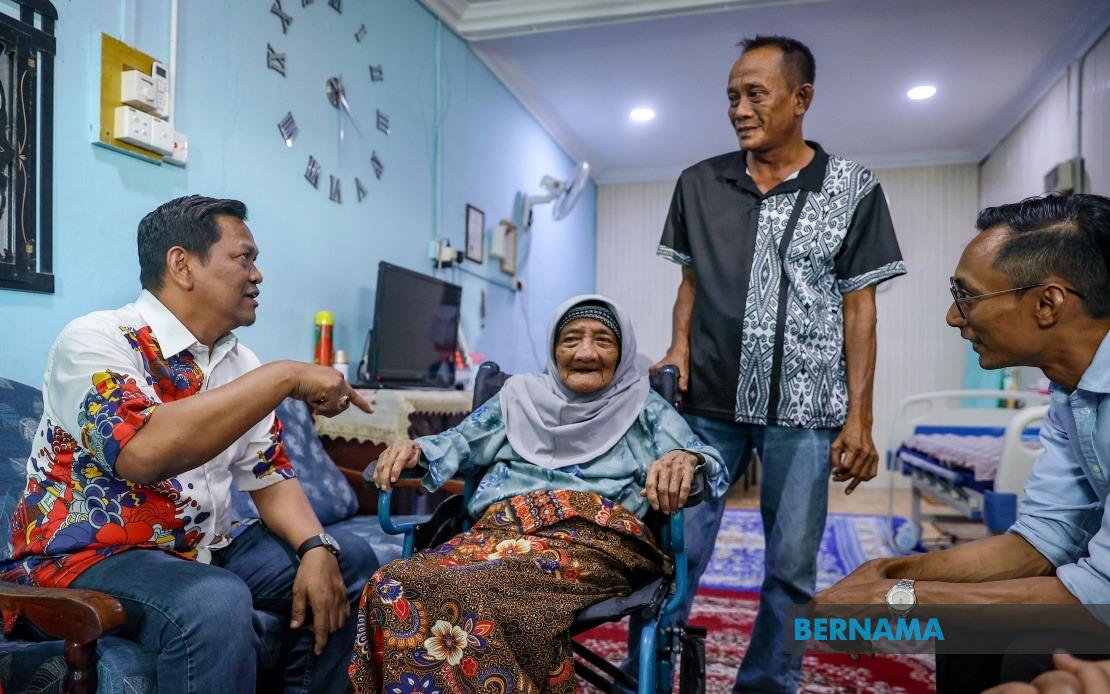
The Mersing engagement, which took place during the Jiwa@Komuniti MADANI Sembang Santai World Cup Edition programme, featured direct visits to elderly residents confronting serious health challenges. Government representatives distributed both financial contributions and practical healthcare equipment, recognising that vulnerable populations often lack access to medical devices that could significantly improve daily living conditions. This hands-on approach to welfare distribution—where officials directly encounter beneficiaries rather than processing applications remotely—creates accountability and allows government representatives to assess needs comprehensively.
One case highlighted during the outreach involved Hamdan Abd Latif, 71, and his wife Meriam Abd Wahab, 66. The couple's circumstances illustrate the cascading consequences of serious illness within Malaysian households. Hamdan, a retired firefighter, suffered a catastrophic fall while engaged in part-time prawn fishing in 2011, just two weeks before his scheduled retirement. Medical investigations subsequently revealed a brain tumour requiring surgical intervention, adding significant medical debt to his household at a critical life stage.
Despite successful tumour removal, Hamdan's post-operative trajectory deteriorated steadily. A stroke following a bathroom fall last year has left him bedridden, requiring full-time care from his elderly wife. Meriam's account reveals the hidden economic cost of caregiving within Malaysia's family structure: she surrendered her independent income stream from sewing work to provide round-the-clock supervision, transforming their household from a dual-income to single-income arrangement while simultaneously increasing care expenses. Government assistance in such scenarios addresses not merely subsistence needs but prevents the kind of financial spiral that forces families into deeper poverty.
The couple's gratitude for government support reflects a broader Malaysian reality: the social safety net, while functioning, often leaves gaps that create genuine hardship for families navigating long-term disabilities. The Ziarah Kasih programme's focus on elderly and chronically ill populations addresses a demographic reality that Malaysia's rapidly ageing society makes increasingly urgent. With fertility rates declining and life expectancy increasing, more Malaysian households will inevitably confront scenarios similar to Hamdan and Meriam's, making sustainable elderly care infrastructure a policy imperative rather than optional compassion.
Another beneficiary, Zainon Ibrahim, 91, illustrates alternative caregiving arrangements emerging within contemporary Malaysian families. Her son, Jamaluddin Ismail, 64, abandoned his supervisory position approximately two years prior to provide maternal care, a sacrifice supported by contributions from siblings. This voluntary withdrawal from formal employment represents a demographic trend deserving closer policy attention: adult children in Malaysia increasingly sacrifice career advancement to address parental care needs, particularly when spouses have passed or extended family resources prove inadequate.
Jamaluddin's decision reflects both filial piety—deeply embedded in Malaysian cultural norms—and practical necessity. The absence of comprehensive elderly care infrastructure means that family-based caregiving remains the default rather than supplementary arrangement. While Komuniti MADANI assistance ameliorates daily financial strain, it cannot restore lost employment income or career trajectory. Government programmes addressing caregiver support—whether through tax incentives, career re-entry assistance, or caregiver allowances—could complement initiatives like Ziarah Kasih by recognising caregiving as socially valuable work deserving institutional acknowledgment.
The programme's sustainability hinges upon adequate resource allocation and efficient targeting mechanisms. In Malaysia's decentralised governance structure, where state-level welfare provisions vary considerably, the national government's emphasis on regular Ziarah Kasih implementation sends important signals about equity and social cohesion. Vulnerable populations in less-developed states must receive comparable support to their counterparts in more prosperous regions, preventing welfare provision from becoming another axis of inequality.
From a Southeast Asian perspective, Malaysia's approach to direct citizen assistance represents a middle path between minimalist welfare states and comprehensive social security systems. The Ziarah Kasih initiative acknowledges that rapid economic development and urbanisation have fractured traditional community support mechanisms, necessitating state intervention. However, by coupling direct assistance with community identification mechanisms rather than purely bureaucratic processing, the programme attempts to preserve social accountability and personalised engagement absent in purely impersonal welfare systems.
The visible engagement of government officials in community settings, distributing aid and hearing citizen concerns directly, serves psychological and political functions alongside material assistance. Citizens observe government commitment through physical presence rather than distant policy pronouncements. This interpersonal dimension, while sometimes dismissed as performative, creates legitimacy crucial for long-term political stability. Vulnerable populations that perceive government indifference become susceptible to alternative political narratives; those experiencing tangible support develop stake in existing institutional arrangements.
Moving forward, Ziarah Kasih's effectiveness will depend upon scaling operations to meet growing demographic demand without compromising targeting precision or administrative efficiency. Malaysia's middle-income status provides financial capacity for comprehensive welfare expansion, yet competing budget priorities require difficult choices about resource allocation. The programme's implicit recognition that vulnerable populations need ongoing, repeated assistance rather than one-time interventions represents important philosophical evolution in Malaysian welfare thinking.
Ultimately, the MADANI Government's reaffirmation of Ziarah Kasih commitment reflects an understanding that inclusive development requires direct mechanisms for addressing citizen hardship. While structural economic policies create conditions for broad prosperity, they cannot eliminate vulnerability stemming from disability, advanced age, or catastrophic health events. Programmes like Ziarah Kasih acknowledge that full participation in Malaysian society requires ensuring basic dignity and material security for all citizens, regardless of economic productivity.

