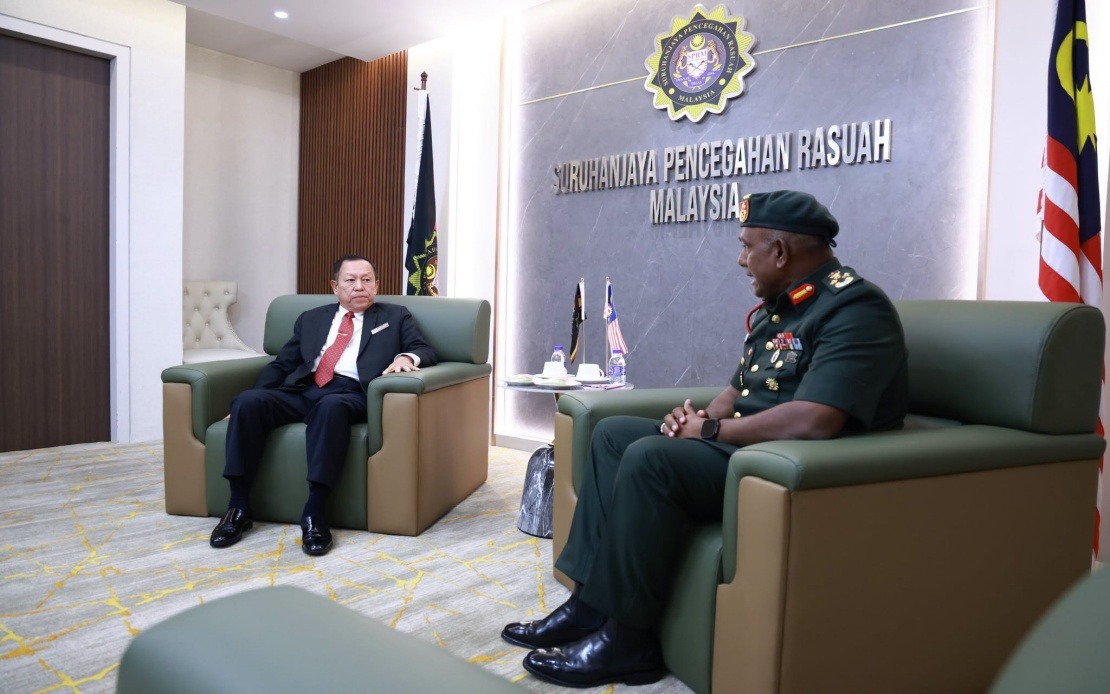
The Malaysian Anti-Corruption Commission and the Malaysian Armed Forces have moved to deepen their institutional partnership, with both agencies signalling renewed commitment to coordinated efforts against corruption. The alignment represents a recognition that combating graft requires seamless cooperation between civilian oversight bodies and military leadership, whose vast operational footprint and defence budgets make them particularly vulnerable to misconduct.
During a meeting at MACC headquarters in Putrajaya on July 7, the commission's chief commissioner Datuk Seri Abd Halim Aman outlined the framework for enhanced collaboration. The partnership will pivot on three main pillars: the systematic exchange of intelligence between agencies, broader information-sharing protocols, and joint initiatives to strengthen governance standards across both institutions. This multifaceted approach acknowledges that corruption within the defence establishment poses distinct challenges, requiring specialised understanding of military structures and procurement processes that civilian authorities alone may struggle to penetrate.
The visit coincided with the official appointment of Lt Gen Datuk Fazal Abdul Rahman as director-general of the Malaysian Defence Intelligence Organisation, effective May 21. His appointment to lead the MDIO—the armed forces' primary intelligence apparatus—carries particular significance for the anti-corruption agenda. Intelligence organisations occupy a sensitive position within any military hierarchy, tasked simultaneously with national security responsibilities and internal oversight. Fazal's installation in this role suggests the defence establishment is prioritising the alignment of its intelligence functions with civilian anti-corruption frameworks.
Abd Halim emphasised that the MACC values the historical relationship between the two agencies, framing the deepening partnership not as a new initiative but as a natural extension of existing cooperation. The language of continuity is deliberate; it avoids suggesting either institution had previously been lax on integrity matters, while simultaneously signalling that both recognise growing challenges ahead. For a regional context, the partnership underscores Malaysia's broader institutional maturity in recognising that anti-corruption requires whole-of-government commitment rather than siloed efforts.
The armed forces' position on the partnership, articulated by Fazal, emphasised their commitment to maintaining governance standards and ensuring operational discipline. His statement that "close cooperation with the MACC will continue to be strengthened in support of the national integrity and good governance agenda" carries practical weight. The defence sector in Malaysia, like most nations, manages substantial procurement budgets, overseas deployment logistics, and personnel management systems—all areas historically vulnerable to corrupt practices. By publicly aligning the MDIO's mandate with MACC's objectives, Fazal signals that the military leadership views anti-corruption as integral to operational effectiveness rather than as external imposition.
The intelligence-sharing dimension of the partnership addresses a longstanding challenge in anti-corruption work. Military and defence intelligence organisations typically operate under strict classification protocols, creating institutional silos that can inadvertently shield corrupt activities. By formalising intelligence exchange mechanisms with MACC, the framework potentially enables investigators to access information previously compartmentalised within defence establishments. This is particularly significant for investigating complex schemes involving defence procurement, where coordination between military procurement specialists and civilian auditors is essential.
Information exchange protocols represent a subtler but equally important element. Beyond classified intelligence, the partnership likely encompasses sharing of administrative data, personnel records, financial transactions, and operational reports. Such comprehensive information sharing creates a more complete picture of institutional activities, making it harder for misconduct to escape notice through bureaucratic opacity. For Malaysian readers concerned about value for public money, this cross-institutional visibility directly supports accountability in defence spending.
Governance enhancement initiatives suggest both agencies will work jointly to identify systemic vulnerabilities within defence operations. This preventative dimension is often overlooked in corruption discourse, which tends to focus on investigation and prosecution. By identifying and addressing governance gaps proactively—whether in procurement procedures, personnel management, or financial controls—the partnership aims to raise institutional barriers against corruption before wrongdoing occurs. This approach aligns with international best practice in institutional integrity.
The meeting also involved senior officials from both organisations, including MACC's intelligence division head Datuk Saiful Ezral Arifin and the Armed Forces Security and Counter Intelligence Directorate director Lt Col Muhamad Zainol Md Yusof. The presence of specialists rather than merely ceremonial attendees indicates this partnership involves substantive technical collaboration rather than symbolic coordination. These officials would be responsible for developing practical mechanisms for intelligence and information exchange, drafting protocols, and establishing regular review cycles.
For Southeast Asia more broadly, the MACC-Armed Forces partnership reflects a regional trend toward institutionalising anti-corruption across traditionally insulated sectors. As defence budgets expand across the region and procurement contracts grow more complex, the risk profile for corruption increases proportionally. Malaysia's experience in formalising cooperation between its anti-corruption watchdog and military establishment offers a potential model for regional peers grappling with similar institutional challenges.
The partnership also carries implications for Malaysia's international standing on governance. The country has previously come under scrutiny regarding corruption in defence procurement and military-linked entities. By demonstrating institutional mechanisms to combat such abuses, the partnership contributes to Malaysia's credibility with international partners and investors who evaluate governance risk when considering defence cooperation or business engagement. For Malaysian businesses operating in defence and security sectors, the strengthened oversight also clarifies the anti-corruption environment in which they operate.
Looking forward, the success of this partnership will depend on sustained institutional commitment beyond the announcement phase. Intelligence sharing and governance initiatives require ongoing resource allocation, regular communication channels, and political protection from internal resistance. Both agencies will need to navigate the inherent tensions between security classification needs and anti-corruption transparency requirements. How MACC and the Armed Forces resolve these practical challenges will determine whether the partnership becomes a model for effective institutional coordination or remains primarily symbolic.

