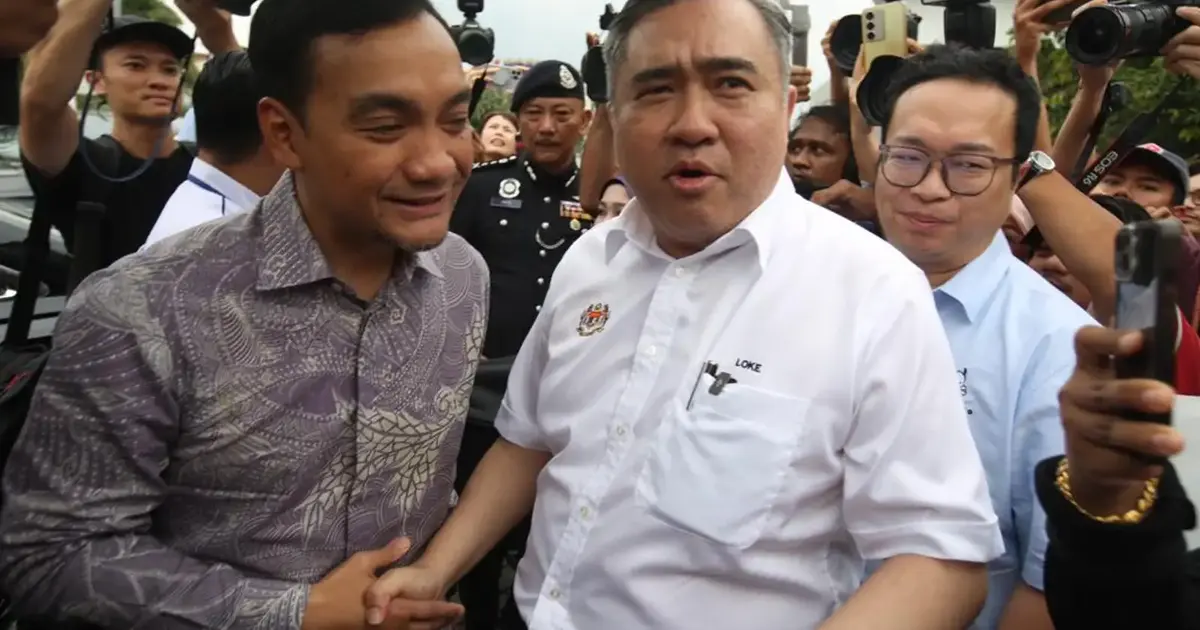
Transport Minister Anthony Loke and Johor Menteri Besar Onn Hafiz Openg have managed to maintain diplomatic composure during their first meeting since engaging in a public spat on social media, signalling an attempt to compartmentalise their political differences and preserve working relationships at the national and state levels.
The encounter at an official transport ministry event demonstrated the pragmatic approach both leaders are taking towards their earlier online dispute. Rather than allowing their disagreement to escalate into a more serious political confrontation, both men chose to conduct themselves with measured professionalism, suggesting an underlying mutual recognition that productive governance requires cooperation despite ideological divergences.
Onn Hafiz, who governs Johor as Menteri Besar, did not entirely refrain from acknowledging the tension between them. During his remarks at the ministry function, he delivered what observers characterised as a subtle barb directed at Loke, using the opportunity to highlight the inconvenience caused by the last-minute scheduling of the event. By noting that he had been forced to rearrange his official commitments due to the short notice provided for the transport ministry's invitation, Onn Hafiz managed to convey his message with restrained wit rather than aggressive confrontation.
This approach reflects a broader pattern in Malaysian politics where leaders from different political camps maintain surface-level civility while continuing to assert their positions and concerns through carefully calibrated remarks. The use of such subtle volleys allows politicians to maintain their base's expectations of vigorous opposition while avoiding the kind of public acrimony that might damage institutional relationships or suggest weakness in negotiating capacity.
The online disagreement that preceded this meeting had captured public attention, as digital platforms have become increasingly important venues for political messaging in Malaysia. Social media disputes between high-profile figures often generate significant engagement and can rapidly escalate if not carefully managed. The fact that both Loke and Onn Hafiz chose to reset the tone at their first in-person encounter suggests a commitment to preventing further deterioration of their relationship, despite the very real political differences between the DAP leader and the Johor leadership.
For Malaysian readers observing inter-state and national relations, this dynamic carries implications for how regional governance intersects with federal policies. Johor, as Malaysia's second-largest state economy, maintains critical relationships with the federal transport ministry regarding infrastructure development, port operations, and connectivity projects. Any sustained deterioration in relations between the state and national transport authorities could complicate implementation of regional development plans affecting the broader Southeast Asian economic landscape.
The incident also underscores the generational approach to political disagreement among Malaysia's current crop of leaders. Unlike previous eras where personal animosity between rival politicians could persist for years, contemporary figures demonstrate greater flexibility in compartmentalising personal disputes from functional relationships. This pragmatism, while reducing dramatic tension, arguably serves the practical interests of governance and constituent service.
Onn Hafiz's reference to rearranging his schedule serves multiple purposes simultaneously. It communicates to his own political supporters that he will not simply defer to federal authority, maintains his standing as a defender of state-level interests against federal presumption, and subtly reminds the transport ministry that state cooperation requires respectful coordination. All of this was conveyed through the understated framework of a scheduling complaint rather than through overt confrontation.
Loke, for his part, by proceeding with the event and accepting Onn Hafiz's participation and remarks without visible irritation, demonstrated confidence in his position and avoided the trap of appearing defensive or vindictive. This approach is consistent with his tenure as transport minister, where he has generally maintained a focus on policy implementation despite periodic political disagreements with various state administrations.
The interaction illustrates how Malaysian politics operates across multiple registers simultaneously. Public statements and social media exchanges serve certain functions in maintaining party cohesion and messaging to party bases, while behind-the-scenes and face-to-face interactions operate according to different norms requiring accommodation and professional courtesy. Both registers serve important functions, and skilled politicians navigate between them effectively.
Moving forward, observers will monitor whether this incident marks a stabilisation of relations between the transport ministry and Johor's administration, or whether underlying tensions will periodically resurface in either public or private channels. For Malaysia's development trajectory, particularly regarding infrastructure and regional connectivity initiatives, maintaining functional relationships between state and federal authorities remains essential, regardless of occasional political disagreements that play out in the public sphere.