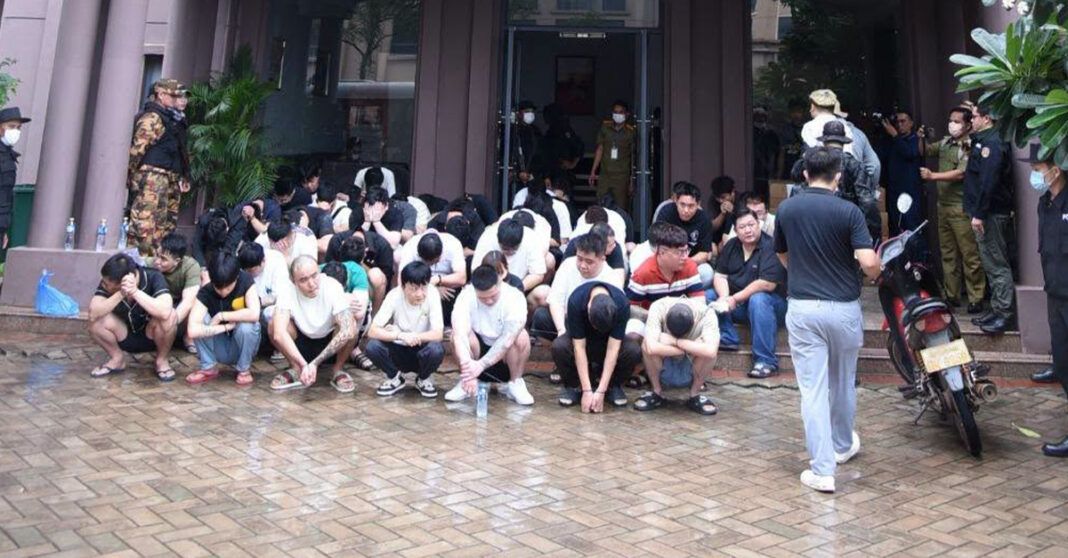
Vientiane police conducted a major enforcement operation on 8 August against a telecommunications fraud and online gambling syndicate operating from a building within the Thatluang Lake Special Economic Zone. The raid resulted in the detention of 261 suspects representing seven different nationalities, marking one of the largest single operations against organised crime networks in the Lao capital in recent months. The scale and composition of those apprehended underscores the increasingly transnational character of digital fraud operations that have emerged across Southeast Asia, drawing operatives from across the region and beyond.
Chinese nationals comprised the dominant contingent at 153 detainees, reflecting the significant role that mainland operators have played in establishing and managing large-scale scam infrastructure throughout the Mekong region. Vietnamese nationals formed the second-largest group with 61 individuals, followed by 36 Thai suspects. The remaining detainees included five Taiwanese nationals, and smaller numbers of Malaysian, South Korean and Myanmar citizens. This multinational composition suggests a well-organised operation with roles distributed across multiple nationalities, each bringing specific expertise or connections to the broader scheme.
The physical infrastructure seized during the operation provides insight into the scale of the criminal enterprise. Police confiscated nearly 500 desktop computers and laptops, along with 2,355 mobile phones, all serving as operational tools for the fraud network. The sheer volume of such equipment indicates that the operation handled a substantial throughput of scam transactions, likely targeting victims across numerous countries simultaneously. Authorities identified the building as property belonging to Lao Thatluang Investment Development Co., Ltd., raising questions about corporate involvement or negligence in allowing such activities to operate from registered premises.
Investigators indicated that the arrested individuals are likely subordinates and operatives within a larger hierarchical structure. Police have explicitly stated their intention to continue investigations aimed at identifying and apprehending the masterminds orchestrating the scheme, as well as accomplices operating at higher levels. This distinction between frontline workers and command-level organisers suggests a sophisticated operation with clear chains of command, typical of mature criminal syndicates that have learned to insulate senior figures from direct operational involvement.
The timing of this raid reflects broader law enforcement priorities across Laos. Authorities are currently executing an accelerated nationwide campaign against scam networks, viewing such operations as a significant threat to national security and economic integrity. The concentration of these criminal enterprises in special economic zones like Thatluang Lake suggests that the relative openness and international character of such zones may inadvertently create environments where transnational criminals can establish operations more easily than in other jurisdictions.
Following the initial raid, Lao authorities accelerated their deportation procedures for foreign nationals implicated in scam operations. On 10 August, just two days after the Thatluang Lake operation, authorities transferred 41 Thai suspects to Thai custody via the 1st Lao-Thai Friendship Bridge. This handover complemented an earlier deportation on 6 August involving 32 Thai nationals, bringing the total number of Thai citizens returned across the border to at least 73 in this particular enforcement cycle. The rapidity of these deportations indicates close cooperation between Lao and Thai law enforcement agencies in managing transnational criminal suspects.
The context for these recent operations extends back to an earlier major raid conducted on 18 July at the ST Vegas complex located in Dongphosy village, Hatsayfong district, Vientiane. That operation proved even larger in scale, resulting in the apprehension of 589 suspected scammers across a single facility. The demographic composition differed somewhat from the Thatluang Lake raid, with Thai nationals representing the largest single group, alongside contingents of Lao, Vietnamese and Cambodian nationals. The July raid demonstrated that complex criminal infrastructure had become established across multiple locations in the Vientiane area, with each site potentially serving specific functions within broader networks.
These enforcement actions carry significant implications for Malaysia and other Southeast Asian nations. Malaysian citizens account for a small but measurable proportion of those detained in Laos, suggesting that some Malaysian nationals have been drawn into these transnational scam operations either as victims or perpetrators. The discovery of such activity in Laos raises concerns about whether similar operations may be operating in or through Malaysia, particularly given Malaysia's role as a regional financial hub and the presence of substantial expatriate communities from relevant countries.
The broader pattern evident across these raids suggests that scam operations have become increasingly sophisticated and transnational in character. No longer confined to single jurisdictions or ethnic groups, these syndicates now coordinate across borders, deploy diverse operational talent, and invest substantial capital in infrastructure. The apparent willingness of Thai authorities to accept deportations and the demonstrated capacity of Lao authorities to execute coordinated raids indicate that regional governments recognise the threat and are attempting coordinated responses.
However, the focus on capturing frontline operatives rather than top-level organisers suggests that law enforcement agencies may struggle to fully dismantle these networks. As long as substantial profit incentives exist and barriers to entry remain relatively low, criminal entrepreneurs will likely find ways to reconstitute operations. The challenge facing authorities throughout Southeast Asia will be disrupting the economic foundations that make such operations attractive while simultaneously improving international cooperation to track and prosecute those directing these schemes from secure locations.

