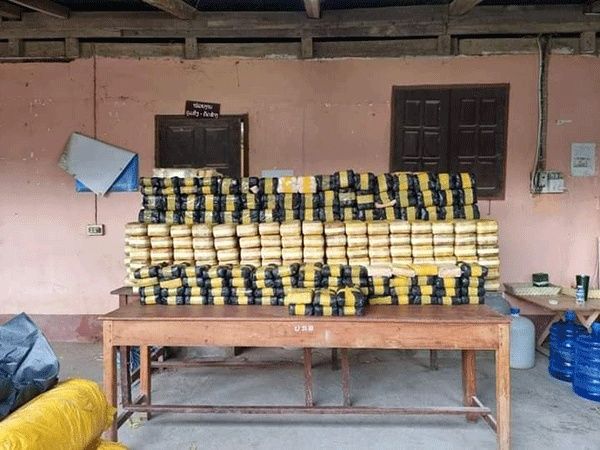
Authorities in Xaysomboun province, central Laos, are escalating their push against narcotics trafficking after a stark mid-year assessment revealed that drug-related offences have become the dominant crime category in the region. Of 54 criminal cases recorded during the first six months of the year, 24 involved drugs, representing nearly 44 per cent of the province's total criminal caseload and underscoring just how deeply narcotics trafficking has penetrated the local security landscape.
The extent of the drug problem extends well beyond Xaysomboun's borders. National figures presented by Prime Minister Sonexay Siphandone to the National Assembly last month showed that across Laos, authorities processed 1,786 drug-related cases in the same period, resulting in 4,025 arrests that included 93 foreign nationals. The scale of seizures—involving large quantities of controlled substances, precursor chemicals, and vehicles used in trafficking operations—indicates that Laos remains a critical node in the broader Southeast Asian narcotics supply chain, a position that carries significant implications for neighbouring countries including Malaysia, which faces increased drug trafficking pressures partly originating from this region.
During an August 7 visit to Xaysomboun, Police Lieutenant General Vanthong Kongmany, the Minister of Public Security, met with Police Brigadier General Ouday Insouvanh, head of the provincial force, to review security conditions and chart a more aggressive enforcement path. Of the 24 drug cases documented so far this year, only two have been concluded and referred to prosecutors, whilst 22 remain in active investigation—a backlog that suggests either resource constraints or the complexity of building prosecutable cases against trafficking networks. The broader crime picture shows similar investigative challenges, with 29 of 50 non-drug cases still under investigation, indicating that the provincial force is stretched thin across multiple fronts.
Beyond narcotics, Vanthong directed the provincial command to intensify action against smuggling, human trafficking, theft, burglary, illegal mining and gambling—a comprehensive agenda that reflects how criminal enterprise has diversified across Laos. The minister's insistence on tackling these varied offences suggests recognition that organised crime networks often operate across multiple illicit sectors simultaneously, and that compartmentalised enforcement efforts may prove ineffective. For Malaysian authorities and regional security planners, Laos's struggle against transnational trafficking networks underscores the interconnected nature of organised crime throughout Southeast Asia, where drug trafficking frequently overlaps with human smuggling and financial crimes.
A notable addition to the provincial security mandate is cybercrime and social media monitoring, an area where Laotian law enforcement has historically lagged. Vanthong's instruction reflects a regional trend of organised criminals exploiting digital platforms for recruitment, distribution coordination, and money laundering. This directive suggests that Laotian officials increasingly recognise that modern trafficking operations depend on encrypted communications and online logistics networks, requiring security forces to develop digital-age investigative capabilities alongside traditional street-level policing.
The drug enforcement campaign itself forms part of a five-year national government initiative to suppress the trade, indicating that sustained political commitment exists at the highest levels. However, the persistence and scale of drug crime despite this longstanding focus raises questions about the effectiveness of current strategies. Resource allocation, inter-agency coordination, and the sophistication of trafficking organisations—which often involve well-funded international syndicates—present formidable challenges that no single province can address in isolation.
Road safety emerged as a secondary but serious concern during the ministerial visit. Xaysomboun recorded 60 traffic accidents in the first six months, resulting in four deaths, 80 injuries and damage to 109 vehicles, with financial losses exceeding 2.56 billion kip. Whilst distinct from organised crime, this toll reflects broader governance challenges around enforcement, infrastructure, and public compliance with regulations. The financial impact alone—losses equivalent to hundreds of thousands of dollars in a provincial economy—demonstrates how dispersed security problems can aggregate into substantial economic damage.
Immigration management and foreign national oversight constitute another growing focus area. Provincial officers inspected 1,698 tourists during the six-month period, identifying 396 as foreign nationals. This activity serves dual purposes: generating tourism revenue whilst monitoring visitor movements to prevent exploitation of border regions for trafficking or other illegal activity. For Malaysia and other Southeast Asian nations concerned about transnational organised crime networks, the management of foreign nationals in Laos holds direct relevance, as porous border controls and inadequate vetting procedures can facilitate the movement of criminal actors across the region.
Vanthong's broader message to provincial leadership stressed the need for enhanced professionalism, clearer individual accountability, and improved strategic responsiveness to evolving criminal tactics. He called for stronger ideological and political education among personnel, emphasising compliance with party policies and state law—language reflecting the Lao government's integration of security work with its broader political control agenda. The minister also demanded that investigations, detention and rehabilitation procedures adhere strictly to legal frameworks, a directive that implicitly acknowledges past concerns about due process and custodial practices.
The leadership challenge outlined by Vanthong goes beyond tactical adjustments. His call for officers to acknowledge weaknesses, act proactively rather than awaiting orders, and assume direct responsibility for outcomes suggests dissatisfaction with existing performance standards and enforcement culture. Building a security force capable of matching the sophistication and resources of organised crime networks requires not just equipment and training but also systemic reform in institutional incentives and professional accountability structures.
For regional observers, Xaysomboun's drug crime concentration illustrates a broader Southeast Asian challenge: how to combat transnational trafficking networks that exploit porous borders, limited resources, and institutional capacity gaps. The province's location in central Laos, coupled with the national scale of the problem, means that solutions must involve inter-provincial coordination and international cooperation. Malaysian policymakers, facing their own narcotics pressures, should note that strengthening law enforcement in Laos and other source regions remains essential to reducing drug supply flowing into Malaysia and supporting regional stability more broadly.

