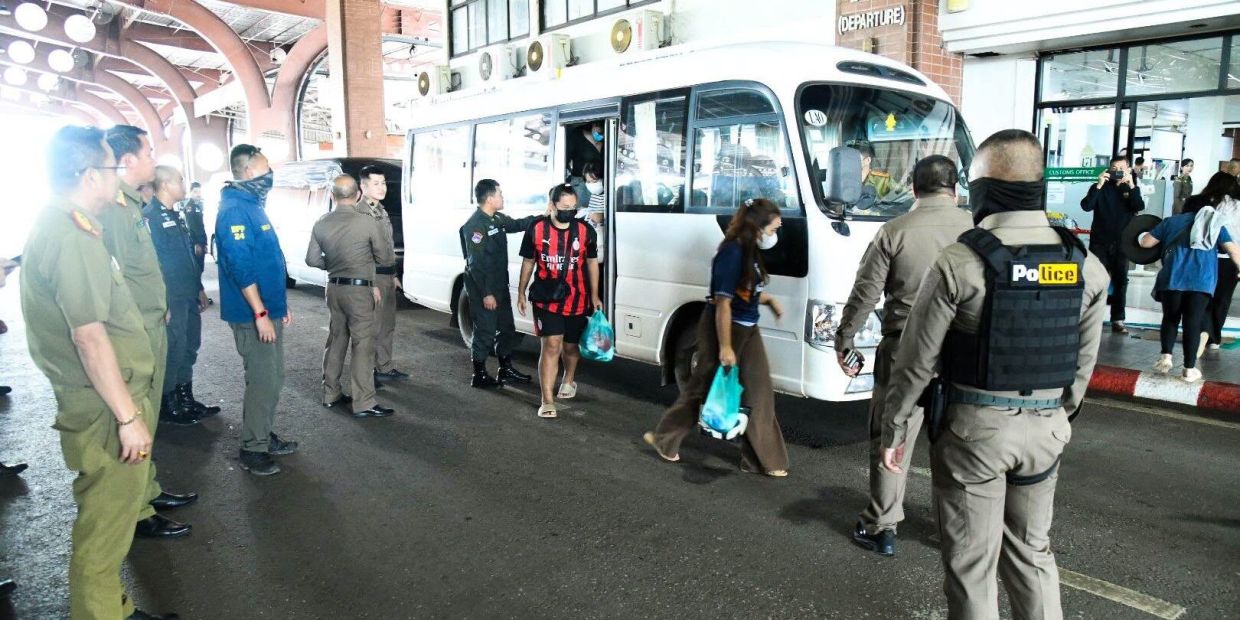
Laos handed over 32 Thai nationals to Thai authorities on 6 August at the First Lao-Thai Friendship Bridge connecting Vientiane Capital and Nong Khai, marking another step in the country's increasingly aggressive response to transnational cybercrime networks operating within its borders. The deportation came after authorities detained this group during a major police operation at the ST Vegas complex, a facility in Dongphosy village, Hatxayfong district, where enforcement teams had uncovered what officials characterised as a significant hub for online fraud and illegal gambling operations.
The raid on 18 July at ST Vegas yielded one of the most substantial enforcement actions Laos has mounted in recent months. Police detained a total of 589 individuals representing four different nationalities: 373 Thai nationals constituted the largest single group, followed by 199 Lao nationals, 15 Vietnamese nationals, and two Cambodian nationals. The breadth of the dragnet underscores how these scam networks operate across Southeast Asia, drawing manpower and participation from multiple countries and representing a genuine regional security concern that extends well beyond Laotian jurisdiction.
The ST Vegas operation sits within a broader campaign that Lao authorities have intensified throughout 2026, particularly in the Vientiane metropolitan area and surrounding districts. Parallel raids conducted on 1 August in Sikhottabong and Hadxayfong districts brought another 63 people into custody, including nationals from China, Cambodia, Thailand, and Laos itself. Officials indicated that these networks specifically targeted victims within China through sophisticated call-centre fraud and online scams, suggesting that Laotian territory has become a convenient operational base for criminal enterprises seeking to exploit populations across the wider region.
For Malaysia and other Southeast Asian nations, the implications are significant. The concentration of cybercrime infrastructure in Laos demonstrates how criminal networks exploit jurisdictional gaps and varying enforcement capacities across the region. Malaysia has increasingly become a source and transit point for cyber fraud victims, with citizens targeted through phone and online scams perpetrated from remote call centres. The Laotian crackdown therefore represents a critical effort to disrupt supply chains that feed these operations, though the scale of the problem suggests that arrests alone may prove insufficient without complementary regional cooperation and intelligence sharing.
Prime Minister Sonexay Siphandone highlighted the magnitude of the cybercrime challenge facing Laos when he addressed the National Assembly in July. According to his remarks, authorities had apprehended more than 4,400 individuals involved in cybercrime, online fraud, and illegal gambling cases during the first half of 2026 alone. This figure establishes context for the ST Vegas raid, which, while substantial, represents only a single operation within a much larger enforcement landscape. The numbers suggest Laos has become a focal point for transnational organised crime, whether by accident of geography or through deliberate targeting by criminal organisations seeking permissive operating environments.
Following the initial July figures, authorities have reported continued arrests that extend into subsequent months. Officials announced that more than 1,000 individuals faced detention during July itself, though these figures remain unverified through independent sources and may reflect duplicative counting or definitional inconsistencies in how authorities categorise offences. Nevertheless, the trajectory indicates Lao law enforcement has mobilised significant resources and political will to confront the problem, suggesting recognition at the highest levels that unchecked cybercrime threatens both national reputation and regional stability.
The mechanics of these operations reveal the structured nature of modern online fraud enterprises. Rather than ad-hoc criminal activity, the networks appear to function as organised businesses with defined hierarchies, technical infrastructure, and operational protocols. Call centres operate with specialised staff, technical support divisions, and management structures that allow them to process large volumes of victim interactions simultaneously. The fact that 589 people were detained in a single location, along with equipment and systems, indicates authorities disrupted an active, functioning operation rather than an abandoned facility.
Transboundary dynamics complicate enforcement responses. The heavy concentration of Thai nationals among those detained reflects both Laos's geographic proximity to Thailand and the cross-border recruitment patterns that criminal networks employ. Workers are often trafficked into these facilities under false pretences, with debt bondage and coercion preventing them from leaving. Understanding this labour dimension matters for Malaysia, where some arrested participants in cybercrime networks have claimed they were unaware of the full scope of their involvement or were themselves victims of human trafficking.
The deportation process itself, while representing a cooperative gesture, raises questions about follow-up investigation and prosecution. Handing individuals to Thai authorities does not necessarily guarantee they will face serious consequences; Thailand's own capacity to investigate and prosecute cybercrime has historically lagged enforcement needs. For Malaysian authorities coordinating with Lao counterparts, ensuring that deportations result in meaningful legal accountability remains essential to disrupting these networks rather than simply rotating personnel between jurisdictions.
Laos's escalating enforcement campaign reflects international pressure that has accumulated over years of complaints from neighbouring countries and international organisations regarding the permissive environment for cybercrime. However, sustained action will require maintaining political commitment despite the resource drain of continuous large-scale operations. The country lacks the technical capacity and financial resources that Malaysia and other wealthier ASEAN members possess for cybercrime investigation, meaning Laotian authorities depend on cooperation from abroad for forensic analysis, intelligence development, and follow-up prosecution support.
For Malaysia's cybercrime victim population and law enforcement community, the ST Vegas raid and ongoing Laotian crackdown offer cautious optimism. Disrupting a single major operation may temporarily displace criminal activities rather than eliminating them, but sustained pressure across multiple sites and jurisdictions can raise operational costs and create deterrence effects. The challenge ahead lies in translating enforcement successes into architectural changes that make Laos a permanently less hospitable environment for these networks, requiring investments in border security, telecommunications regulation, and financial transparency measures that exceed current Laotian capacity without external assistance.

