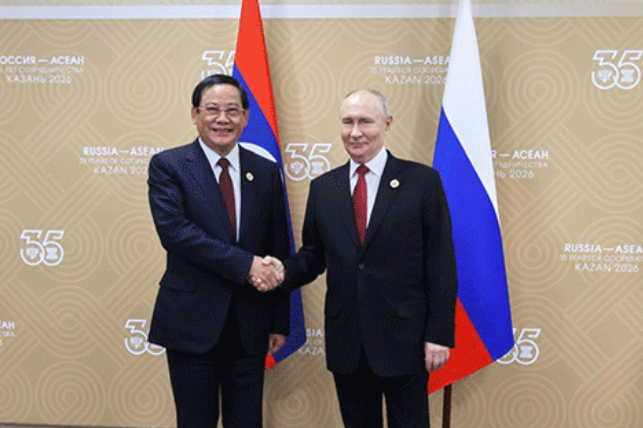
Laos and Russia have reinforced their long-standing partnership through high-level diplomatic engagement, with Prime Minister Sonexay Siphandone and President Vladimir Putin meeting during the Russia-Association of Southeast Asian Nations Summit in Kazan. The encounter represented a significant milestone in regional diplomacy, occurring as Sonexay concluded his inaugural official visit to Russia since assuming office in August 2023, and underscoring Moscow's sustained interest in deepening ties with Southeast Asian nations despite international isolation.
The June 14-17 visit, conducted at the invitation of Russian Prime Minister Mikhail Mishustin, served as a platform for both nations to chart an expanded trajectory of cooperation. Putin's statements to the Kremlin reflected Russia's calculation that strengthening relationships with smaller Southeast Asian partners remains strategically valuable, particularly given the 2026 milestone marking 35 years of Russia-ASEAN diplomatic engagement. This positioning suggests Moscow views its Laotian ties as instrumental to maintaining broader regional influence and demonstrating continued diplomatic momentum in Southeast Asia.
A centrepiece of the discussions was the signing of an intergovernmental agreement on cooperation in peaceful nuclear energy applications. Putin characterised this accord as a significant achievement, emphasising that it establishes the legal foundation for Russia to construct a small nuclear power plant in Laos utilising Russian technology. For Laos, this represents a strategic energy diversification initiative, as the landlocked nation seeks to develop its power generation capacity beyond hydroelectric sources. The agreement carries broader implications for regional energy politics, as it positions Russia as a technological partner in Southeast Asia's nuclear ambitions during a period when China has dominated such infrastructure projects in the region.
The nuclear cooperation framework reflects deeper geopolitical calculations extending beyond energy sectors. By facilitating Lao access to Russian nuclear expertise, Moscow reinforces bilateral ties whilst establishing long-term economic and technological interdependencies. For Malaysian observers, this development illustrates how smaller Southeast Asian nations negotiate with major powers, balancing engagement with traditional partners like Russia against economic realities dominated by China and growing strategic partnerships with the West. Laos's acceptance of Russian nuclear technology may influence regional discussions on energy sovereignty and technological transfer within ASEAN.
Beyond nuclear energy, bilateral cooperation encompasses traditional sectors where Russia maintains comparative advantages. The two sides reviewed collaborative opportunities in energy extraction, industrial development, agricultural projects, mining operations, digital economy initiatives, banking relationships, transportation infrastructure, tourism development, and educational exchange. This broad sectoral engagement demonstrates that Laos-Russia relations extend substantially beyond symbolic gestures, encompassing practical commercial partnerships that generate mutual economic benefits. The range of cooperation areas reflects Russia's attempt to position itself as a comprehensive development partner rather than merely a geopolitical counterweight.
Educational cooperation represents a particularly enduring dimension of the partnership. Prime Minister Sonexay specifically acknowledged Russia's ongoing provision of annual scholarships and training programmes benefiting Lao nationals, with particular emphasis on developing government officials and technical specialists. This human capital investment creates generational ties between the nations, as Lao decision-makers educated in Russian institutions develop professional networks and policy perspectives influenced by their training experiences. For Malaysia, which competes with Russia in regional educational markets, this underscores the strategic value Russia attaches to sustaining influence through educational channels.
The planned Laos-Russia Friendship School in Vientiane exemplifies institutionalised cooperation extending cultural and diplomatic dimensions beyond governmental relations. Both nations anticipate completion of this educational facility, which will serve as a physical manifestation of their partnership whilst providing Russian language and culture instruction to Lao students. Such institutions generate long-term constituency support for bilateral relationships by embedding them in civilian educational infrastructure and creating sustained interaction between populations.
Sonexay's participation in addressing a Laos-Russia business forum during his visit highlighted commercial dimensions of the relationship. By bringing together business representatives from both nations, the forum aimed to identify investment opportunities and expand trade flows. This business engagement suggests that beyond state-to-state diplomacy, Russian companies seek commercial opportunities in Laos, whilst Lao enterprises explore market access to Russian and Eurasian markets. For regional observers, this commercial engagement demonstrates how diplomatic partnerships translate into economic activities that affect broader Southeast Asian trade dynamics.
Diplomatic reciprocity manifested through symbolic gestures reinforced the partnership's cultural foundations. Sonexay presided over the handover of two elephants to the Kazan Zoo as a gift from Laotian President Thongloun Sisoulith and the Lao people, commemorating both the 65th anniversary of Laos-Russia diplomatic relations and Russia Day on June 12. Such ceremonial exchanges, whilst seemingly peripheral to substantive policy discussions, carry significance in diplomatic protocol by demonstrating goodwill and cultural respect. The elephant transfer connected to Laos's cultural identity as a nation with Asian elephant heritage, symbolically positioning Russia as appreciative of Lao cultural contributions.
Laos's strategic positioning within ASEAN provides contextual importance for evaluating the bilateral relationship. As a communist nation and longstanding Russian ally, Laos occupies a distinctive role within the regional bloc, maintaining warmer relations with Moscow than most other ASEAN members. This positioning allows Russia to claim active engagement with ASEAN despite limited relationships with other major member states. Conversely, Laos benefits from Russia's diplomatic support at international forums, including the United Nations, where Moscow and Vientiane coordinate positions on regional and global issues.
Putin's acknowledgment of President Thongloun's attendance at Russia's Victory Day celebrations in May and the participation of a Lao People's Army unit in the 80th-anniversary parade commemorating Soviet victory in World War II carried layered significance. These participatory gestures demonstrated Lao willingness to engage in Russian historical commemoration, strengthening emotional and historical ties between the nations. For contemporary geopolitics, such participation signals alignment with Russian narratives regarding historical events and current international affairs, particularly regarding perceptions of Western actions.
The timing of this diplomatic engagement within the Russia-ASEAN Summit context amplified its significance. By hosting the summit, Russia positioned itself as an engaged regional actor despite international sanctions and Western attempts to isolate Moscow. Laos's prominent role in the summit, combined with Sonexay's separate bilateral meetings with both Putin and Mishustin, elevated Vientiane's diplomatic profile within Russian calculations. This elevated attention suggests Russia views Laos as strategically important beyond its modest economic size, valuing its role as a reliable partner and potential advocate within ASEAN deliberations.
The multifaceted nature of Laos-Russia cooperation spanning nuclear energy, education, commerce, culture, and defence reflects a comprehensive strategic partnership designed to deepen mutual dependence and reinforce political alignment. For Malaysia and other Southeast Asian nations monitoring regional dynamics, the Laos-Russia relationship illustrates how smaller nations navigate great power competition by maintaining diversified partnerships. The nuclear agreement particularly signals that Russian technological partnerships remain attractive to regional actors despite international pressures, potentially influencing discussions within ASEAN regarding energy policy and technology transfer from major powers.

