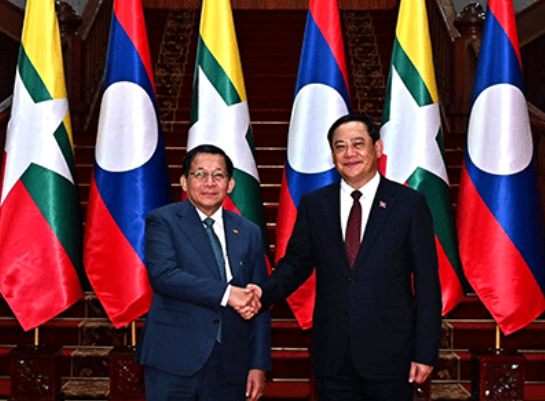
Myanmar's President Min Aung Hlaing wrapped up a high-profile state visit to Laos this week, cementing a partnership that both countries are positioning as central to regional stability and economic development in Southeast Asia. The three-day visit from July 3-5, which saw Myanmar's leader received with full presidential honours at Vientiane's Presidential Palace, signals strengthening alignment between two of the region's most strategically positioned nations as they navigate evolving geopolitical currents and development priorities.
The timing of the visit carries symbolic weight beyond routine diplomatic protocol. Both nations marked the 70th anniversary of their diplomatic relations, a milestone that prompted reflection on seven decades of engagement rooted in shared revolutionary history and geographical proximity. Laotian President Thongloun Sisoulith characterised the occasion as a "new milestone" in cementing traditional bonds, while Myanmar's leader used the platform to emphasise his government's commitment to regional partnership at a moment when Myanmar's international standing has been subject to considerable scrutiny and debate.
During formal talks, the two presidents outlined an ambitious agenda spanning multiple economic and security domains. Political cooperation remains the cornerstone, with both sides emphasising the regular exchange of high-level visits and the mutual trust underpinning their relationship. Beyond ceremonial gestures, however, the substance of their discussions touched on practical challenges that affect both nations' development trajectories. Defence and security coordination, trade expansion, investment frameworks, transport linkages, energy partnerships, labour mobility and educational exchanges all featured prominently in their deliberations.
The visit extended beyond the presidential level, demonstrating the breadth of institutional engagement both countries are cultivating. Prime Minister Sonexay Siphandone met separately with President Min Aung Hlaing to explore avenues for deepening bilateral ties, while Xaysomphone Phomvihane, President of Laos' National Assembly, held parallel discussions with the Myanmar leader on strengthening parliamentary cooperation. This multi-layered approach reflects recognition that sustainable regional partnerships require alignment not only among executives but also within legislative bodies tasked with ratifying and monitoring bilateral agreements.
From a Southeast Asian perspective, the visit underscores an important dynamic within the region's shifting architecture. Laos, as chair of the Association of Southeast Asian Nations (Asean) at various points and a consistent voice for maintaining multilateral frameworks, has positioned itself as a bridge-builder between nations navigating complex geopolitical terrain. Myanmar's participation in regional mechanisms remains contested internationally, yet its geographic and strategic importance to Laos makes bilateral engagement a pragmatic necessity independent of broader international controversies. The two sides explicitly committed to strengthening collaboration through Asean, the United Nations, and the Mekong-Lancang Cooperation framework, signalling their intention to work through established regional channels.
Cross-border issues featured prominently in discussions, with particular emphasis on security coordination, information sharing and environmental challenges. The commitment to addressing cross-border air pollution reflects growing recognition that transnational environmental problems demand joint governance responses. Border security cooperation, meanwhile, remains perpetually relevant given the porous nature of the Myanmar-Laos frontier and the challenges both nations face in managing irregular migration, trafficking and resource management in remote border regions.
Two cooperation agreements were formalised during the visit, reflecting areas where both nations identified concrete opportunities for mutual benefit. A tourism memorandum of understanding between Myanmar's Ministry of Hotels, Tourism and Culture and Laos' Ministry of Culture and Tourism targets the growing number of regional travellers exploring Southeast Asia. Complementing this initiative, a "friendship city" agreement between Vientiane and Naypyidaw establishes a framework for municipal-level exchanges and people-to-people connections. These agreements, while modest in scope, represent low-risk mechanisms for building institutional relationships and fostering familiarity between citizens of both nations.
President Min Aung Hlaing's selection of Laos as his first official foreign destination for state visits since taking office carried diplomatic significance that Lao leaders were quick to highlight. Xaysomphone noted that Laos became the first Asean member state to receive such a visit, a distinction that simultaneously reflects the depth of Myanmar-Laos ties and Myanmar's relative isolation from other regional capitals given international concerns about its governance trajectory. For Laos, the prioritisation affirmed its status as a close partner and justified its efforts to maintain constructive engagement across political divides within the region.
The cultural and ceremonial dimensions of the visit reinforced emotional and historical bonds. President Min Aung Hlaing's wreath-laying at Vientiane's Unknown Soldier Monument paid homage to shared revolutionary legacies, while his participation in a traditional Baci ceremony and state banquet allowed for informal relationship-building among senior officials. These moments, often overlooked in analyses focused on technical cooperation agreements, perform essential functions in personalising diplomatic relationships and building the informal networks through which governments often operate most effectively.
The planned extension to Luang Prabang, a Unesco World Heritage city, provided opportunity for the Myanmar President to engage with Laos' cultural patrimony while experiencing firsthand the assets driving the nation's tourism ambitions. Such visits serve multiple functions: they allow visiting dignitaries to grasp host nations' development priorities and economic models, while demonstrating commitment to understanding partner nations beyond capital cities and government buildings.
From a Malaysian and broader Southeast Asian standpoint, the Myanmar-Laos strengthening warrants attention as part of the region's continuing realignment. Both nations remain committed to Asean frameworks and multilateral engagement, even as they pursue bilateral partnerships that may not always align with all member states' preferences. The emphasis on Mekong-Lancang Cooperation and participation in mechanisms beyond traditional Asean structures reflects how regional middle powers are diversifying their diplomatic portfolios in response to shifting strategic circumstances.
Looking forward, the concrete outcomes from this visit—the cooperation agreements, the strengthened parliamentary ties, and the expanded coordination mechanisms—will require sustained implementation efforts. The establishment of a Laos-Myanmar Joint Committee on Bilateral Cooperation provides institutional machinery for maintaining momentum between high-level visits. Success will depend on whether relevant agencies in both nations dedicate resources and political will to translating aspirational language into tangible results across trade, investment, energy and security domains.
The visit ultimately underscores a fundamental truth about Southeast Asian regionalism: despite the region's diversifying partnerships and complex international alignments, traditional bilateral relationships rooted in geography, history and mutual interest continue to provide the foundation upon which broader regional cooperation rests. Myanmar and Laos, bound by shared borders, overlapping cultural influences and complementary strategic interests, have reaffirmed their commitment to deepening an engagement that both nations regard as vital to their respective futures and to regional stability more broadly.

