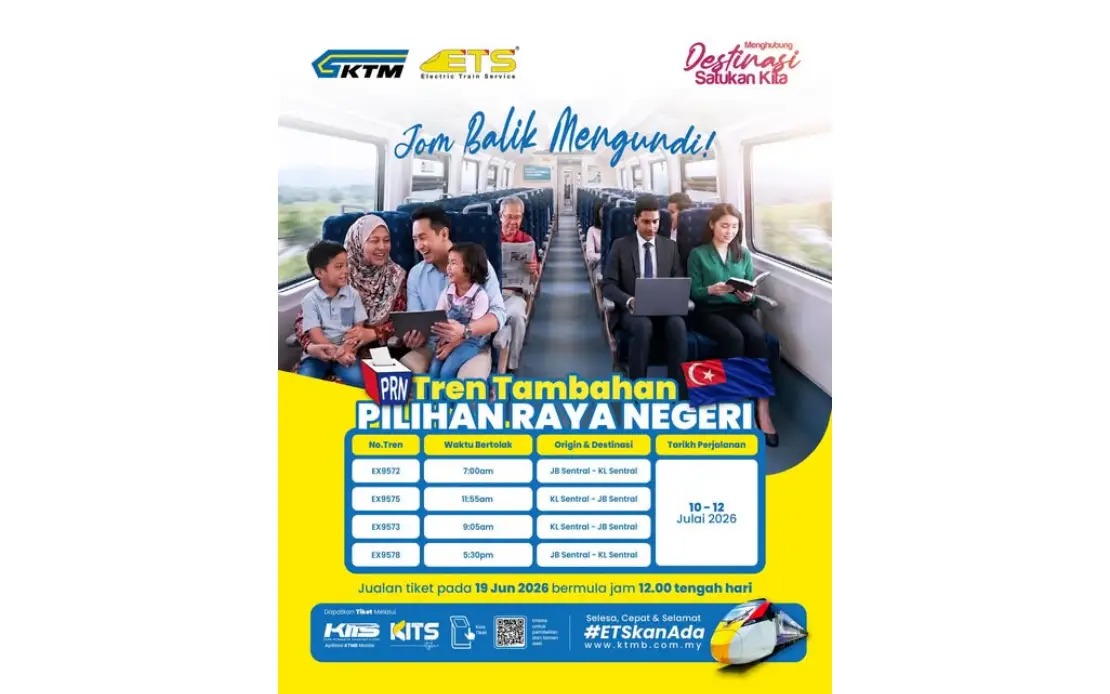
Keretapi Tanah Melayu Berhad (KTMB), Malaysia's primary rail operator, has moved to expand its transport capacity as voters prepare to return to Johor for the upcoming state election. The additional ETS services, which will run between July 10 and 12, represent the company's effort to ease the logistical challenge of moving large numbers of Malaysians back to their constituencies for the crucial vote.
The timing of these enhanced rail services reflects the anticipated surge in travel demand typical of major electoral events. Given that voting privileges are restricted to those physically present in their registered constituencies, many Johor residents working in other parts of the country face the necessity of travelling south for the July 11 polling day. KTMB's intervention acknowledges this predictable spike in passenger numbers and seeks to prevent overcrowding and journey delays that might discourage participation.
Ticket procurement has been streamlined across multiple platforms to maximise accessibility for diverse traveller preferences. Sales commence at noon on the announcement date, with the company offering purchasing options through its dedicated KTMB Mobile app, the KITS Style app, the main online portal at online.ktmb.com.my, and traditional ticket kiosks at stations. This omnichannel approach recognises that Malaysian commuters operate across varying comfort levels with digital technology, ensuring no eligible voter is excluded by unfamiliar booking procedures.
The Election Commission formally set July 11 as polling day following the dissolution of the Johor State Legislative Assembly on June 1. This timeline provided KTMB with sufficient notice to coordinate scheduling changes with existing passenger services, arranging additional rolling stock allocation, and staffing requirements across multiple routes. The coordination between electoral and transport authorities illustrates the logistical coordination required to facilitate democratic participation in a geographically dispersed nation.
For Johor residents based in the Klang Valley, Selangor, and other northern employment centres, train travel offers a cost-effective and fuel-efficient alternative to driving during peak election season. The ETS network's development over the past decade has substantially reduced intercity travel times, making the southern routes increasingly attractive. A return journey from Kuala Lumpur to Johor Bahru by train is considerably cheaper than driving when accounting for fuel, tolls, and parking, considerations that weigh heavily for middle-income voters.
The three-day service window—July 10 through 12—accommodates voters with staggered work schedules and varying travel preferences. Some will depart immediately prior to polling day to minimise time away from employment, whilst others may opt for earlier departure to avoid the congestion anticipated on July 11 itself. The extended window also permits return journeys on July 12 for those who cannot travel back immediately after voting.
This initiative carries particular significance for Johor's urban electorate, notably those in highly mobile professional categories who have relocated for career advancement. Facilitating their participation addresses a chronic challenge in modern democracies where rapid urbanisation and economic centralisation concentrate employment in capital regions whilst voters retain constituency ties elsewhere. By reducing the friction costs of voting, enhanced transport services can meaningfully influence turnout levels.
The coordination between KTMB and the electoral process also demonstrates the state's capacity to mobilise infrastructure in service of democratic imperatives. Unlike nations with fixed electoral cycles, Malaysia's ability to announce elections and implement supporting logistics within compressed timeframes requires both institutional flexibility and practical resourcefulness. KTMB's rapid deployment of additional services exemplifies this responsiveness.
For the broader Southeast Asian context, Malaysia's rail infrastructure plays an increasingly important role in domestic mobility patterns. As fuel prices fluctuate and congestion intensifies around metropolitan areas, intercity rail captures growing passenger volumes. Election-related travel represents a predictable demand peak that railway operators increasingly anticipate and accommodate, reflecting rail's maturation as essential national transport infrastructure rather than supplementary capacity.
The practical success of this initiative will likely influence how KTMB approaches future electoral events. Measurable data on utilisation rates, booking patterns, and service quality during this election cycle will inform subsequent operations. Railway operators across Southeast Asia monitoring Malaysia's election logistics may adopt comparable strategies in their own jurisdictions, particularly as democratic participation gains recognition as a transport planning consideration alongside tourism and regular commuting.
Ultimately, KTMB's additional ETS services represent more than logistical accommodation—they signal institutional recognition that democratic engagement requires practical enabling conditions. Removing transport barriers to voting participation, however modestly, contributes to the democratic process's functionality and legitimacy across the nation's diverse geography.

