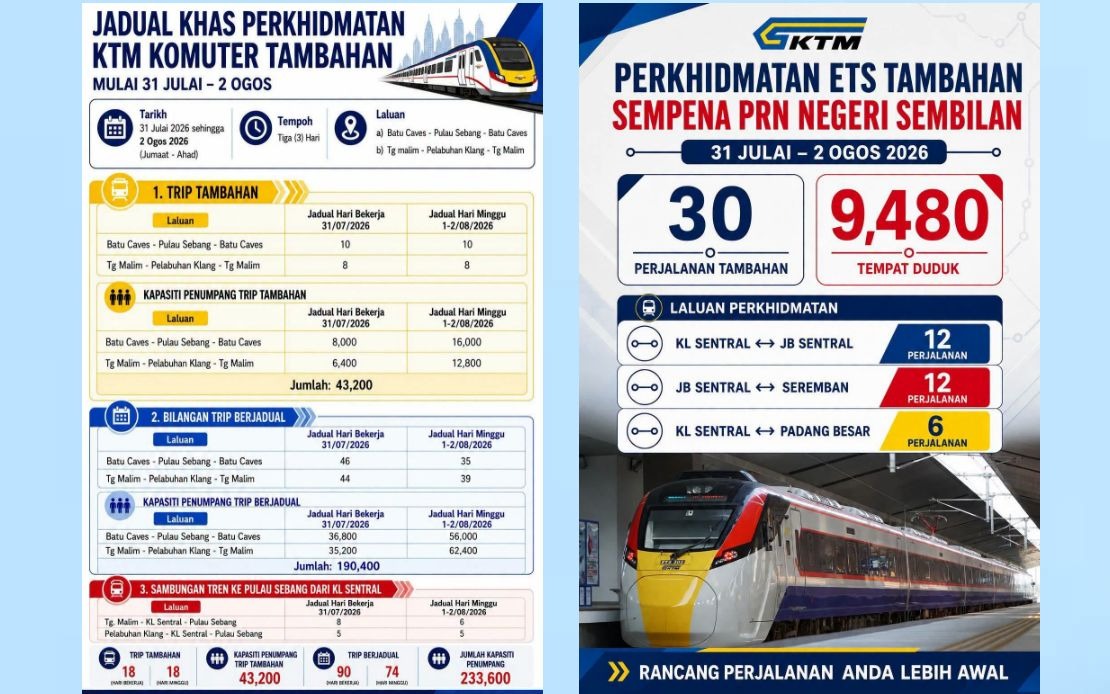
Keretapi Tanah Melayu Berhad (KTMB) is ramping up train services across its network to facilitate voter movement during the Negeri Sembilan state election. The railway operator announced that it will operate additional KTM Komuter and Electric Train Services (ETS) trains from July 31 through August 2, strategically timed to help citizens returning to the state to cast their ballots on August 1, 2026. This operational surge reflects the logistics challenge of managing mass transit during major electoral events when voter participation patterns create unpredictable surges in passenger demand across key corridors.
The decision to expand capacity underscores how Malaysian transport authorities plan ahead for democratic events, recognising that many voters working in the Klang Valley and other major urban centres need reliable connections home. KTMB's three-day initiative aims to prevent overcrowding and service disruptions by distributing additional trains strategically across its most-travelled routes. The operator is deploying a total of 48 supplementary train journeys—split evenly between Komuter and ETS services—representing substantial operational coordination during a period when election-related travel patterns can overwhelm standard scheduling.
For KTM Komuter services, KTMB will run 18 additional trips on Friday, July 31, following weekday timetables, with another 18 trips scheduled across the weekend of August 1-2 using weekend patterns. This approach maintains familiar scheduling rhythm while increasing frequency. The reinforced Komuter network focuses on two key routes: the Batu Caves–Pulau Sebang–Batu Caves service will receive 10 extra trips, while the Tanjung Malim–Port Klang–Tanjung Malim corridor gets eight additional journeys. These routes service critical commuter populations who depend on affordable rail access, particularly workers unable to use private vehicles.
The cumulative capacity increase is substantial. Across all three days, KTMB anticipates moving 233,600 passengers through its network, comprising 190,400 through existing scheduled services and an additional 43,200 through the new trains. This represents a 23 percent boost to baseline capacity—a meaningful cushion against congestion and delays. The specificity of this figure suggests KTMB has modelled expected voter travel patterns, likely based on historical election data and registration records for Negeri Sembilan constituencies.
ETS services receive equally ambitious expansion, with 30 additional high-speed train trips introduced across three critical routes. The Johor Bahru Sentral to Seremban to Johor Bahru Sentral corridor will see 12 extra services, while the Kuala Lumpur Sentral to Johor Bahru Sentral corridor also receives 12 additional trips. The longer northern route to Padang Besar receives six supplementary services. Together, these ETS additions offer 9,480 seats, enabling faster transit for voters with longer journeys.
Sample ETS schedules reveal KTMB's granular planning. For the Johor Bahru-Seremban route, train EP9636 departs Johor Bahru at 2.10pm, arriving in Seremban at 5.15pm, while the return service EP9637 leaves Seremban at 5.45pm and reaches Johor Bahru at 8.50pm. Morning options include train EP9630 departing Johor Bahru at 6.15am (9.20am arrival) and train EP9633 leaving Seremban at 9.50am (12.55pm arrival), accommodating both early and mid-day travellers. For the Kuala Lumpur route, departures span from 7.00am through evening hours, ensuring voters across different schedules can find suitable connections.
The timing of this expansion coincides with temporary suspension of the Klang Valley Electric Double Track Infrastructure Facilities Upgrading Project Phase 2 (KVDT2) work. By halting maintenance and upgrading activities on affected routes during these three days, KTMB prioritises uninterrupted service flow when demand peaks. This operational trade-off—deferring infrastructure work to accommodate electoral movement—reflects how transport planning must flex around civic events, accepting temporary project delays to fulfil broader social responsibilities.
For passengers on the Tanjung Malim–Port Klang Komuter route, KTMB has arranged a transfer procedure to maintain connectivity. Commuters are instructed to change trains at Kuala Lumpur Sentral Station to continue toward Seremban Station or Pulau Sebang Station, which adds journey complexity but preserves destination access. This contingency planning demonstrates how operators manage route constraints by redesigning passenger flows rather than simply cancelling services.
The announcement carries particular significance for Negeri Sembilan's diaspora workforce. Many state residents work in Federal Territories or Selangor, where wage and employment opportunities concentrate in the Klang Valley manufacturing, services, and technology sectors. Election participation requires physical presence in one's state of registration, creating a time-bounded transportation crisis that KTMB's capacity increase directly addresses. Without these measures, voters might face impossible queues or missed departure windows, effectively creating barriers to franchise exercise.
Southeast Asian electoral logistics increasingly hinge on transport coordination, particularly as urbanisation disperses workers far from family constituencies. Malaysia's experience with KTMB's election-period expansion offers a model: identifying predictable demand surges, deploying additional rolling stock, pausing maintenance to preserve network fluidity, and communicating schedules clearly to the public. This approach prevents the transportation chaos that can undermine election credibility when citizens cannot reach polling stations despite willingness to vote.
KTMB has urged the public to plan journeys in advance and consult updated timetables through official channels. This communication strategy—emphasising passenger responsibility for checking information—acknowledges that despite operational increases, services will remain busier than usual, requiring deliberate coordination. Voters are implicitly advised to travel at off-peak times within the three-day window where possible, spreading demand across available capacity.
The broader implications for Malaysian transport policy centre on whether rail infrastructure has adequate baseline capacity for routine operations plus predictable surge demand. If election periods consistently overwhelm the system despite additional trains, this signals long-term underinvestment in rail corridors. Conversely, KTMB's proactive deployment suggests the operator believes current infrastructure, when fully utilised, can accommodate demand spikes with temporary operational adjustments. The next test will come if voter turnout rates in Negeri Sembilan prove higher than anticipated, potentially exposing capacity limits even with 48 additional trains. How smoothly August 1-2 unfolds will provide data informing future election-period planning across the national railway network.

