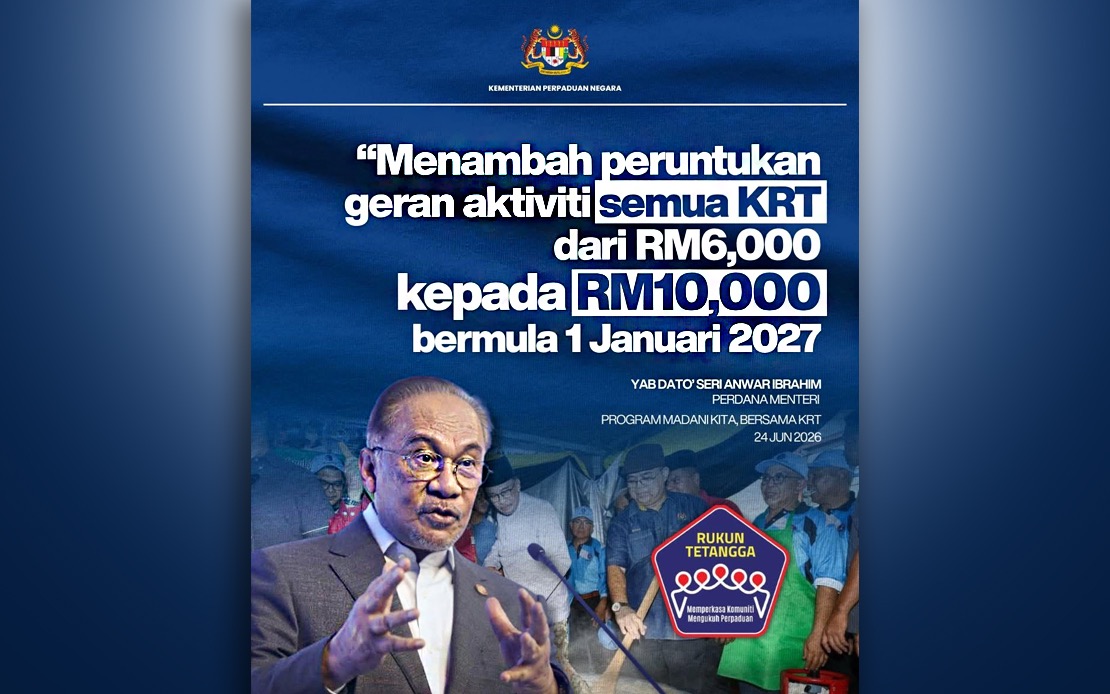
The Malaysian Government has announced a significant funding uplift for its neighbourhood watch network, with all 8,615 KRT (Kawasan Rukun Tetangga) committees nationwide set to receive substantially increased annual grants beginning next year. The grant amount will jump from RM6,000 to RM10,000 per unit, a 67 per cent increase designed to enhance operational capacity at the community level. Prime Minister Datuk Seri Anwar Ibrahim unveiled the measure during the MADANI KITA programme in Dataran Segamat, Johor, signalling renewed government commitment to grassroots structures that have served Malaysia for over five decades.
National Unity Minister Datuk Aaron Ago Dagang characterised the funding increase as evidence of government recognition for KRT's foundational role in building community cohesion and social stability. He framed the decision within the broader MADANI framework, which emphasises bottom-up nation-building through empowerment of local movements rather than top-down administration. By directing additional resources to these neighbourhood units, the Government intends to catalyse more community-driven initiatives that address local needs while reinforcing the bonds holding Malaysian society together across diverse ethnic and religious lines.
The scale of KRT's existing reach underscores why the funding injection matters for Malaysian policymakers. With approximately 250,000 active members across the country, these committees directly touch the lives of more than 12 million Malaysians, making them among the most extensive grassroots networks in the nation's civic infrastructure. Over the past twelve months alone, KRT units organised over 100,000 community activities, ranging from neighbourhood security patrols to social welfare initiatives and educational programmes. This operational footprint places KRT in a unique position to identify and address local concerns before they escalate into broader social issues.
The enhanced funding is expected to broaden the scope and quality of programmes delivered at the community level. With an additional RM4,000 annually per committee, neighbourhood units can now sustain initiatives that previously faced resource constraints. These include strengthened unity activities designed to foster inter-communal understanding, formal community development projects addressing local infrastructure or amenities, expanded welfare support for vulnerable residents, educational scholarships or learning programmes for youth, enhanced neighbourhood security measures, structured volunteerism activities, and microeconomic initiatives that build local entrepreneurship. The expanded budget allows committees to move beyond ad hoc activities towards more strategic, sustained interventions.
For Malaysian neighbourhoods, the practical implications are substantial. Many KRT committees in urban and suburban areas have operated with minimal budgets, forcing reliance on volunteer labour and contributions from committee members. The additional funding transforms what was often a labour of love into a more professionally managed operation capable of planning multi-year initiatives. In rural areas where government services are sometimes distant, KRT committees serve as primary points of contact for community organising, making the funding increase particularly significant for underserved populations.
Government messaging emphasises that the funding increase reflects philosophical commitment to Malaysia's multicultural social compact. Minister Aaron stressed that neighbourliness—the practical reality of people from different backgrounds living in proximity and managing shared spaces—represents the nation's core strength as a diverse society. KRT committees, by design, operate at the granular level where this neighbourliness either flourishes or deteriorates. When committees function effectively, they create platforms for trust-building across religious and ethnic lines, establish dispute-resolution mechanisms for local tensions, and create shared identity based on common residential location rather than sectarian affiliation. The funding increase essentially bets that investing in these mechanisms yields returns in national stability and social cohesion.
The timing of the announcement—effective January 1, 2027—suggests deliberate government planning to incorporate the increased commitments into budget cycles. This phased approach provides committees time to plan how to deploy the additional resources strategically rather than face sudden influxes with no clear allocation framework. Government officials have indicated that ministry oversight will ensure funds are utilised optimally, suggesting accountability measures will accompany the increased disbursements. This supervisory element distinguishes the initiative from simple cash transfers, embedding expectations of measurable community outcomes.
Regionally, Malaysia's emphasis on formalising and funding neighbourhood structures offers a model worth observing. Southeast Asian nations frequently struggle to connect central government programmes with community-level implementation, creating implementation gaps and citizen disengagement. By strengthening KRT funding and explicitly framing neighbourhood committees as pillars of the MADANI vision, Malaysia positions grassroots civic engagement as central to its development model rather than peripheral. This could influence how other regional governments conceptualise their relationship with community structures, particularly in countries managing ethnic or religious diversity.
For KRT committees themselves, the funding increase carries implicit expectations. With resources comes accountability to demonstrate impact beyond activity counts. Communities will likely expect committees to produce tangible outcomes—measurable improvements in neighbourhood safety, documented reduction in inter-communal tensions, successful completion of infrastructure projects, or demonstrable enhancement of welfare delivery. This performance dimension may require some committees to strengthen their administrative and planning capacities, potentially necessitating training programmes or technical support from the Ministry of National Unity.
The announcement also signals government prioritisation of community-level unity work at a time when social media and economic pressures create centrifugal forces in Malaysian society. Rather than respond reactively to communal tensions, the Government is investing proactively in structures designed to prevent tensions from crystallising. Whether this approach succeeds depends significantly on committee quality, local leadership, and how effectively neighbourhood-level relationships translate into measurable social outcomes. The funding increase provides necessary resources, but success ultimately depends on how effectively these additional means are deployed.
Looking forward, the KRT funding increase represents a substantial commitment—approximately RM86.15 million in additional annual expenditure once fully implemented. This investment reflects confidence in the neighbourhood committee model as a vehicle for nation-building and suggests the Government views grassroots structures not as administrative convenience but as strategic infrastructure for maintaining social stability in an increasingly complex society. For the committees themselves, the challenge now lies in demonstrating that enhanced resources translate into enhanced community wellbeing and stronger national bonds.

