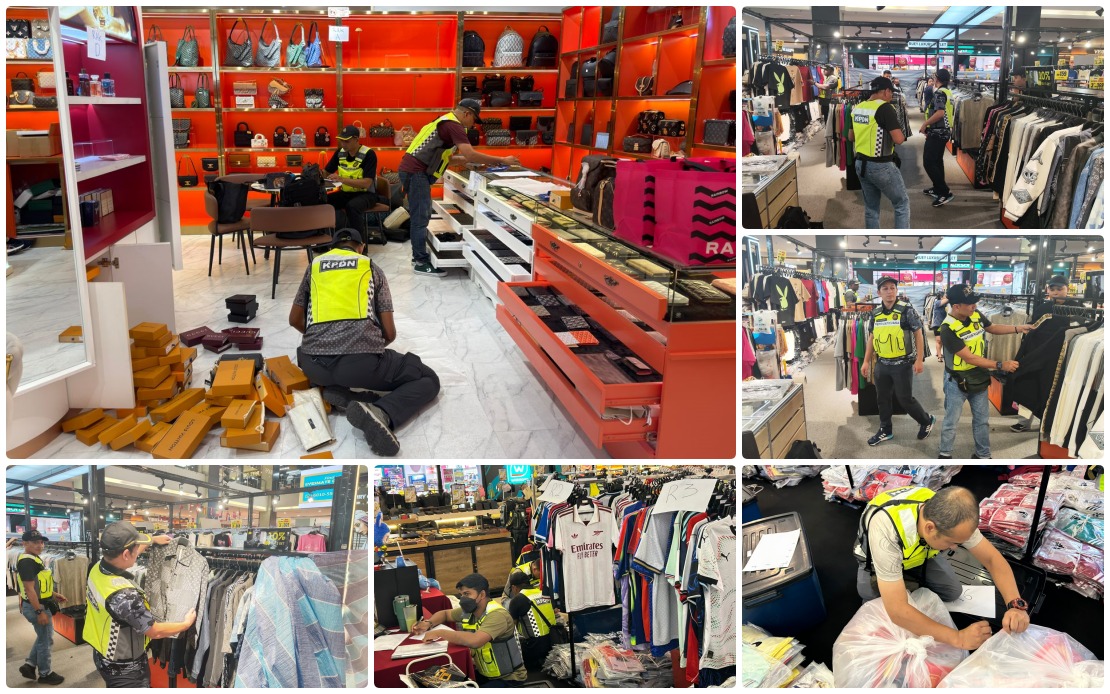
The Ministry of Domestic Trade and Cost of Living (KPDN) has moved decisively against intellectual property infringement in Johor, conducting coordinated raids that netted RM600,000 in suspected counterfeit merchandise at three separate Johor Bahru locations on June 15. The enforcement action, announced through the Putrajaya Enforcement Division, signals intensifying efforts to combat the proliferation of fake branded goods that have become increasingly sophisticated and widespread across Malaysian retail channels.
The operation emerged from sustained intelligence work spanning a full month, during which enforcement teams identified traders operating from strategic positions within major supermarket locations while simultaneously functioning as wholesalers supplying further downstream distribution networks. This multi-tier distribution pattern suggests the counterfeit operations had achieved considerable scale and market penetration, potentially affecting numerous retailers across the state. The identification of supplier-distributor relationships rather than isolated retail outlets points to a more organized and entrenched counterfeiting infrastructure than typical small-scale knockoff sales.
According to Datuk Azman Adam, the KPDN enforcement director-general, the seized inventory encompassed a diverse range of luxury-sector goods including apparel, handbags, wallets, belts, and perfumery items, all bearing unauthorized reproductions of established brand trademarks. The breadth of product categories suggests the operation capitalized on consumer demand across multiple lifestyle segments. Beyond the physical merchandise, enforcement teams recovered related business documentation, which will likely prove crucial in establishing distribution chains and identifying connected retailers who may have purchased from these distributors.
Four individuals, including the premises owner and caretaker, were detained pending investigation, with authorities viewing them as central to operational management. Their detention marks the beginning of what will likely be an extended inquiry into the full scope of the enterprise, potentially uncovering additional supply chain participants and retail partners. The involvement of multiple detained parties suggests coordinated business operations rather than incidental infringement by casual operators.
The legal framework underpinning these prosecutions derives from Section 102(1)(c) of the Trademark Act 2019, which establishes liability for knowingly possessing counterfeit goods intended for commercial purposes. For individual offenders, first-time convictions carry maximum penalties of RM10,000 per item or three years imprisonment, with repeat offences escalating to RM20,000 per item or five-year sentences. Corporate entities face substantially steeper fines of RM15,000 per item initially, doubling to RM30,000 for subsequent violations.
These penalty structures, while appearing substantial, must be contextualized within the economics of counterfeiting operations. The ability to fine individual operators RM10,000 per item creates genuine financial exposure given the quantity typically recovered in enforcement actions. For corporations, the per-item penalty structure becomes particularly onerous when multiplied across large inventory seizures, potentially translating into several million ringgit in liability.
The Johor operation reflects broader Southeast Asian challenges with counterfeit product distribution. The region's geography, with porous borders and established smuggling infrastructure, creates conditions favoring illicit trade in branded goods. Malaysia's position as a significant consumer market with considerable purchasing power for luxury items makes it an attractive target for counterfeit operations, particularly when distribution can leverage proximity to Thailand and Singapore.
The intelligence-driven approach exemplified by the month-long investigation represents methodological sophistication in KPDN's enforcement capacity. Rather than reactive responses to consumer complaints, proactive market surveillance enables authorities to dismantle larger operations before they achieve maximum distribution. This approach contrasts with historical enforcement focusing primarily on street-level retailers rather than wholesale distribution points, suggesting evolved institutional capability.
For Malaysian consumers, the implications extend beyond abstract intellectual property concerns. Counterfeit products, particularly in categories like perfumery and personal care items, often contain inferior or potentially harmful substances and lack quality assurance processes. Counterfeit luxury goods perpetuate consumer deception and artificially depress perceived brand value. The operation thus protects both legitimate brand owners' market positioning and consumer welfare simultaneously.
The RM600,000 seizure value, while significant, likely represents only a fraction of active counterfeit trading within Malaysian retail ecosystems. Enforcement actions of this magnitude typically constitute punctual interventions rather than comprehensive market solutions. The scale of contraband suggests structural challenges requiring sustained commitment to enforcement infrastructure, intelligence capabilities, and cross-agency coordination.
KPDN's stated commitment to intensifying operations and refusing compromise with counterfeiters indicates recognition that trademark infringement represents a growing problem requiring elevated institutional priority. The announcement of continued enforcement focus signals that the Johor operation was not an isolated incident but part of sustained campaign strategy. This positioning suggests consumers and businesses can anticipate further enforcement actions targeting both distribution and retail sale of counterfeit merchandise.
Longer-term solutions to counterfeiting require complementary approaches beyond law enforcement, including enhanced consumer education regarding trademark verification, supply chain transparency measures by legitimate retailers, and technological anti-counterfeiting features on authentic products. The Johor operation demonstrates KPDN's willingness to engage the enforcement dimension aggressively, creating consequences for producers and distributors of fake goods. However, sustained success requires parallel progress on prevention and consumer awareness fronts.

