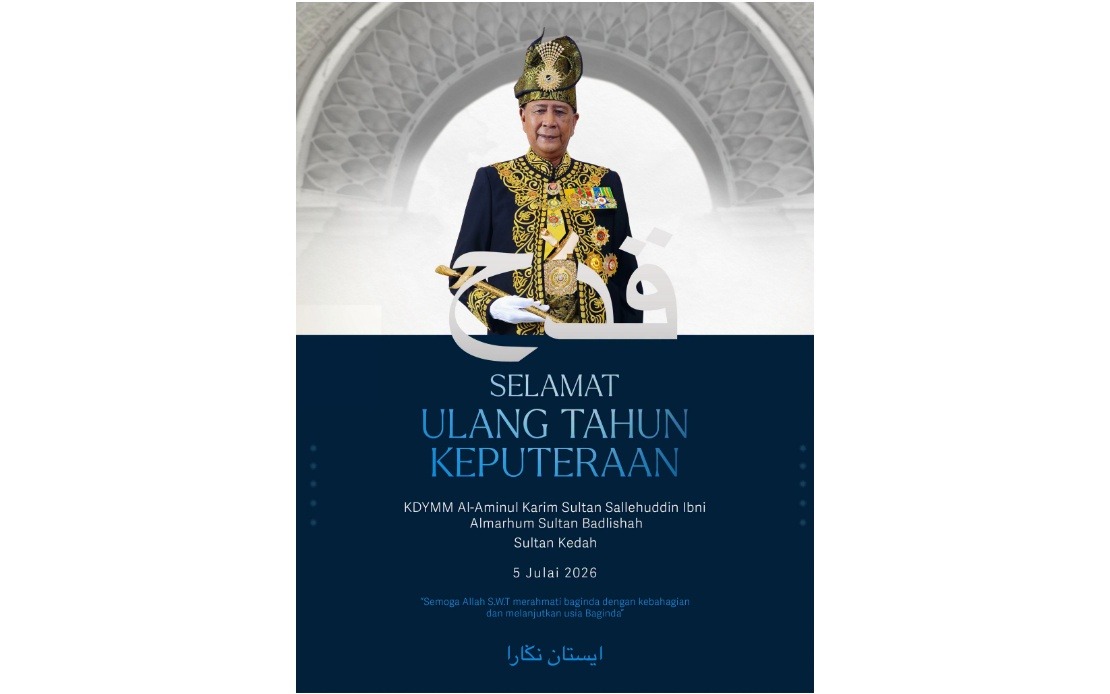
His Majesty Sultan Ibrahim, King of Malaysia, has offered his personal birthday greetings to the Sultan of Kedah, Al-Aminul Karim Sultan Sallehuddin Sultan Badlishah, who is marking his 84th birthday. The royal wishes, shared through the official Facebook account of the King, underscore the customary exchanges of goodwill that punctuate Malaysia's royal calendar and reflect the deep bonds between the nation's constitutional monarchy and its component state rulers.
In his message, the King invoked divine blessings upon Sultan Sallehuddin, expressing hope that Allah SWT would grant him enduring happiness, robust health, and a prolonged life. Such sentiments are central to the ceremonial life of Malaysia's royal institutions, where the well-being of reigning monarchs and their families receives formal acknowledgment from state and federal leadership alike. The timing of these greetings carries particular significance given Sultan Sallehuddin's long tenure as Kedah's ruler and his prominent role within Malaysia's Conference of Rulers.
Prime Minister Datuk Seri Anwar Ibrahim similarly extended his heartfelt wishes to the Kedah Sultan, demonstrating the government's commitment to maintaining harmonious relations with the nation's nine state monarchs. The Prime Minister's message went beyond individual birthday pleasantries, encompassing prayers for the entire Kedah royal household, including Sultanah Maliha Tengku Ariff and the broader royal family. This inclusive approach reflects the constitutional interdependence between the federal executive and state rulers, a relationship that remains foundational to Malaysia's system of governance.
Sultan Sallehuddin's long life and continued active participation in matters of state governance have made him a respected figure within Malaysia's royal institutions. Reaching the age of 84 represents a significant milestone, particularly for a reigning monarch who continues to discharge ceremonial and constitutional duties. His longevity contrasts with the sometimes turbulent transitions that have marked other state rulerships in recent decades, lending stability to Kedah's institutional framework.
The exchange of birthday greetings between federal leaders and state rulers serves multiple symbolic functions within Malaysia's constitutional framework. These public expressions of goodwill reinforce the formal channels of communication and mutual respect that bind the monarchy to executive authority. In a federal system where state rulers retain considerable ceremonial power and institutional significance, such gestures assume heightened importance as affirmed markers of constitutional propriety and intergovernmental harmony.
Kedah's position as one of Malaysia's northern states carrying significant historical and cultural weight amplifies the relevance of such royal courtesies. The state has long been regarded as a custodian of Malay-Muslim traditions and heritage, with its sultanate commanding deep reverence among the local population. Sultan Sallehuddin's stewardship of these responsibilities over several decades has contributed to the state's institutional stability during periods of considerable political transformation at the federal level.
The Prime Minister's inclusion of the phrase "Daulat Tuanku. Dirgahayu Tuanku" in his message invokes the traditional Malaysian royal salutation wishing the sovereign longevity and prosperity. This vernacular flourish carries cultural weight among Malaysian audiences and demonstrates the linguistic and ceremonial competence expected of federal leadership in navigating the nation's complex relationship with its state-level monarchical institutions. Such language use reinforces cultural continuity and respect for traditional hierarchies even within contemporary political discourse.
Birthday observances of senior state rulers often become occasions for broader reflection on the institutional role of Malaysia's monarchy within the federation's governance structure. While the Yang di-Pertuan Agong serves as the paramount constitutional head of state, the nine sultans retain significant ceremonial authority and participate in crucial state matters through the Conference of Rulers. Sultan Sallehuddin's advancing age and continued engagement thus assume implications beyond mere personal milestone celebration.
The public nature of these birthday greetings through social media platforms represents the evolution of royal communication in the digital age, making state-level courtesies accessible to broader audiences rather than limiting them to formal gazette announcements or ceremonial occasions. This democratization of royal communication reflects contemporary expectations regarding transparency and public engagement while maintaining the essential deference toward monarchical institutions that remains central to Malaysian political culture.
For Malaysian readers, these exchanges reinforce the institutional continuity that undergirds the nation's federal system despite the considerable political turbulence that has characterized recent years. The steady rhythm of ceremonial observances and constitutional proprieties maintained between federal and state leadership provides reassurance of institutional stability and predictability. As Malaysia navigates ongoing political realignments and governance challenges, the preservation of such courtesies signals commitment to maintaining the constitutional compact upon which the federation rests.

