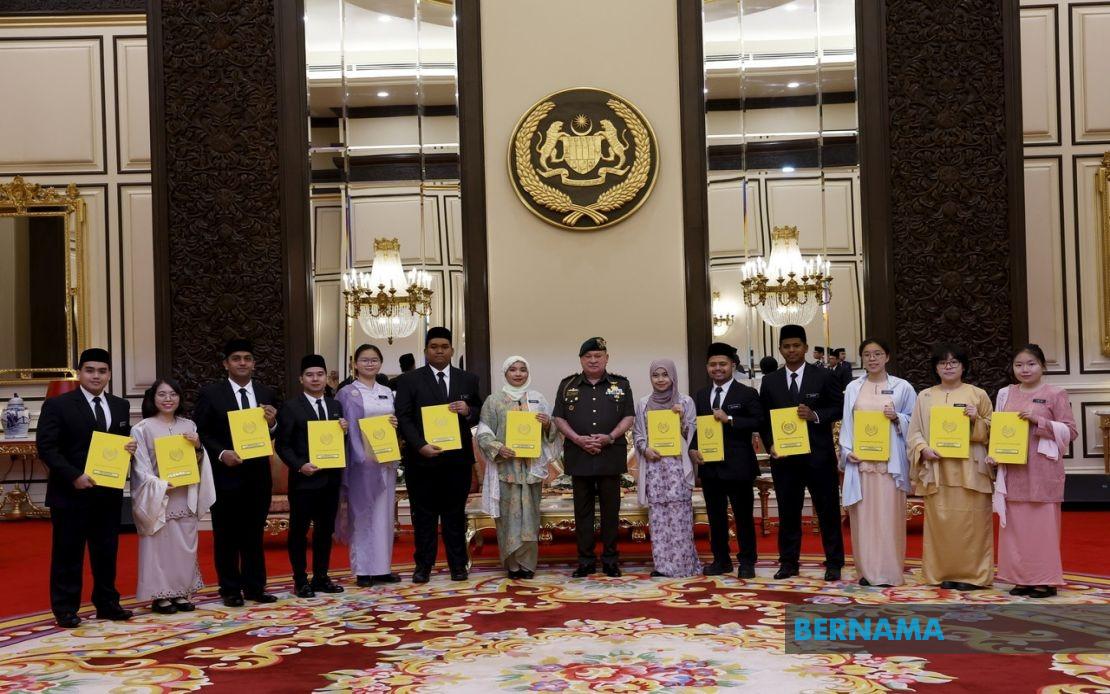
His Majesty Sultan Ibrahim, King of Malaysia, conferred the 2026 Yang di-Pertuan Agong Scholarships (BYDPA) upon 14 outstanding scholars during a formal ceremony at Istana Negara in Kuala Lumpur on June 24. The occasion underscores the monarchy's continued commitment to nurturing academic excellence and supporting the nation's intellectual capital through one of the country's most distinguished postgraduate funding schemes.
The cohort of recipients reflects a deliberate balance between doctorate and master's-level research. Seven scholars were awarded scholarships to pursue PhD programmes, positioning them for advanced research contributions in their respective fields. The remaining seven recipients will undertake Master's (Research) studies, providing pathways for mid-career academic development and specialisation. This distribution ensures the programme continues to cultivate talent across both early and intermediate stages of research careers.
The geographical spread of placements demonstrates the scheme's dual commitment to developing Malaysia's domestic research ecosystem while maintaining access to world-class international institutions. Ten recipients will conduct their postgraduate research at established Malaysian universities, strengthening local research capacity and ensuring knowledge retention within the country's academic infrastructure. Simultaneously, four scholars have secured placements at leading foreign universities, enabling exposure to cutting-edge methodologies and international research networks that will benefit their home institutions upon return.
Tan Sri Wan Ahmad Dahlan Abdul Aziz, Director-General of the Public Service, highlighted the BYDPA's standing as Malaysia's most generously funded government scholarship programme during remarks to media following the ceremony. This distinction carries significant implications for the nation's research competitiveness, as scholarship accessibility directly influences the calibre of researchers pursuing advanced degrees and their capacity to contribute to solving complex national challenges. The programme's funding generosity positions it as an attractive alternative to international scholarships, reducing the risk of talent drain among Malaysia's brightest postgraduate candidates.
The presence of senior officials including Tan Sri Dr Azmi Rohani, the Comptroller of the Royal Household, underscored the institutional importance assigned to the BYDPA. Such high-level participation reflects the monarchy's direct engagement with human capital development and research advancement as pillars of national progress. This ceremonial emphasis signals to recipients and the broader academic community that postgraduate scholarship recipients represent not merely individual achievements but strategic assets in Malaysia's economic and innovation ecosystem.
For Malaysian educators and research institutions, the BYDPA's prominence operates as both validation and catalyst. The scheme's prestige influences how universities prioritise research infrastructure and attract doctoral supervisors, as institutions hosting BYDPA scholars gain recognition and resources. The scholarship thus functions as an indirect policy tool for distributing research capacity across the country's universities, with recipient placements effectively directing institutional development priorities based on research excellence rather than political considerations.
The timing and visibility of this awards ceremony within Malaysia's academic calendar carry pedagogical weight. By presenting scholarships through formal royal recognition, the government amplifies the cultural value of postgraduate research, particularly crucial in a region where career aspirations often trend toward immediate employment rather than extended academic pathways. For secondary school and undergraduate students observing these ceremonies, the symbolic message reinforces that research careers merit national recognition equivalent to other prestigious professions.
From a regional perspective, Malaysia's investment in postgraduate scholarships reflects competitive positioning within Southeast Asia's knowledge economy. As neighbouring countries similarly expand research funding and attract international talent, programmes like the BYDPA signal Malaysia's commitment to remaining a research hub rather than primarily an export market for Malaysian talents. The presence of both domestic and international placements ensures recipients gain comparative advantages in regional academic and professional networks.
The demographic composition and field distribution of this cohort, while not detailed in available information, would typically reveal strategic government priorities in science, technology, engineering, and social research. The BYDPA thus serves simultaneously as an academic honour and a visible manifestation of national research priorities, with recipient field selections reflecting evolving economic and social policy agendas.
Looking forward, the cumulative impact of annual BYDPA awards accumulates as previous recipients advance into faculty positions, research leadership, and policy advisory roles. This longitudinal effect creates a self-reinforcing cycle where earlier scholarship recipients increasingly mentor and influence subsequent cohorts, gradually shifting Malaysia's research culture toward greater rigour and international engagement. The 14 recipients being honoured today will inevitably shape the research environment that future scholars inhabit.

