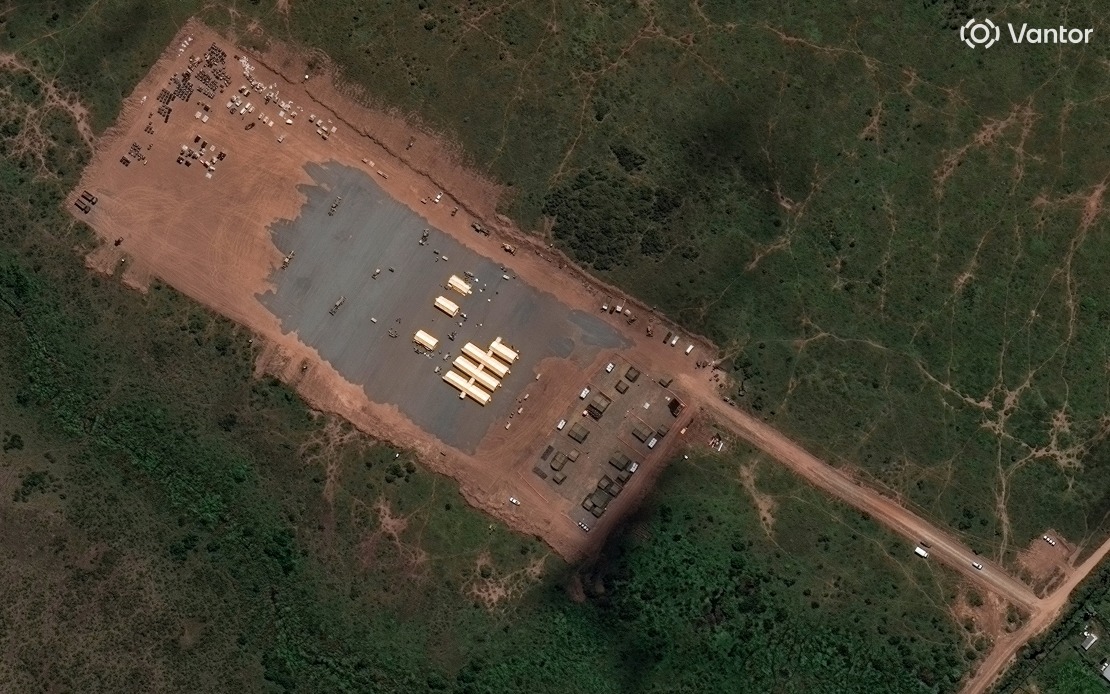
Kenya's High Court has found Health Minister Aden Duale in contempt of court for persistently advancing construction of a contentious Ebola quarantine facility backed by the United States, defying multiple judicial directives to halt work. High Court Judge Patricia Nyaundi delivered the ruling on Monday, determining that Duale had systematically disregarded court orders issued on May 28 and confirmed on June 2 that mandated suspension of the project. The minister was instructed to appear before the court the following day for consideration of sanctions and sentencing related to the contempt finding.
The disputed facility is a planned 50-bed quarantine and isolation centre intended to be constructed at Laikipia Air Base in Nanyuki, positioned approximately 8 kilometres west-northwest of the town and roughly 200 kilometres north of Nairobi. According to government and US sources, the facility would serve to accommodate Americans who may have been exposed to Ebola during disease response operations connected to outbreaks in the Democratic Republic of the Congo and neighbouring countries in East and Central Africa. The project has become one of the most polarising public health proposals in recent Kenyan history, triggering sustained legal challenges, street demonstrations, and fierce criticism from opposition lawmakers, human rights advocates, and local government authorities in Laikipia County.
The High Court previously suspended the initiative following legal action by the Katiba Institute, a constitutional advocacy organisation that challenged the project on grounds of constitutional propriety, inadequate public health consultation, and insufficient transparency in decision-making processes. These judicial concerns reflected broader anxieties about whether the government had complied with legal requirements mandating public participation and environmental assessment for major health infrastructure projects. The government's justification that the facility forms an essential element of Kenya's Ebola readiness framework has carried limited weight with judicial authorities and civil society actors who question both the necessity and the appropriateness of the arrangement.
The controversy intensified when President William Ruto publicly acknowledged that he had authorised the project in response to a direct request from United States President Donald Trump, characterising the arrangement as an extension of longstanding bilateral health cooperation between the two nations. This revelation transformed what might have been presented as a purely technical public health matter into a geopolitical issue, raising questions about Kenya's sovereignty in determining its own health infrastructure priorities. Opposition voices seized on the presidential disclosure as evidence that Kenyan decision-making had been subordinated to external pressure, despite the government's framing of the partnership as mutually beneficial.
For Malaysian and Southeast Asian observers, the Kenyan dispute offers instructive insights into the tensions that emerge when foreign powers seek to establish health security infrastructure on allied territory, particularly when such arrangements are perceived as benefiting foreign nationals rather than the host population. The controversy mirrors regional anxieties about security installations and foreign presence that periodically surface in Southeast Asian countries, where public sensitivity to perceived compromises of national sovereignty remains acute. The willingness of Kenya's court system to challenge executive action in this domain demonstrates the potential role of judicial institutions in constraining overreach, though the minister's apparent defiance of court orders simultaneously highlights limitations on judicial power when executive officials choose not to comply.
US Embassy officials have maintained that the facility presents no epidemiological hazard to adjacent communities and represents part of coordinated continental efforts to strengthen detection and response capabilities targeting Ebola transmission chains. This defence has not substantially altered public or judicial scepticism, particularly given the project's explicit design to serve American personnel rather than ordinary Kenyans. The asymmetry inherent in the facility's purpose—protecting foreign nationals while the broader Kenyan population shoulders potential environmental or health risks—has fuelled much of the political opposition and explains why government arguments about regional health security have resonated weakly with affected populations.
Protests in Laikipia County have escalated alongside the legal proceedings, with demonstrators objecting both to the facility itself and to what they characterise as governmental disregard for court decisions and public opinion. Security force responses to these protests have generated casualties; police, eyewitnesses, and human rights monitors have documented at least three deaths occurring during demonstrations opposed to the project. These confrontations between state security apparatus and civilian demonstrators underscore the depth of local hostility and the government's apparent determination to proceed regardless of judicial or grassroots resistance.
The contempt finding against Duale represents a significant judicial rebuke, though its practical consequences remain uncertain given the minister's apparent willingness to disregard prior orders. The requirement for personal courtroom appearance and the prospect of sanctions may yet provide leverage to enforce compliance, or alternatively may demonstrate the limits of judicial authority when senior government officials prioritise executive decisions over court directives. The episode illuminates fundamental tensions within Kenya's constitutional framework regarding the proper distribution of power between judicial and executive branches.
This dispute carries implications extending beyond Kenya's borders. Southeast Asian governments monitoring the situation may draw lessons about managing foreign security arrangements, the power of courts to constrain executive overreach, and the difficulties governments face when they commit to foreign partnerships that domestic constituencies oppose. The Ebola facility controversy demonstrates that even security partnerships framed as technical or health-related can generate profound political friction when they appear to prioritise external interests over national welfare. For Malaysia and its neighbours, the Kenyan experience underscores the necessity of robust public consultation and legislative oversight when contemplating similar arrangements.

