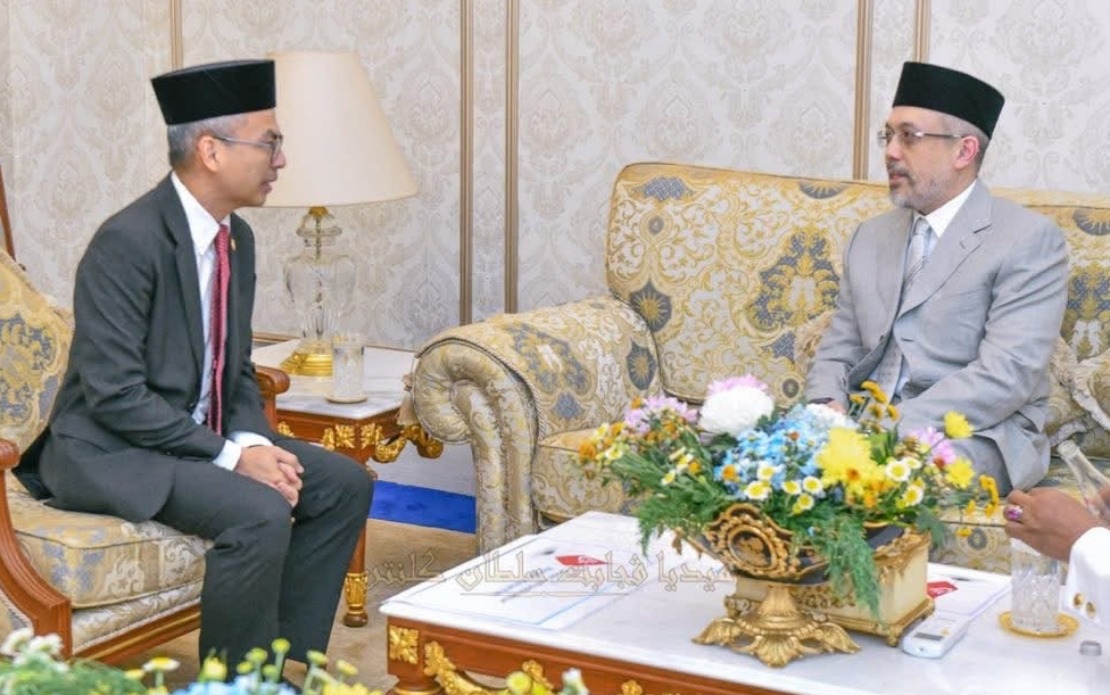
The Regent of Kelantan, Tengku Muhammad Fakhry Petra, hosted Communications Minister Datuk Fahmi Fadzil at Kota Lama Palace in Kota Bharu on June 17, marking an official audience that underscored the monarchy's growing concern about digital misinformation. The hour-long engagement, beginning at 5 pm, reflected the palace's interest in understanding how federal authorities are tackling the surge of fraudulent social media accounts that proliferate false narratives online.
The formal nature of the gathering demonstrated the seriousness with which Kelantan's royal institution views the communications portfolio's mandate. By inviting the Minister to brief him directly, Tengku Muhammad Fakhry signalled that digital governance and content moderation have transcended purely technical governance to become matters of constitutional concern. The Kelantan Sultan's Media Office subsequently issued a statement clarifying that the session aimed to apprise the Regent of current developments within the Ministry of Communications' operational scope and broader policy direction.
At the heart of discussions lay the twin challenges of proliferating fake accounts and coordinated disinformation campaigns on social platforms. Malaysia has witnessed an alarming trend of fraudulent profiles disseminating unverified claims, particularly those targeting the institution of the monarchy—a foundational pillar of the Malaysian constitutional framework. The rise of such activity compounds existing concerns about digital literacy and the vulnerability of public discourse to organised manipulation, issues that transcend party politics to affect national cohesion.
The problem of fake accounts carries particular weight in Malaysia's context, where social media penetration remains among Southeast Asia's highest and where misinformation can rapidly inflame communal sensitivities. Unlike isolated falsehoods that fade quickly, coordinated inauthentic behaviour—networks of bot accounts amplifying divisive content—represents a structural threat to information ecosystems. The Regent's decision to engage directly with the Minister suggests palace officials believe executive action at ministerial level is necessary to address the scale and sophistication of current operations.
Content targeting the Royal Institution warrants special attention under Malaysian law and constitutional custom. Such material not only violates sedition provisions but strikes at the symbolic unity that the monarchy represents across Malaysia's diverse population. The fact that this issue featured prominently in the Kota Lama Palace discussion indicates the palace perceives an acceleration in both volume and viciousness of such attacks, likely conducted through networks of inauthentic accounts designed to evade detection and enforcement.
Fahmi's attendance, alongside Senior Private Secretary Mohamad Asif Afifi Mohd Yusof and accompanying officer Ahmad Afifi Hamdan Tuan Aziz, reflected the delegation's preparedness to engage substantively with palace concerns. The presentation of a ceremonial memento by Fahmi acknowledged both the formality of the occasion and the respect due to constitutional authority. Such courtesies matter in Malaysia's political culture, particularly when federal officials seek institutional support for sensitive policy initiatives.
The Ministry of Communications holds broad responsibility for regulating digital content, licensing telecommunications infrastructure, and coordinating with social media platforms on compliance with Malaysian law. Yet the scale of fake account networks often outpaces regulatory capacity, particularly when accounts operate across multiple jurisdictions and employ sophisticated evasion techniques. The Regent's willingness to receive briefings suggests potential for mobilising royal institution's moral authority to reinforce public messaging about digital citizenship and the harms of misinformation.
Kelantan's positioning as a venue for this discussion carries symbolic weight. As a state ruled by the Dewan Negara and home to significant conservative constituencies, Kelantan has proven particularly susceptible to misinformation campaigns that exploit religious and communal divisions. Hosting the Communications Minister signals the palace's recognition that digital threats now rank alongside traditional governance challenges requiring high-level attention and coordinated response.
The friendly conclusion—marked by informal interaction and photography—humanised what could have remained purely ceremonial. Such elements facilitate rapport between federal officials and state-level institutions, potentially smoothing implementation of policies that require subnational cooperation. The presence of Kelantan Sultan's Office senior officers ensured continuity of awareness and commitment to the agenda items discussed.
Looking forward, this audience may presage broader engagement between the Ministry of Communications and royal institutions across Malaysia's states. As fake accounts and coordinated misinformation campaigns multiply, palace-level awareness becomes crucial for mobilising both official and cultural resources against digital malfeasance. The Kelantan meeting demonstrates that addressing online falsehoods increasingly demands conversation beyond technical circles, extending into constitutional and institutional frameworks that command public respect and legitimacy.