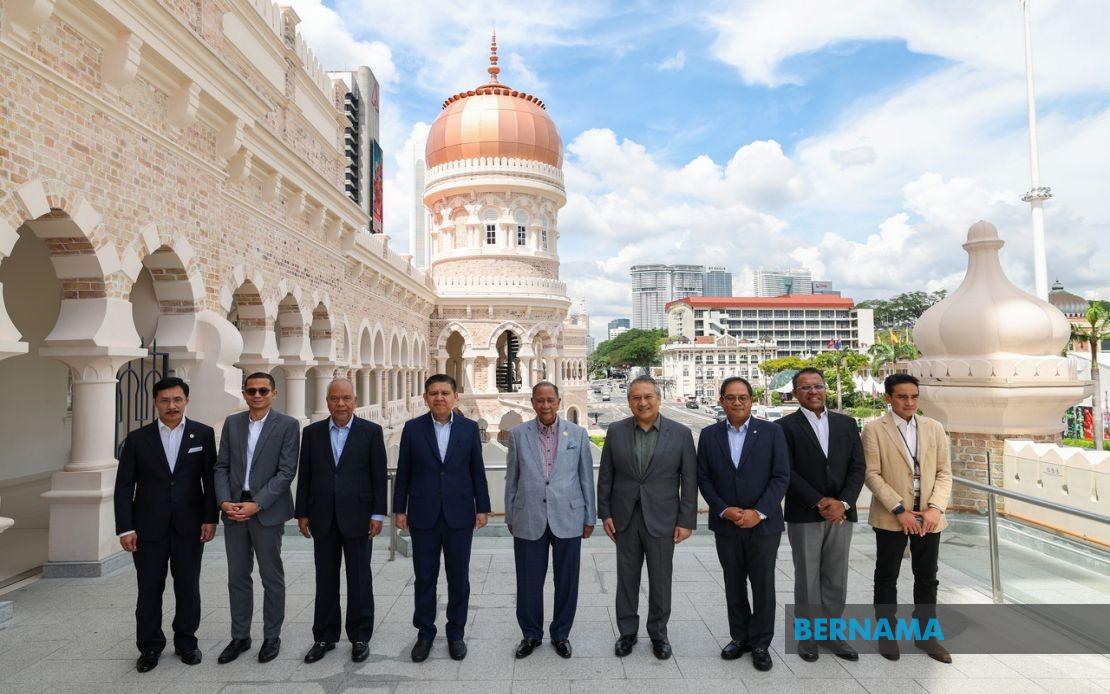
The Sultan of Kedah, Al Aminul Karim Sultan Sallehuddin Sultan Badlishah, paid a significant visit to the Sultan Abdul Samad Building in Kuala Lumpur on June 24, underscoring the continued importance placed by Malaysia's royal institution on the preservation of the nation's heritage landmarks. Arriving at approximately 10.30 am, His Royal Highness was welcomed by Khazanah Nasional managing director Datuk Amirul Feisal Wan Zahir, alongside other senior officials from the state-owned investment holding company, including chief corporate officer Datuk Mohamed Nasri Sallehuddin and head of real assets Selvendran Katheerayson.
The Sultan Abdul Samad Building stands as one of Malaysia's most symbolically significant structures, a position that has only grown more pronounced following its comprehensive restoration programme completed earlier this year. The iconic colonial edifice, originally constructed as the Secretariat Building, functioned as the administrative heart of the nation during critical junctures in Malaysian history. Most notably, it was within this building that the Union Jack was lowered and the Federation of Malaya flag was raised for the first time in 1957, a moment that remains central to the national narrative of independence and sovereignty.
During his visit, the Kedah Sultan engaged in an extensive tour of the building's newly restored exhibition spaces, beginning with the Confluence Hall. This gallery, developed in collaboration with Think City, traces the historical origins and developmental trajectory of Kuala Lumpur from its founding through to its emergence as a modern metropolis. Senior manager Mariana Isa provided detailed briefings on the exhibits, allowing His Royal Highness to gain comprehensive insights into the various phases that shaped the capital city's urban landscape and character over more than a century.
The tour subsequently proceeded to the Visionary Hall, which employs contemporary display techniques including scale models and interactive multimedia presentations to illustrate Kuala Lumpur's ongoing development and future urban planning initiatives. This space represents a deliberate curatorial choice to bridge historical narrative with contemporary vision, allowing visitors to understand not merely where the city has come from but the strategic direction it is pursuing. Following this, the Sultan accessed the building's distinctive architectural feature—the balcony overlooking the Porte Cochere, the grand covered entrance that has witnessed countless ceremonial arrivals and departures throughout Malaysia's modern history.
The royal itinerary also encompassed a visit to the School of Hard Knocks, an enterprise operated by Royal Selangor that operates within the building's grounds. This venture represents an attempt to infuse the heritage site with contemporary commercial and educational activity, ensuring that the preservation of historical structures serves functional rather than purely museological purposes. His Royal Highness concluded his inspection with a light luncheon before departing the premises at approximately 1.15 pm.
Khazanah Nasional's managing director subsequently elaborated on the significance of the royal visitation, characterising it as a validation of the organisation's multifaceted approach to heritage conservation. Amirul Feisal emphasised that the preservation initiative extends considerably beyond the technical restoration of the building's physical fabric. Rather, the undertaking encompasses a deliberate project to animate and communicate the historical narratives embedded within the structure—narratives that speak not merely to the development of Kuala Lumpur and Selangor but to the broader trajectory of Malaysian nation-building and institutional development. For Khazanah Nasional, the royal endorsement carries particular weight given the involvement of the nation's monarchy in historical consciousness and cultural stewardship.
Since the Sultan Abdul Samad Building opened its doors to public visitation on February 2, the facility has welcomed approximately 200,000 visitors, a figure that underscores considerable public interest in accessible heritage tourism and historical education. This attendance rate suggests that Malaysians and international tourists alike regard the building as a significant destination worthy of extended engagement, particularly given the enhanced interpretive frameworks now available through the newly designed galleries. The visiting statistics provide Khazanah Nasional with quantifiable evidence that heritage preservation, when coupled with effective curation and public accessibility, can attract sustained interest from diverse audiences.
The restoration initiative itself represents the culmination of eleven months of intensive conservation work executed under the auspices of the Khazanah Heritage Fund programme. His Majesty Sultan Ibrahim, King of Malaysia, formally inaugurated the completion of Phase One restoration works on January 31, lending royal imprimatur to the technical and curatorial achievements of the project team. This phased approach signals that Khazanah Nasional envisages ongoing enhancement and development of the site, rather than viewing the current restoration as a terminal point in the building's evolution as a public institution.
For Malaysian policymakers and cultural institutions, the Sultan of Kedah's visit carries broader implications regarding the role of heritage preservation in national identity formation and institutional legitimacy. The participation of a reigning state monarch in the opening festivities of a restored heritage site—particularly one so intimately connected with Malaysia's transition to independence—reinforces cultural narratives that position royal institutions as custodians of national memory and historical continuity. This symbolic dimension complements the practical achievement of having restored a deteriorating colonial-era structure to contemporary standards of accessibility and environmental performance.
The Sultan Abdul Samad Building's restoration arrives at a moment when Southeast Asian nations are increasingly grappling with questions about how to preserve colonial-era heritage while avoiding uncritical celebration of imperial histories. Malaysia's approach, exemplified through the Sultan Abdul Samad Building project, attempts to contextualise the building within narratives of independence and nation-building rather than colonial nostalgia. The galleries emphasise the structure's role in Malaysian self-determination, a curatorial choice that inflects its historical significance toward post-colonial national consciousness.
Looking forward, the completion of Phase One restoration and the evident public enthusiasm for the site suggest that heritage-based tourism and education may offer substantial returns for cultural investment in Malaysia. The 200,000-visitor milestone within approximately four months of opening indicates that well-curated heritage facilities can generate sustained economic and cultural benefits, provided they offer compelling interpretive experiences and convenient public access. For Khazanah Nasional and other custodians of Malaysia's built heritage, the Sultan of Kedah's visit and the broader public response to the Sultan Abdul Samad Building reopening provide compelling evidence that heritage preservation, approached with contemporary curatorial sophistication, remains integral to Malaysian cultural life and national self-understanding.

