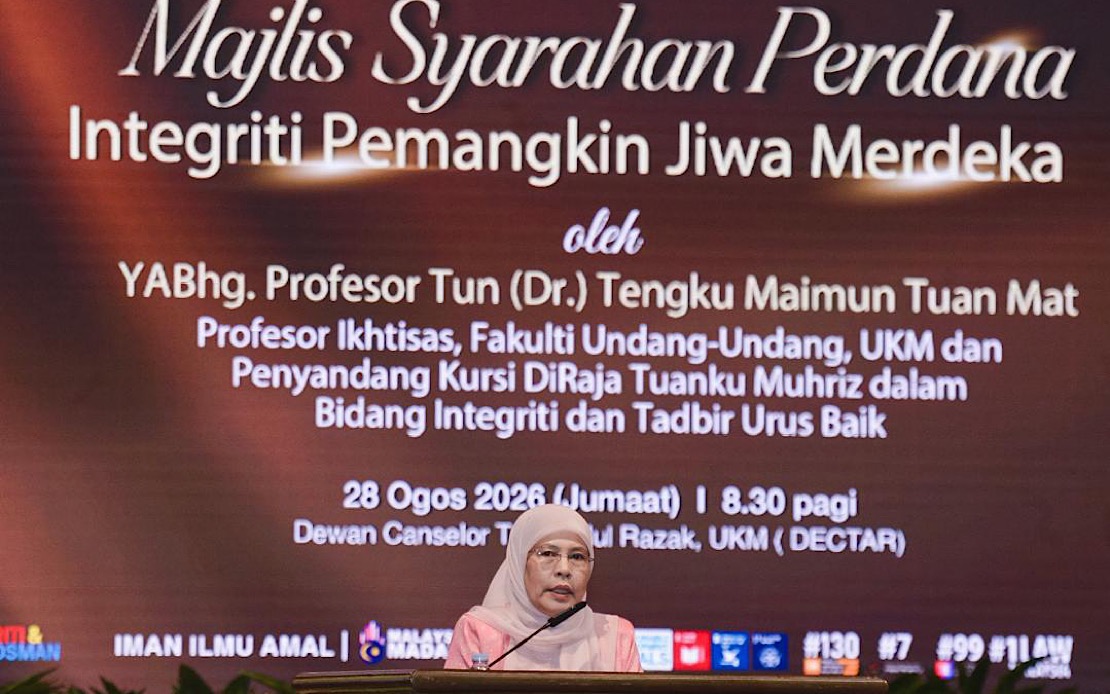
Former Chief Justice Tun Dr Tengku Maimun Tuan Mat has reinforced the judiciary's paramount role as a foundational institution responsible for maintaining justice, protecting public welfare, and preserving the nation's constitutional integrity. Speaking at Universiti Kebangsaan Malaysia in Bangi on Wednesday, Tengku Maimun highlighted how the courts function as essential mechanisms for ensuring accountability, fairness, and adherence to the Federal Constitution in Malaysia's system of government.
As a Professor of Practice at UKM's Faculty of Law and holder of the Tuanku Muhriz Royal Chair in Integrity and Good Governance, Tengku Maimun articulated the judiciary's multifaceted responsibilities within the Malaysian constitutional framework. She emphasized that judicial independence remains crucial for maintaining public confidence in legal institutions and ensuring that the rule of law operates effectively across all levels of society. The judiciary's capacity to provide impartial rulings directly influences how Malaysians experience justice and whether their fundamental rights receive adequate protection.
A defining characteristic of Malaysia's constitutional arrangement, Tengku Maimun noted, distinguishes the country from Commonwealth systems like the United Kingdom. Rather than embracing parliamentary sovereignty—where legislators hold supreme authority—Malaysia operates under the principle of constitutional supremacy. This structural difference carries profound implications for how power is distributed and constrained within government, positioning the Federal Constitution as the supreme law that supersedes even parliamentary legislation when conflicts arise.
The enforceability of constitutional supremacy depends almost entirely on judicial vigilance and interpretation. Article 4(1) of the Federal Constitution explicitly renders any post-Merdeka legislation that contradicts constitutional provisions void to the extent of such inconsistency. This provision places substantial responsibility on the judiciary to scrutinize both executive actions and legislative measures, ensuring neither branch exceeds its constitutionally prescribed powers. Without robust judicial review, the protective mechanisms embedded in Malaysia's founding document could effectively become hollow promises.
Tengku Maimun illustrated the judiciary's protective function through concrete examples spanning multiple dimensions of citizens' lives. Court decisions have addressed workers' rights to livelihood and employment security, environmental protection standards that balance development with ecological preservation, freedom of expression safeguards, indigenous land rights for Orang Asli communities, and citizenship disputes affecting vulnerable populations. These rulings demonstrate how judicial intervention extends beyond abstract legal principles to tangibly improve circumstances for ordinary Malaysians facing real-world injustices.
Beyond institutional mechanics, Tengku Maimun articulated a sophisticated understanding of integrity that transcends surface-level compliance with regulations. True integrity, she suggested, involves an unwavering commitment to righteous conduct even when such choices entail personal sacrifice, professional disadvantage, or social unpopularity. This conception challenges organizational cultures that prioritize technical rule-following while tolerating individuals who exploit legal technicalities to circumvent accountability. Moral integrity demands something deeper—an internalized ethical compass guiding behavior when no external oversight operates.
The former Chief Justice identified a critical distinction between mechanistic compliance frameworks and cultures rooted in genuine moral commitment. Institutions emphasizing superficial adherence to regulations may inadvertently cultivate employees skilled at identifying loopholes and evading consequences through procedural manipulation. Conversely, organizations fostering authentic integrity encourage individuals to grapple seriously with fundamental questions about right conduct, creating environments where ethical reasoning shapes decision-making rather than mere rule-compliance.
Tengku Maimun emphasized that institutional integrity requires multiple supporting mechanisms functioning in concert. Merit-based appointment systems ensure competent, principled individuals occupy positions of authority. Transparent monitoring frameworks create accountability while deterring misconduct through visibility. Consistent and equitable law enforcement prevents selective application that undermines public confidence. Importantly, penalties must be imposed uniformly without fear or favoritism, as inconsistent enforcement corrodes institutional credibility and signals that rules apply only to certain groups.
At the deepest level, Tengku Maimun invoked a spiritual dimension to integrity that resonates across Malaysia's diverse religious landscape. She suggested that ultimate integrity emerges from recognizing that no hidden transaction, confidential communication, or concealed intention escapes divine scrutiny. This theological grounding for ethical conduct transcends secular governance frameworks, appealing to believers' awareness that accountability extends beyond human judgment systems. For Malaysia's multi-faith society, framing integrity this way potentially creates common moral ground despite theological differences.
The lecture's emphasis on judicial independence and constitutional guardianship holds particular significance for Malaysian stakeholders navigating contemporary governance challenges. As societies experience pressures toward executive dominance or legislative overreach, the judiciary's capacity to function as an independent check remains crucial for protecting democratic institutions and individual rights. Tengku Maimun's articulation of the judiciary's role as bulwark against institutional excesses reinforces why judicial autonomy and public confidence in courts warrant sustained institutional investment.
For legal professionals, judges, and government officials throughout Southeast Asia, Tengku Maimun's framework offers valuable insights into designing institutions capable of delivering justice while maintaining public legitimacy. The connection between integrity, transparency, merit-based advancement, and equitable enforcement provides practical guidance for institutional reform efforts. Countries wrestling with judicial credibility challenges or governance legitimacy questions may find instructive principles in her integrated approach combining constitutional theory with practical integrity mechanisms.
The lecture's presentation at UKM, attended by high-ranking dignitaries including Tuanku Muhriz and senior university administrators, underscored the seriousness with which Malaysia's leadership regards judicial integrity and constitutional governance. By platforming Tengku Maimun's arguments within an academic setting, the university reinforced how constitutional principles and integrity frameworks deserve sustained scholarly attention and public discourse. This institutional endorsement suggests ongoing commitment to maintaining vigilant, independent, and ethically-grounded judicial institutions essential for Malaysia's continued democratic development.

