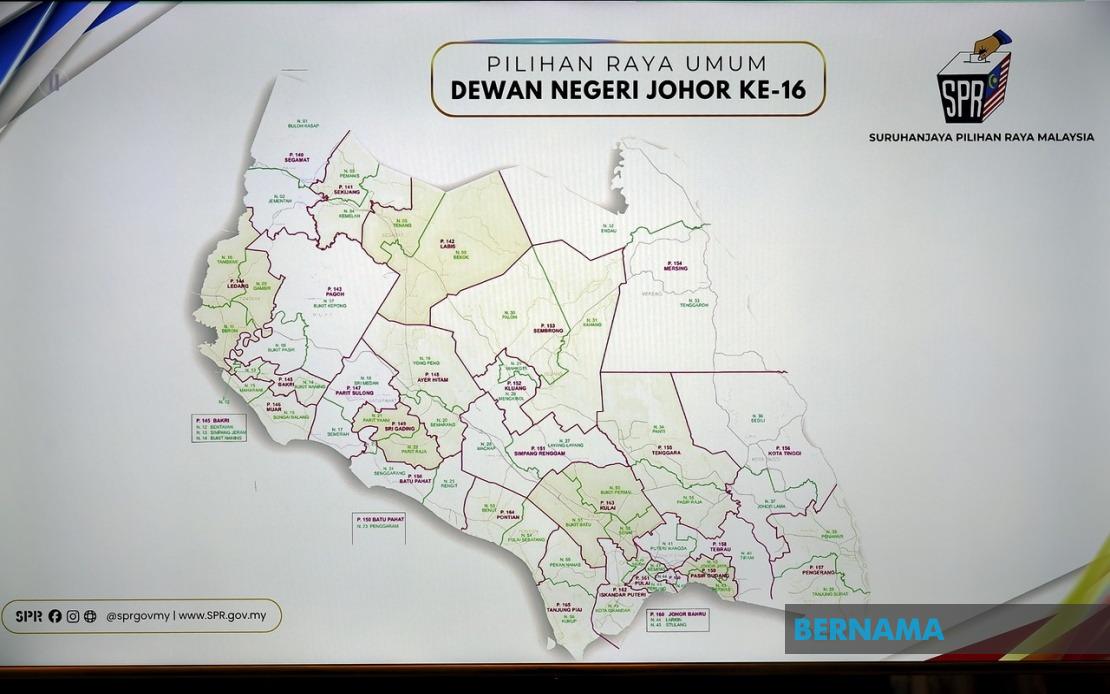
Johor's political landscape is set for transformation as the state's 16th general election formally commences tomorrow with nomination day, marking the official start of campaigning across all 56 state assembly seats. The nomination registration window opens at 9 am and closes at 10 am at designated centres throughout the state, with electoral officials expected to complete their screening process and release the final roster of candidates before the day concludes. Johor voters will determine the composition of the state assembly on July 11, though early voting opportunities are available from July 7, enabling military and police personnel stationed outside their constituencies to participate in the democratic process.
The electoral register encompasses 2,727,926 eligible voters according to the Election Commission, a figure comprising over 2.7 million civilian voters supplemented by 12,041 military personnel and their spouses, plus 12,710 police officers and dependents. This voter base represents a crucial demographic for understanding Johor's political trajectory, as the state remains Malaysia's second-largest economy and a bellwether for broader political trends within the country. The state's industrial prominence, combined with its geographic significance straddling the Singapore border, means election outcomes here often carry implications extending well beyond Johor itself.
Pakatan Harapan has committed to fielding candidates across the entire state, with Parti Keadilan Rakyat contributing 20 nominees, Amanah fielding 19, and the Democratic Action Party presenting 17 contenders. This comprehensive approach signals the coalition's determination to recapture ground lost in 2022, when they secured only 12 seats in an election dominated by Barisan Nasional's commanding performance. The coalition's candidate distribution reflects internal negotiations and strategic calculations about which constituencies offer the strongest prospects for victory, incorporating both retaining experienced lawmakers and introducing new voices intended to broaden electoral appeal.
Barisan Nasional has matched Pakatan Harapan's ambition by fielding a complete slate of 56 candidates, featuring 36 from UMNO, 16 from MCA, and four from MIC. The coalition's performance in the 2022 election, when it captured 40 seats and regained control of Johor, established it as the incumbent force with considerable organisational advantage and name recognition among voters. However, the three years since that election have witnessed significant political upheaval nationally, including shifts in coalition dynamics and periodic governance challenges that may influence voter sentiment during this campaign.
Perikatan Nasional enters the contest with a more limited but strategically focused presence, with PAS contesting 11 seats, Bersatu fielding 16 candidates, and the Malaysian Indian People's Party competing in five constituencies. This configuration reflects Perikatan's relatively smaller footprint in Johor compared to the two major coalitions, though the coalition has demonstrated ability to mobilise support in specific communities and regions. The partnership between PAS and Bersatu continues to represent a significant factional divide within Malaysia's political ecosystem, particularly relevant in Johor given its diverse demographic composition.
Beyond the major coalitions, smaller parties are seeking to establish or expand their presence in the state assembly. The Malaysian United Democratic Alliance is attempting to capture four seats with a youthful political brand, while the Socialist Party of Malaysia fields a single candidate representing ideological diversity in Malaysian electoral politics. Most notably, Parti Bersama Malaysia makes its debut in a Johor election, contesting 15 seats and potentially drawing votes from multiple demographic constituencies dissatisfied with established parties.
The Election Commission has emphasised the importance of prospective candidates completing administrative requirements promptly to avoid last-minute complications. Candidates are being directed to verify their nomination forms in advance at the Returning Officer's Office or State Election Office, while deposit payments must be settled early with receipts retained as proof when submitting nomination documentation. These procedural requirements, though seemingly routine, take on significance given the competitive intensity of this election and the potential for candidates to lose their positions through administrative oversights.
Anti-corruption enforcement represents another critical dimension of the electoral process. The Malaysian Anti-Corruption Commission has issued formal notices to all candidates and parties warning against violations of the MACC Act 2009 or the Election Offences Act 1954 as amended in 2012, establishing clear parameters for acceptable conduct during the campaign period. To monitor compliance and investigate suspected infractions, the MACC has established five dedicated 24-hour operations rooms in Tampoi, Batu Pahat, Kluang, Segamat, and Mersing, providing public channels for reporting suspected corruption or abuse of authority. This infrastructure reflects institutional recognition that election integrity depends on active surveillance and public participation in identifying violations.
The dissolution of the Johor State Legislative Assembly on June 1 formally triggered the electoral timeline, with nomination day tomorrow representing the practical commencement of the campaign phase. Johor's political history offers instructive context for understanding what unfolds in coming weeks. The 2022 election delivered a decisive mandate to Barisan Nasional, which secured 40 assembly seats while Pakatan Harapan won 12, Perikatan Nasional captured three, and MUDA claimed a single seat. That result signalled voter preference for political stability after the turbulence of the 2018-2020 period nationally, though circumstances have evolved substantially since then.
The coming election will test whether the Barisan Nasional coalition retains the voter confidence it demonstrated two years ago or whether accumulated grievances—whether economic, governance-related, or concerning broader national developments—have altered electoral preferences. For Pakatan Harapan, the contest represents an opportunity to demonstrate recovery from the 2022 setback and rebuild its Johor political machinery. Perikatan Nasional will be seeking to expand its limited footprint, while smaller parties view the election as a platform for advancing alternative political visions to Malaysian voters.
From a Malaysian perspective, the Johor election carries significance extending beyond state boundaries. As the nation's largest economy outside Kuala Lumpur and the federal territories, Johor's governance substantially affects Malaysia's overall economic performance and regional standing. The electoral outcome will influence political calculations at the federal level and may provide insights into voter sentiment regarding national coalition arrangements, economic management, and institutional governance heading toward the next federal election.

