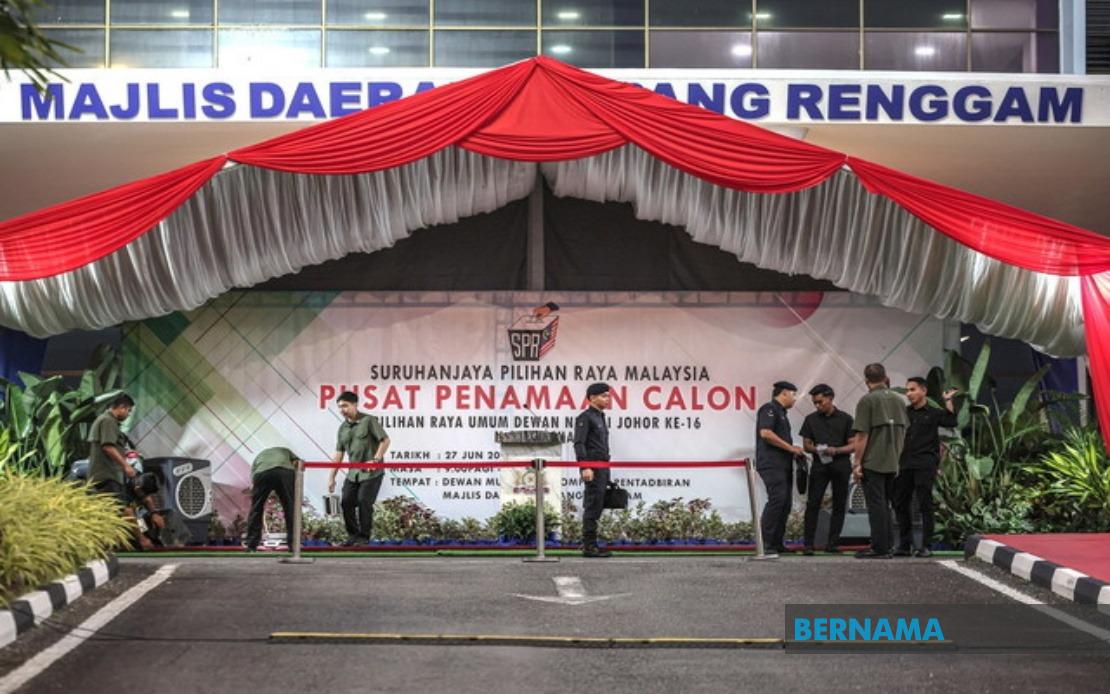
The machinery for Johor's 16th state election shifted into high gear this morning as all 56 nomination centres opened their doors at 9am sharp, marking the formal commencement of the electoral process that will culminate in July. The staggered opening across the state represented a coordinated effort by the Election Commission to manage the influx of candidates seeking to contest the 56 state assembly seats at stake in the southern Malaysian state.
Candidates faced a compressed timeline to lodge their nomination papers, with the submission window closing at 10am—a single-hour deadline that created palpable urgency at centres throughout Johor. The nomination forms could be submitted by the candidate personally, accompanied by a proposer and seconder, or alternatively by any two of these three individuals, or even by a single representative acting on behalf of the aspirant. This flexibility in submission procedures acknowledged the logistical complexities of coordinating simultaneous filings across the expansive state.
The scenes unfolded against a backdrop of impressive grassroots mobilisation. Supporters of various political parties had begun congregating outside nomination centres as early as 6.30am, several hours before the official opening, demonstrating the considerable enthusiasm that characterises Malaysian electoral contests. These early arrivals were intent on demonstrating public backing for their respective candidates, a visible show of political engagement that underscores the significance of state-level elections in the Malaysian political landscape.
Weather considerations added an additional layer of complexity to the nomination day proceedings. The Malaysian Meteorological Department had issued forecasts the previous day indicating scattered rainfall across several districts including Johor Bahru, Muar, Batu Pahat, Kota Tinggi, Pontian, Tangkak and Kulai during the morning hours, with other districts such as Segamat, Kluang and Mersing expected to remain dry. Afternoon thunderstorms were anticipated across most districts, which could have impeded voter movement and campaign preparations in the days ahead.
To safeguard the integrity of the nomination process and prevent disruptions, security arrangements were implemented comprehensively across all nomination centres. The police force, working in tandem with the People's Volunteer Corps, established robust security perimeters and managed traffic flow in the vicinity of each centre. These precautions reflected the Election Commission's commitment to ensuring orderly proceedings and preventing any incidents that might compromise the electoral process or pose risks to candidates, officials and the general public.
Once the verification phase concludes and eligible candidates are officially announced, the campaign period will formally commence, running for precisely 14 days until 11.59pm on July 10. This defined campaign window provides political parties and independent candidates with a structured timeframe to appeal to voters, organise grassroots activities, and articulate their policy platforms. The duration represents a standard configuration for Malaysian state elections, balancing the need for substantive political discourse with voter fatigue considerations.
The electoral register for this contest reveals a substantial participation potential across the state. According to official Election Commission data, a total of 2,727,926 voters are eligible to participate in the 16th Johor State Election. This aggregate comprises 2,703,175 ordinary voters, supplemented by 12,041 military personnel and their spouses, and 12,710 police personnel and their spouses. The inclusion of security force voting blocs reflects institutional recognition of these groups' civic participation rights, though their voting procedures typically follow distinct administrative arrangements.
The electoral calendar has been calibrated to allow adequate preparation and voter engagement prior to the decisive moment. The Election Commission designated July 7 as the date for early voting, accommodating individuals unable to cast ballots on the primary polling day. This provision has become increasingly important in Malaysian electoral practice, reflecting diverse work schedules and mobility patterns among the electorate. The main polling day itself has been scheduled for July 11, providing a four-day interval between early voting and the standard polling period.
For Malaysian observers and the broader Southeast Asian region, the Johor election carries considerable political weight. As Malaysia's second-largest state by population and a traditional stronghold of the ruling Barisan Nasional coalition, electoral outcomes in Johor often serve as bellwether indicators for national political sentiment. The state's economic significance as a manufacturing and logistics hub amplifies the stakes, as state government policies directly affect business operations, infrastructure development, and commercial regulation affecting the broader region.
The nomination day proceedings underscore the complex machinery required to conduct democratic elections in a diverse, geographically dispersed jurisdiction. The simultaneous opening of 56 centres across varied terrain, the coordination of returning officers and electoral staff, and the management of security arrangements all testify to the institutional capacity required for credible elections. For Malaysian democracy, these visible processes of orderly administration and peaceful political competition represent foundational elements that sustain public confidence in electoral outcomes.
As campaigns unfold over the coming fortnight, the focus will shift to candidate platforms, party strategies, and voter preferences across the 56 constituencies. The nomination day's successful completion without significant incident provided an encouraging foundation for the election process to proceed, setting the stage for what promises to be a consequential electoral exercise that will shape Johor's political direction and potentially influence broader Malaysian political dynamics.

