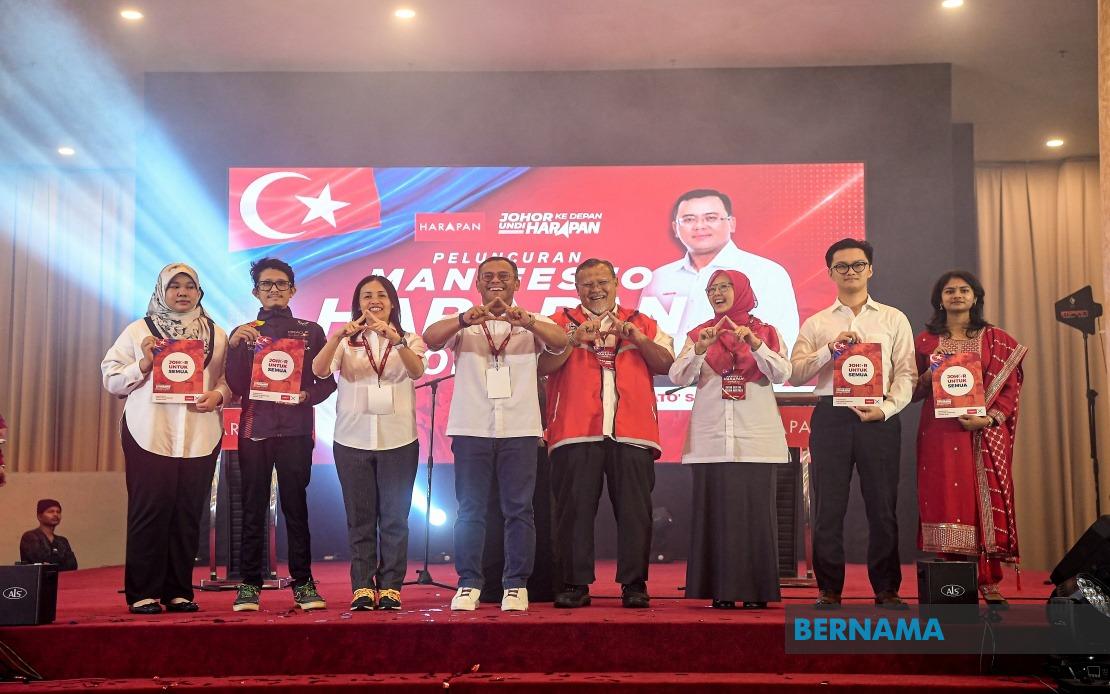
Pakatan Harapan is making its recent governance record the centrepiece of its campaign pitch to Johor voters, with coalition leaders insisting their ability to honour election promises demonstrates they deserve another mandate. The strategy reflects a broader political calculation that in an era of voter scepticism toward campaign rhetoric, tangible delivery on past commitments carries substantial persuasive weight. Speaking at the launch of PH's manifesto for the upcoming Johor state election, Johor PH chairman Aminolhuda Hassan emphasised that the coalition completed all 10 major initiatives from its 100-day plan during its previous tenure in the state, a completion rate he suggested should reassure voters about the coalition's seriousness and capability.
The ten pledges that PH highlighted as proof of its commitment spanned healthcare, governance reform, economic support, and social initiatives. The Johor Health Card represented an attempt to improve healthcare access, while the decision to limit the Menteri Besar to two terms addressed concerns about executive power concentration. Economic measures included implementing an open tender system to enhance government transparency and competitive bidding, alongside specific relief programmes such as 10 cubic metres of free water provision for qualifying households. These initiatives targeted middle and lower-income Johor residents most directly affected by cost-of-living pressures.
Among the social programmes PH emphasised were a takaful insurance scheme designed for elderly citizens, education incentives to support higher learning aspirations, and marriage incentives aimed at encouraging younger Malaysians to formalise relationships. The coalition also highlighted hawker support through licence fee exemptions, a 50 per cent rent discount programme for People's Housing Project residents, and the vertical government quota system intended to improve bureaucratic efficiency. Taken together, these initiatives painted a picture of a coalition concerned with systemic governance improvements alongside direct material assistance to ordinary households.
The timing of this manifesto launch, roughly a week before the July 11 election, reflects a deliberate campaign strategy to position PH as a coalition that talks less and delivers more. Aminolhuda's argument essentially reverses the traditional critique of political parties—rather than dismissing opposition promises as empty rhetoric, PH frames its own past performance as the strongest possible guarantee of future delivery. This approach attempts to capitalise on whatever goodwill the coalition earned during its 2018-2023 period administering Johor, particularly if specific beneficiary groups recall tangible benefits they received from programmes like the health card or water subsidies.
The political context surrounding this campaign message matters considerably for Southeast Asian observers. Johor's state election occurs amid broader Malaysian political volatility, with the federal government under Anwar Ibrahim's leadership and multiple state contests shaping the country's electoral trajectory. For PH, successful performance in Johor—a large, economically significant state with substantial urban and rural populations—would represent validation of its national governing model. Conversely, poor results might suggest that federal-level policies and positioning are not translating effectively to state-level appeal, a troubling signal for the coalition's long-term sustainability.
The manifesto launch featured prominent PH figures including Amirudin Shari from the Presidential Council, PKR secretary-general Fuziah Salleh, and state-level leadership from component parties DAP and PKR. This visible coalition unity represented a deliberate show of strength heading into the campaign's final week. The presence of multiple party representatives underscored that PH functions as a coordinated electoral machine rather than a collection of rival entities, a message particularly important in Malaysian politics where voter concerns about inter-party tensions within coalitions can influence electoral choices.
Aminolhuda specifically connected PH's state-level record to the federal government's direction under Anwar Ibrahim, arguing that voters should expect consistent delivery across governance levels. This linkage carries strategic importance—it frames a Johor PH victory not merely as a state-level outcome but as validation of the broader national project. Conversely, it also exposes PH to criticism that state government performance should be judged independently rather than through a federal lens. Opponents could argue that blaming or crediting the federal government for state outcomes represents an evasion of direct state-level accountability.
The coalition's decision to contest all 56 state seats represents another calculated gambit. Rather than ceding seats to opposition parties or independent candidates, PH is positioning itself as the primary alternative to Barisan Nasional, attempting to consolidate opposition support and prevent vote-splitting. This all-in approach suggests confidence in the coalition's organisational capacity and local candidate viability, though it also means PH will face direct contests in virtually every constituency, increasing the logistical and financial demands of its campaign.
For Malaysian voters in Johor specifically, the manifesto launch raises important questions about how to evaluate political performance. Should voters prioritise a coalition's track record of programme delivery, or focus on future promises and policy proposals? The PH strategy implicitly argues the former—that demonstrable past performance is the most reliable predictor of future conduct. This premise gains credibility in Malaysian politics where repeated cycles of broken campaign promises have eroded public trust. However, it also assumes that voters remember past initiatives with sufficient clarity and positivity to act on that memory, an assumption that may not hold uniformly across different voter demographics and constituencies.
The specific programmes PH highlighted suggest an attempt to build appeal across multiple voter segments. Healthcare improvements and education incentives appeal to young families and professionals. Water subsidies and housing support target lower-income urban residents. The takaful and marriage initiatives suggest outreach to both elderly citizens and younger demographic groups. This diversified policy portfolio indicates sophisticated campaign targeting, though it also raises questions about whether a government can deliver comprehensively across such a broad range of constituencies and priorities simultaneously.
As Johor heads toward its July 11 election, the fundamental challenge for PH remains converting past delivery into present-day voter support. Many Johor residents may have switched their voting patterns since 2018, particularly younger voters who have come of age since the last general election. Voters dissatisfied with federal government performance on issues like inflation, employment, or development quality may be reluctant to support the same coalition at state level. Regional economic conditions, local development disputes, or specific grievances about particular constituencies could outweigh considerations about the coalition's general track record.
The upcoming election will test whether Malaysian voters genuinely reward coalitions for delivering on past promises, or whether contemporary concerns and future-oriented considerations dominate electoral decision-making. A strong PH performance would suggest that demonstrable governance competence remains electorally valuable despite broader political fragmentation. Conversely, significant losses would indicate that voters prioritise other factors—dissatisfaction with incumbent performance on current issues, preference for alternatives offering fresh approaches, or simple desire for political change regardless of past record. The result will carry implications extending well beyond Johor's borders, shaping how Malaysian political coalitions calculate their electoral strategies heading into future contests.

