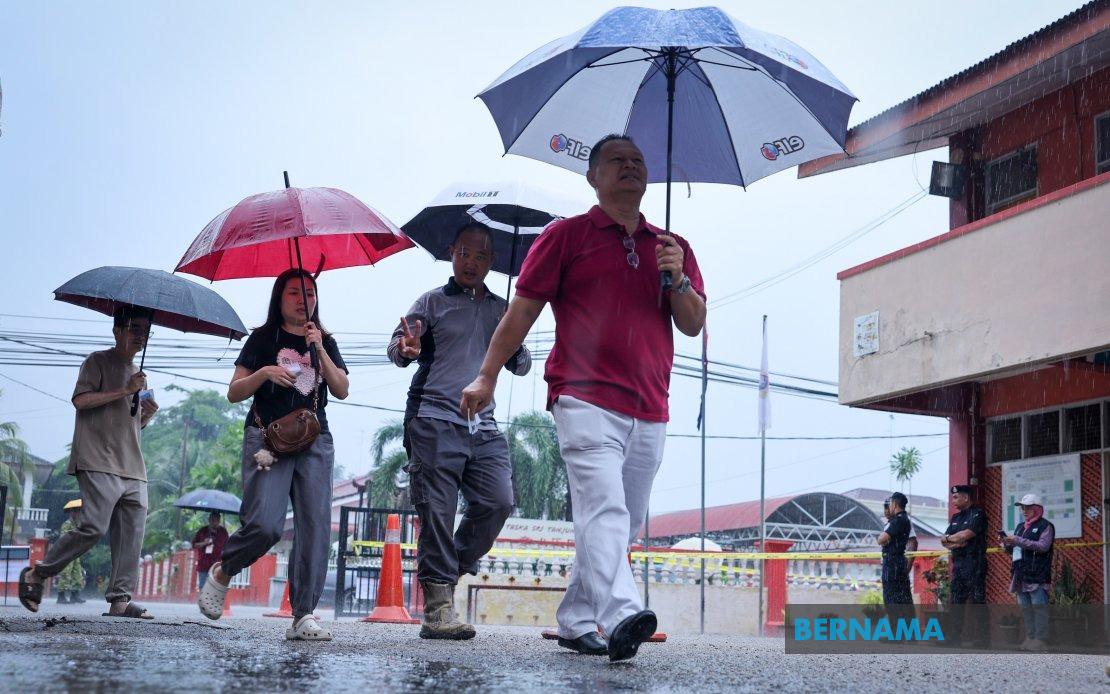
The 16th Johor State Election unfolded on July 11 with polling day operations proceeding broadly as scheduled, despite weather challenges that affected voter turnout in certain constituencies. Across the southern state's 56 contested seats, more than 2.7 million eligible voters were expected to exercise their franchise at 1,076 polling centres, with 172 candidates representing various political coalitions vying for legislative representation. The Election Commission had set staggered closing times for voting stations, with ballot counting to commence immediately after each centre's designated polling period ended.
Meteorological conditions varied significantly across Johor's geography on election day. Most polling centres benefited from clear skies and settled weather that facilitated voter movement and queuing. At Sekolah Kebangsaan Seri Pantai in Mersing, bright conditions welcomed early arrivals including elderly citizens and voters with mobility challenges, who had been specifically encouraged to vote in the morning hours when voter congestion tends to be lighter. Similarly favourable atmospheric conditions persisted at other major polling locations including Dewan Raya Taman Ungku Tun Aminah in the state capital and several schools across Batu Pahat and Kulai districts.
The Muar district presented a notably different scenario, however, with persistent heavy rainfall from the pre-dawn hours onwards casting a grey pall over voting operations in that region. Rather than deterring civic participation, the inclement weather appeared to have minimal impact on voter resolve. Despite navigating wet conditions and the logistical challenges posed by downpours, constituents in Muar proceeded to polling stations including SJKC Limbong and Sekolah Kebangsaan Ismail 1, demonstrating determination to participate in the electoral process. The contrast between Muar's weather and conditions elsewhere underscored the significant geographical variation in climate patterns within the peninsula's southernmost state.
Election infrastructure appeared well-prepared across all polling locations visited by observers. Election Commission officials, security personnel, and accredited media representatives had positioned themselves at voting centres from 7am onwards, well before the official 8am commencement of polling. This advance positioning enabled smooth operational flow despite varying weather conditions and the logistical complexity of managing voting at over one thousand individual polling stations simultaneously. The presence of trained EC staff ensured that procedural requirements were maintained consistently even where weather presented challenges.
The electoral contest represented a significant political moment for Johor, which constitutes approximately one-fifth of Malaysia's state-level legislative seats. The composition of the outgoing state assembly, dissolved on June 1, provided insight into the political landscape that voters were reshaping. Barisan Nasional had dominated the previous legislature with 40 of 56 seats, establishing the ruling coalition's historical dominance in the state. Pakatan Harapan represented the principal opposition force with 12 seats, while Perikatan Nasional held three and independent candidate-supported MUDA claimed a single seat. This distribution meant that any significant shifts in voter preference or constituency boundaries would substantially alter Johor's political representation.
The 172 candidates contesting the 56 state seats represented diverse political affiliations and ideological positions, creating competitive races across most constituencies. For many voters, particularly first-time participants and younger electors unfamiliar with recent Johor political history, the election presented an opportunity to influence the state's trajectory on matters ranging from economic development to social policy and administrative efficiency. The multiplicity of candidates reflected both the strength of Malaysia's multi-party democracy and the intensity of competition for control of state-level resources and legislative authority.
Voter behaviour patterns observed at various polling centres provided preliminary indications of engagement levels. The notably early arrival of elderly citizens, persons with disabilities, and other early voters suggested that outreach campaigns emphasising accessibility and convenience voting windows had achieved notable uptake. The willingness of Muar voters to brave adverse weather indicated strong motivation to participate regardless of external obstacles. These patterns suggested that the 2.7 million eligible voters represented a significant proportion of Johor's adult population, though final turnout figures would emerge only after polling day operations concluded.
The staggered closure times for different polling stations, implemented according to Election Commission protocols, meant that vote-counting operations would extend across several hours following 8am commencement of polling. This procedural approach, while administratively complex, ensures that ballot security is maintained at each individual polling centre and that counting processes occur under controlled conditions with appropriate observation by representatives of competing parties and independent monitors. The immediate commencement of counting following each station's closure aimed to produce timely preliminary results, though official certification of outcomes requires completion of processes at all polling locations.
For Malaysian observers and regional analysts tracking Johor's political developments, the election results would carry implications extending beyond the state itself. Johor's economic significance as a manufacturing and trade hub, its geographical proximity to Singapore, and its role as a bellwether for Peninsular Malaysian politics meant that the composition of the new state government would influence not only local policy but also broader national political dynamics. The election served as a test of voter sentiment regarding incumbent Barisan Nasional governance and the appeal of opposition alternatives within a state that has historically delivered consistent support for the ruling coalition.
The successful completion of polling operations, despite weather challenges in certain districts and the logistical demands of managing elections across 1,076 centres simultaneously, reflected the institutional maturity of Malaysia's electoral system. The Election Commission's capacity to conduct large-scale elections with security and procedural integrity, even when confronted with geographical and meteorological variation, demonstrates the robustness of democratic institutions that Malaysian citizens have built over decades of electoral practice. As votes were counted and results tabulated through the evening of July 11, the democratic will of Johor's 2.7 million voters would reshape the state's legislative composition and determine which political coalition would steer the southern state's development agenda in the years ahead.

