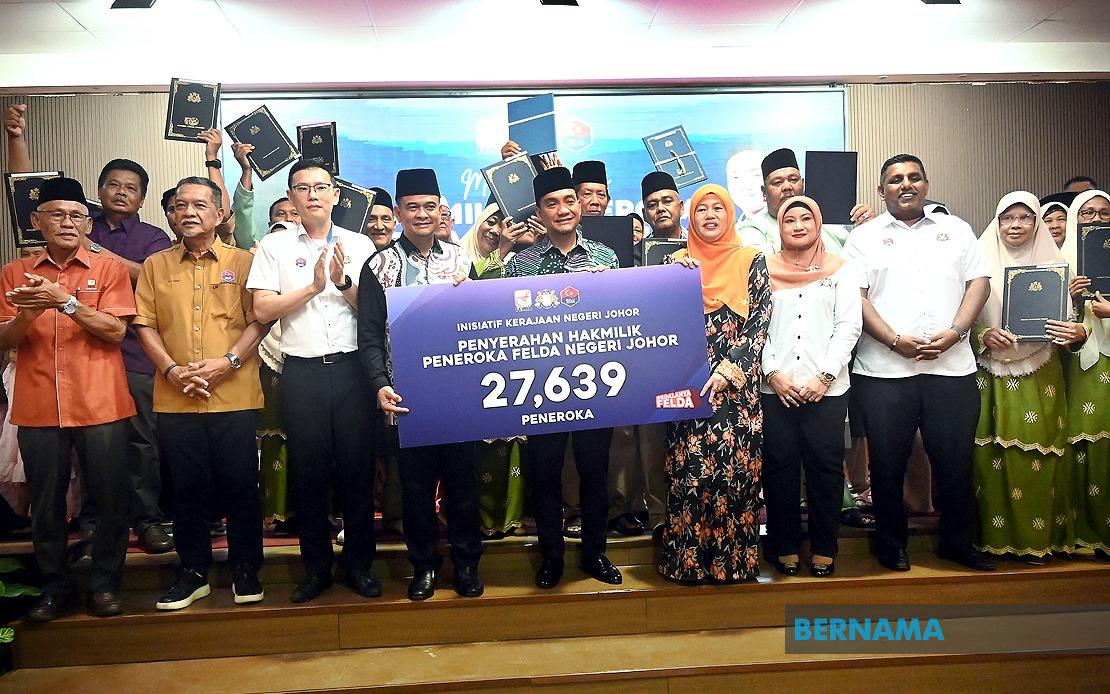
Johor has reached a watershed moment in resolving a protracted administrative challenge that has shadowed Federal Land Development Authority (FELDA) communities for decades. State authorities have now settled 27,639 land title applications out of 27,642, achieving a 99.99 per cent resolution rate that represents the culmination of sustained bureaucratic effort to restore property certainty to rural smallholders. The completion of this vast majority of cases signals the beginning of the end for a saga that has created anxiety among FELDA settlers who have lived and worked on their plots without formal legal recognition of ownership.
Menteri Besar Datuk Onn Hafiz Ghazi announced the breakthrough during a formal land title presentation ceremony in Kluang on June 23, where 210 settlers from Kluang, Kota Tinggi and Mersing received their long-awaited documentation. For many recipients, the documents represent vindication after years of uncertainty and represent tangible proof of their land rights—a particularly important distinction in Malaysian property law where informal occupation carries inherent risk. The selective nature of the presentation, focusing on three specific districts, underscores the methodical approach the state government has adopted in processing and distributing what amounts to thousands of individual transactions.
The resolution of land title issues carries profound significance beyond the technical matter of paperwork. For FELDA settlers—many of whom are among the nation's less affluent agricultural communities—formal land ownership unlocks access to credit facilities, inheritance planning mechanisms, and the ability to realise asset value through sale or development. The absence of clear title has historically trapped these smallholders in a precarious economic position, unable to leverage their most valuable asset for entrepreneurial expansion or intergenerational wealth transfer. This bureaucratic logjam has therefore perpetuated rural poverty cycles that government development agendas have long sought to break.
The Johor government has framed the resolution initiative as integral to its broader rural development philosophy. According to Datuk Onn Hafiz Ghazi, the work reflects the state administration's recognition that FELDA settlements merit priority treatment within governance hierarchies. This positioning matters because it signals an ideological commitment to treating rural welfare as a mainstream policy concern rather than a peripheral issue. By elevating FELDA communities to priority status, the Johor administration has created institutional momentum that may encourage other state governments managing FELDA schemes to accelerate their own resolution processes.
The 99.99 per cent figure, while appearing final, actually masks a small but meaningful residue: just three applications remain unresolved out of the total pool. These outlier cases likely involve complex title disputes, boundary disagreements, or documentation deficiencies that require deeper investigation than routine applications. The government's forthright acknowledgment of these remaining cases—rather than rounding the figure to 100 per cent—suggests administrative honesty about the granular difficulties that persist even in heavily completed projects. These final cases will probably receive individual attention, but their resolution may require sustained bureaucratic engagement beyond routine processing.
The involvement of Johor's Agriculture, Agro-based Industry and Rural Development Committee, led by Datuk Zahari Sarip, reflects the cross-departmental coordination that large-scale title resolution demands. FELDA matters intersect agricultural policy, land administration, property law, and rural social welfare—domains that typically operate within separate bureaucratic silos. The public presence of agricultural leadership at the ceremony underlines an effort to integrate FELDA concerns into mainstream development discourse rather than treating settlers' issues as isolated grievances.
This achievement holds relevance across Southeast Asia's broader development landscape. Multiple countries in the region manage government-sponsored agricultural settlement schemes with comparable structural issues around land documentation and settler security. Malaysia's progress in resolving its FELDA backlog offers a template—demonstrating both what becomes possible through sustained administrative commitment and what obstacles persist even in relatively developed governance systems. The methodical approach Johor has adopted, culminating in formal title presentation ceremonies that celebrate settler achievement, represents a governance model that other nations managing similar schemes might profitably study.
For FELDA settlers themselves, the title presentations provide tangible closure on an exhausting chapter of institutional uncertainty. Across Malaysian rural society, the formal receipt of government-issued documentation carries profound symbolic weight—it represents acknowledgment, respect, and the state's recognition of individual rights. The ceremony format, bringing together settlers from multiple districts for collective recognition, transforms what might otherwise be routine administrative completion into a gesture affirming settler dignity and contribution to national agricultural production.
The remaining three unresolved applications warrant monitoring, as their ultimate disposition will determine whether the Johor government achieves genuine completion or whether these edge cases become perpetual reminders of administrative limitations. The state's demonstrated capacity to resolve 27,639 cases suggests organisational capability and political will sufficient to address the final three, assuming no insurmountable legal obstacles emerge. The trajectory suggests movement toward genuine resolution rather than abandonment of problematic cases.
This initiative demonstrates how persistent administrative effort targeted at a clearly defined problem can produce measurable results that substantively improve lives for thousands of rural Malaysians. The land title resolution programme has required sustained coordination across multiple agencies, careful documentation handling, and systematic outreach to dispersed settler populations. By bringing closure to what had become a defining grievance within FELDA communities, the Johor government has transformed a chronic point of social friction into a completed policy achievement. As Malaysia pursues regional competitiveness and inclusive development, such unglamorous but essential administrative successes merit recognition as genuine contributions to social cohesion and economic opportunity.

