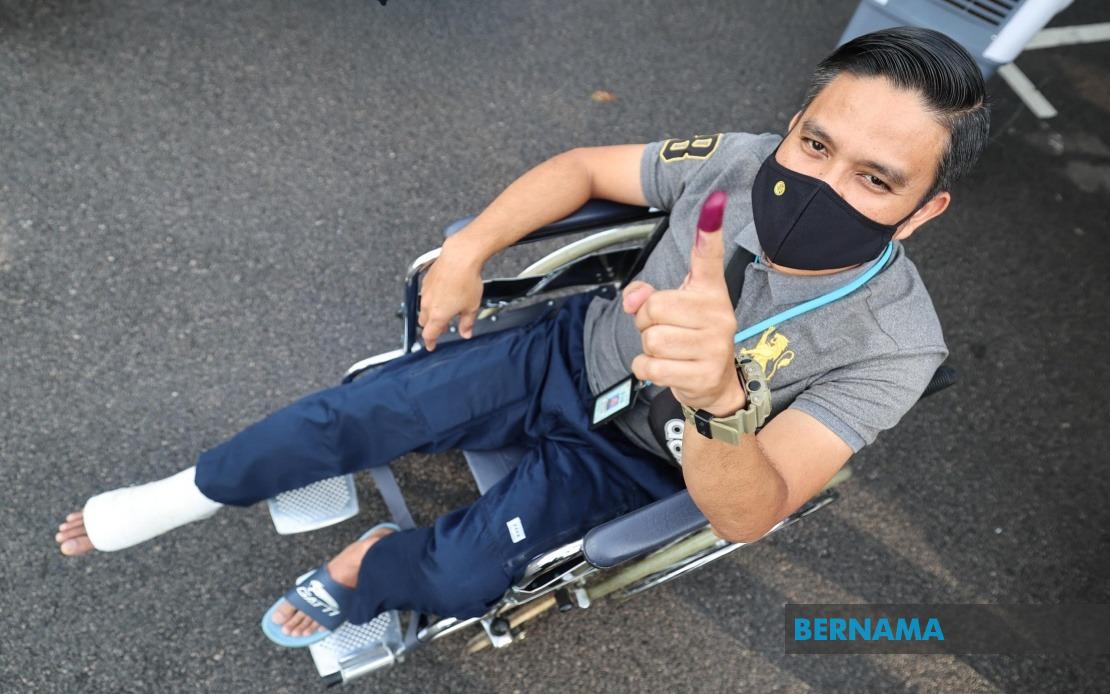
Sergeant Syahrizal Musa's determination to participate in the democratic process proved stronger than physical adversity. The 40-year-old police personnel, confined to a wheelchair following an Achilles tendon injury sustained during a sepak takraw match, travelled from his police quarters in Tampoi to vote in the 16th Johor state election on July 7. His decision to cast an early ballot despite ongoing medical leave—which extended until July 16—underscores the commitment many public service employees maintain towards their civic responsibilities, even when facing genuine hardship.
Syahrizal, who serves with the Internal Security and Public Order Department at Johor Police Contingent Headquarters, represents a particular cohort of Malaysian voters whose occupational obligations have traditionally required them to vote before general election day. The injury, confirmed by medical professionals as a minor tear to his Achilles tendon, would ordinarily have provided justifiable grounds for deferring his participation. Yet his choice to proceed—making the journey with assistance from a friend rather than remaining at home—speaks to a personal philosophy regarding electoral engagement that extends beyond mere formal duty.
The sergeant's background as an accomplished sepak takraw player, a sport in which he has represented the police contingent in multiple tournaments, renders his injury particularly poignant. An athlete since youth, Syahrizal had inadvertently sustained his injury while pursuing a passion that defined much of his recreational life. The irony was not lost on him, yet the temporary physical limitation failed to dampen his resolve to exercise what he clearly regards as a fundamental responsibility of citizenship. His own reflection on the experience—noting that this represented his first opportunity to vote while wheelchair-bound across more than two decades of police service—carries a certain dignity in acknowledging both the challenge overcome and the normalcy with which he accepts accommodation.
The context of Syahrizal's early voting takes on broader significance within Malaysia's electoral framework. The early voting mechanism exists primarily to facilitate civil and uniformed services personnel who may be deployed or stationed away from their constituencies during general polling day. On July 7, a total of 64 designated polling centres across Johor facilitated this early voting process, accommodating 24,751 eligible voters. This figure comprised 12,041 Malaysian Armed Forces personnel and their spouses, alongside 12,710 Royal Malaysia Police and General Operations Force personnel with their families. The infrastructure reflects the substantial number of public service employees whose occupational realities necessitate alternative voting arrangements.
The broader electoral contest unfolding in Johor demonstrated the significance Malaysians across various demographics attached to participation. The 16th Johor state election involved 172 candidates competing for 56 state assembly seats, with approximately 2.7 million ordinary voters scheduled to participate in general polling on Saturday following the early voting period. The scale of this electoral exercise underscores the ongoing engagement of Malaysians with their democratic institutions at the state level, even as national attention sometimes concentrates on federal politics. Johor's prominence within Malaysia's political landscape has historically made its elections barometers for broader political sentiment.
Syahrizal's perspective on the importance of voting participation carries particular weight given his longevity within the uniformed services. With more than 22 years of police service behind him, and having been stationed at Johor IPK since 2014 following nine years at Muar IPD, he has witnessed multiple electoral cycles and the evolution of Malaysia's democratic processes. His explicit statement that he had never previously missed voting in any election—across all those years and despite whatever circumstances arose—demonstrates a consistency of principle that extends beyond the current injury. This pattern of participation itself constitutes a meaningful commentary on how individuals in public service positions perceive their relationship to democratic processes.
The accessibility accommodations that enabled Syahrizal to vote from a wheelchair represent practical applications of inclusive democratic infrastructure. While such provisions exist within most polling frameworks in principle, their actual implementation varies considerably. The fact that a wheelchair-bound voter could access the early voting centre, cast a ballot, and complete the process reflects at least functional, if not exemplary, attention to ensuring that physical limitations do not constitute electoral disenfranchisement. For a police officer whose mobility challenges were temporary, the accommodation proved sufficient; yet the broader conversation regarding accessibility for voters with permanent disabilities remains relevant within Malaysian electoral discourse.
Syahrizal's articulation of his motivation—that voting constituted a responsibility, not merely an option—resonates with certain philosophical traditions within Malaysian civic culture. His journey from Tampoi to the voting centre, undertaken despite genuine discomfort and medical advice regarding rest, illustrates a particular conception of duty that transcends personal convenience. This perspective, whether common or increasingly exceptional among Malaysian voters, deserves recognition as a meaningful expression of democratic commitment. His presence at the polling centre functioned as both a practical exercise of rights and a symbolic statement regarding the priority he assigned to participation.
For Malaysian readers observing this election cycle, Syahrizal's example offers a counternarrative to broader discussions regarding voter apathy or declining participation. While electoral fatigue and cynicism about political outcomes certainly characterise portions of the Malaysian electorate, individuals who persist in voting despite significant personal obstacles present a contrasting testimony. His explicit hope that more Malaysians would exercise their voting rights—articulated precisely as he himself overcame adversity to do so—carries particular rhetorical force. The sergeant's perspective suggests that the question of electoral participation sometimes hinges less on structural barriers than on individual conceptions of civic responsibility and democratic value.
The early voting period in Johor thus accommodated not only the logistical realities of military and police deployment but also instances of individual determination operating within that framework. Syahrizal Musa's participation, unremarkable in purely technical terms—he was simply one among thousands who voted early—acquires significance through the circumstances of his participation and what those circumstances reveal about one individual's commitment to democratic engagement. His decision, when multiplied across the broader electorate, contributes to the patterns of participation that ultimately shape electoral outcomes and democratic legitimacy in Malaysia.

